-
Topics
TopicsOur programs create spaces where open-minded leaders can gather for breakthrough conversations on pressing global issues – each aligned to one of the following pillars:Get Involved
-
Events
EventsExplore the variety of events Salzburg Global hosts within Austria and in the rest of the world. Learn more about our programs and what else happens at Schloss Leopoldskron.Upcoming EventsOct 19 - Oct 22, 2026Peace & JusticeThe Collective Action Problem: How Should Democratic Societies Respond to Increasing State Violence without Exacerbating Polarization and Political Violence?Violent Threats to Democratic SystemsOct 21 - Oct 25, 2026Peace & JusticeDemocracy Across the Frontlines: How Can Democracy Movements Collaborate To Build Resilience Across Borders?Democracy Resilience Forum
- Insights
-
Fellowship
FellowshipSince 1947, more than 40,000 people from over 170 countries have participated in Salzburg Global's sessions. Collectively, these alumni are known as Salzburg Global Fellows.
-
About Us
About UsSalzburg Global is an independent, non-profit organization committed to creating spaces that overcome barriers and open up a world of better possibilities.Our Approach
-
Support Us
Support UsYour generosity helps us gather open-minded leaders for breakthrough conversations, while creating space for dialogue that overcomes barriers and opens up a world of better possibilities.
- Donate

- Published date
- Written by
Share
Peace & Justice
Feature
“Trump Is Not the Architect of Autocracy - He Is a Symptom”
Published date
Written by
Share
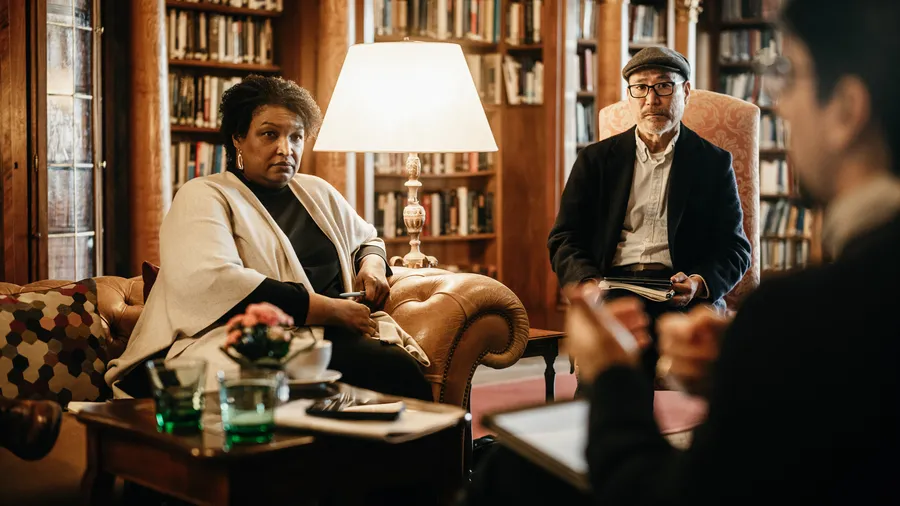
Stacey Abrams (left) at a Salzburg Global session in April 2026. Photo Credit: Richard Schabetsberger
Key takeaways
- “Trump is not the architect of autocracy; he is a symptom,” Stacey Abrams argues, warning that the ideology behind democratic erosion existed before him and will continue after him.
- Democrats must “earn” support “group by group” by appealing to voters' identities, whether they are workers, women, or minorities.
- Democracy is not an abstract issue: “When we talk about democracy, we mean healthcare and affordable housing,” Stacey says.
This article has been translated from German and was originally published by Austrian newspaper DER STANDARD. The original article can be accessed here.
As the Democratic minority leader in the Georgia House of Representatives (2011-2017), Stacey Abrams succeeded in mobilizing Black voters in particular. She laid the groundwork for Joe Biden’s victory in this traditionally conservative state in the 2020 presidential election and for the subsequent election of two Democratic U.S. senators. As the Democratic candidate for governor, she narrowly lost to Republican Brian Kemp in 2018 and was defeated more decisively in 2022.
DER STANDARD interviewed her in April 2026 at Salzburg Global's session on “Democracy on the Frontlines: How Can Democracies Defend Themselves?”
Polls suggest that Democrats could make gains in the midterm elections in November 2026. What are the chances of a landslide victory, like the one the Republicans achieved against Barack Obama in 2010?
Stacey Abrams: I am convinced that we will win the House of Representatives, gaining ten seats or more. We also have a chance to gain four or five seats in the Senate, which would be enough for a majority. With every day that the war continues and gangs of masked, heavily armed police officers roam the cities, that becomes easier. But demographics and polarization in electoral districts no longer allow for landslide victories. There are not enough seats where the majorities could shift. And Supreme Court decisions have made the competition more difficult.
What could still go wrong for Democrats between now and November?
SA: The biggest challenge is the Republicans’ plans to suppress the will of the voters. This is not just about what is happening in Washington, but also about what happens in every state controlled by Republicans. The Supreme Court could make mail-in voting more difficult in order to reduce turnout among marginalized groups. The greatest danger for Democrats is overconfidence.
People’s Identities
There is an ongoing debate among Democrats about whether to focus on progressive candidates to energize the base and get them to the polls, or to appeal to independent voters and frustrated Republicans with more moderate positions. Based on your experience, what do you think?
SA: There is no single correct strategy. But we have to appeal to people’s identities, whether they are workers, women, or minorities. It is a mistake to expect them to vote for you anyway. You have to earn their support group by group.
Does that also apply to the 2028 presidential election, or will that election be won by appealing to the political center?
SA: The last three presidential elections—2016, 2020, and 2024—were all very close. Do you win a majority by persuading voters who voted against you last time, or by mobilizing those who did not vote at all? I belong to the second camp, though not exclusively. You have to convince people that your values will benefit them. Even conservative voters want progressive things like a good healthcare system, affordable housing, lower prices, and personal freedoms. I do not believe that fighting for progressive values ignores the needs of conservative voters. But what people are looking for is authenticity in your values and integrity in your goals. That goes beyond a simple left-right framework.
The Erosion of Democracy
What can Democrats accomplish if they retain control of Congress after the November elections?
SA: If we win even one chamber, we can at least stop the erosion of democracy and curb the power of the regime. But let’s not forget: Trump is not the architect of autocracy - he is a symptom. He was a skilled salesman who turned what was already broken into a weapon. “Project 2025” was not written by Trump. The autocratic ideology was there before him and will live on after him. When Hugo Chávez in Venezuela was succeeded by Nicolás Maduro, the system did not change. And under Delcy Rodríguez, it isn’t changing either. American democracy was already fragile before; this administration has merely exposed its fractures further. It is now our responsibility to put democracy back on its feet, and that is a great opportunity.
But wouldn’t it be more effective in the election campaign to talk about economic issues instead of warning about the end of democracy? That did not work well in Kamala Harris’s campaign.
SA: Americans are smart; they respond to what they see. In the last campaign, they had not yet experienced autocracy. Now they have. Our job is to connect the dots and tell a compelling story. That’s what I do as a writer. When we talk about democracy, we mean healthcare and affordable housing. Democracy means not being stopped, arrested, or even killed by police officers on the street. It is not an either/or. We need to tell this story better.