-
Topics
TopicsOur programs create spaces where open-minded leaders can gather for breakthrough conversations on pressing global issues – each aligned to one of the following pillars:
-
Events
EventsExplore the variety of events Salzburg Global hosts within Austria and in the rest of the world. Learn more about our programs and what else happens at Schloss Leopoldskron.
- Insights
-
Fellowship
FellowshipSince 1947, more than 40,000 people from over 170 countries have participated in Salzburg Global's sessions. Collectively, these alumni are known as Salzburg Global Fellows.
-
About Us
About UsSalzburg Global is an independent, non-profit organization committed to creating spaces that overcome barriers and open up a world of better possibilities.Our Approach
-
Support Us
Support UsYour generosity helps us gather open-minded leaders for breakthrough conversations, while creating space for dialogue that overcomes barriers and opens up a world of better possibilities.
- Donate

- Published date
- Written by
Share
Peace & Justice
Opinion
The Pushback Era: Defending Democracy in an Age of Backsliding
Published date
Written by
Share
Key takeaways
- Democratic backsliding does not inevitably lead to autocracy - illiberal leaders in Brazil, Poland, and Hungary have all been voted out of office in the 2020s.
- Opposition movements do not need ideological unity to push back; broad coalitions behind single candidates have proven more effective than ideological purity.
- Corruption almost always increases under backsliding governments and is the opposition's most powerful campaign issue.
This article was written by Salzburg Global Fellow Javier Corrales, who attended the Pathways to Peace Initiative session on "Democracy on the Frontlines: How Can Democracies Defend Themselves?" in April 2026.
The views expressed here belong to this Fellow individually and should not be taken to represent those of any organizations to which they are affiliated.
We live in an age of democratic backsliding. But it seems we have also entered a new era: the pushback era.
Twenty-five years since the start of the backsliding age, political actors in some countries have found ways to contain democratic backsliding. Many opposition forces today are better equipped than they were at the start of this backsliding age to identify backsliding when it starts and push back against it to slow down or reverse its progress. There are several key factors for successful pushback.
Resisting Backsliding: Pushback Is Possible
No democracy today is safe from illiberal or populist leaders. But even when such leaders get elected, democratic backsliding is not inevitable. Successful pushback can happen.
An important piece of evidence supporting pushback is the fact that very few cases of backsliding lead to full autocratization. Just as encouraging, since the 2020s, approval ratings for backsliding presidents tend not to be as high as was the case in the early 2000s, when backsliders such as Hugo Chávez in Venezuela, Alvaro Uribe in Colombia, or Vladimir Putin in Russia would achieve above 60-percent approval ratings. While there are still highly popular backsliding presidents (e.g., as Nayib Bukele in El Salvador and Narendra Modi in India), the more typical case is for backsliding presidents to be hyper-polarizing, with huge sections of society decidedly opposed to them. Most backsliding presidents today have approval ratings hovering around 40 percent.
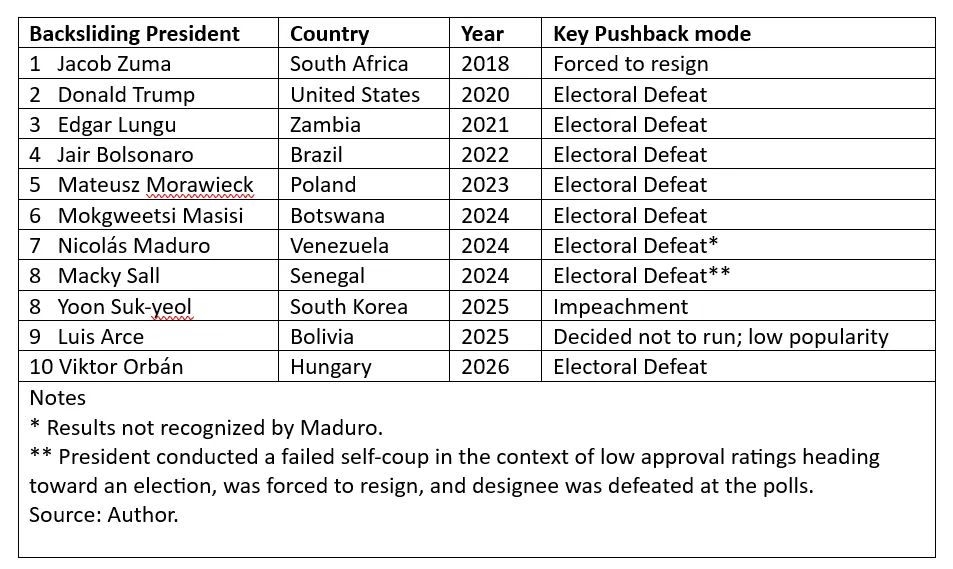
In addition, since the late 2010s, high-profile backsliding Executives have experienced difficulty getting re-elected or staying in office, i.e., staying electorally hegemonic (see Table 1). Elections, therefore, continue to play an important role in blocking backsliding, and for that reason, effective pushback requires effective electoral strategies.
Table 1: Pushback Cases, 2018-2026
Successful Pushback: Institutions
Successful electoral pushback depends on a combination of institutional factors and agency.
Scholars have tried to determine which institutional factor needs to be the most resilient to contain backsliding. The list includes: the courts and the legal profession, civil servants and the bureaucracy, civil society and NGOs, and the information society (the media, think tanks, and universities). If any of these become weak, the chances of backsliding increase. Presidents have the capacity to use institutions to gain electoral advantage over opponents, especially changing electoral rules in their favor.
In my work, I have focused on a particular type of ex-post institutional weakness: asymmetrical party system fragmentation. An asymmetrically fragmented party system is one in which one party, typically the ruling party, becomes united, cohesive, and electorally competitive, while the other parties, typically the opposition, become disunited, unstable, and uncompetitive. I have argued that under conditions of asymmetrical party system fragmentation, the chances of backsliding increase. This is good news for the United States because its electoral system creates incentives against party system fragmentation.
However, research shows that if the ruling party becomes not just cohesive, but more importantly, excessively personalist (organized as a simple rubber stamp on the president), the chances of backsliding increase, regardless of the organizational features of the opposition. This is concerning for the United States because the ruling party under Donald Trump has become increasingly obsequious to the president.
Successful Pushback: Agency
But even when institutions are not favorable, pushback can still happen if actors adopt the right type of agency.
The primary strategy is perhaps combatting abstentionism. We know that backsliding presidents try to discourage the vote. They intentionally want the electorate to know that voting for the opposition is hopeless - the cards are stacked against them. When the electorate perceives that the state is using unfair electoral rules, many voters opt not to vote. This abstentionism works to the advantage of the incumbent. Voters may also abstain because they become disenchanted with the opposition. This is one reason that backsliders spend a lot of time using transgressive language against opponents - precisely to destroy their brand-name and thus electoral appeal.
Successful democratizing leaders are those who figure out ways to counter this tendency toward abstentionism. They persuade voters that even if the rules are rigged and the opposition is flawed, voting against the incumbent is still useful. They don’t call for boycotts. They call for getting the vote out.
Pushback requires generating a surge in voting, which tends to help the opposition. The surge is essential to defeat backsliding presidents electorally, and even if that fails, to signal to all actors that the president does not have a broad mandate.
Another lesson is the importance of electoral unity. Opposition movements do not need ideological uniformity to defend democracy. What matters is creating broad coalitions across ideologies, along with unity behind single candidates per elected posts.
Protests are vital and unavoidable, but they can backfire. Becoming too extreme could play into the hands of incumbents. Communities should be trained to engage in strategic nonviolence. Authoritarian-leaning governments often seek to provoke violence to justify repression. Democratic movements need to maintain discipline and not be provoked into violence while bearing witness and taking action.
Counter-messaging strategies need to become more sophisticated than simple information campaigns or policy campaigns. Exposing partisan audiences to opposing viewpoints can sometimes backfire, hardening rather than moderating existing views.
Ultimately, opposition groups must do a better job explaining the value of democracy. They should explain that democracies do not deliver perfect outcomes or magical solutions, but that its strength lies elsewhere: in protecting societies from the tyranny of both minorities and majorities. They distribute power broadly and work to limit the power of the already powerful. They provide citizens with peaceful opportunities to correct policy errors by voting officials out of office.
That said, it is not clear that the best pushback strategy is to focus only on defending the value of democracy. Such a goal may seem too abstract for many voters. It is also not clear that opposition parties should focus on the typical left vs. right ideological divides. The thinking “if the backslider moves to the left (or the right), we should move deeper into the right (or the left),” can risk reifying rather than overcoming existing cleavages. Overall, it is better to find a campaign issue that appeals across ideologies.
Backsliding typically produces a surge in government corruption and incompetence. The public perceives this surge easily. Effective pushback campaigns capitalize on these vulnerabilities typical of most backsliders.
Backsliding presidents often make the argument that they are concentrating power to fight the corruption of existing institutions. Successful pushback requires not letting the backsliding president take control of the narrative on corruption. It requires flipping the narrative. Democratic forces need to make corruption their key theme, rather than the government’s. They need to remind voters that undermining the independence of institutions, as backsliders try to do, is what actually increases corruption, or at least, the most serious kind, the corruption between the president and their cronies.
Looking Ahead
The current period of democratic backsliding endures, but it has nonetheless given rise to a countervailing phenomenon: the pushback era. Illiberal threats to democracy will linger. No democracy is safe from backsliding. Push factors are not disappearing. However, citizens and leaders today have become better at identifying and pushing back against democratic backsliding.
To survive, democracies require citizens who understand what democratic institutions are designed to prevent and why institutional constraints expand freedoms for all. In moments of backsliding, pushback will depend on the extent to which democratic leaders can organize broad coalitions across the ideological spectrum, combat abstentionism, explain to the public that heightened corruption is a side effect of backsliding, and persuade citizens that imperfect democracy remains preferable to concentrated power.