

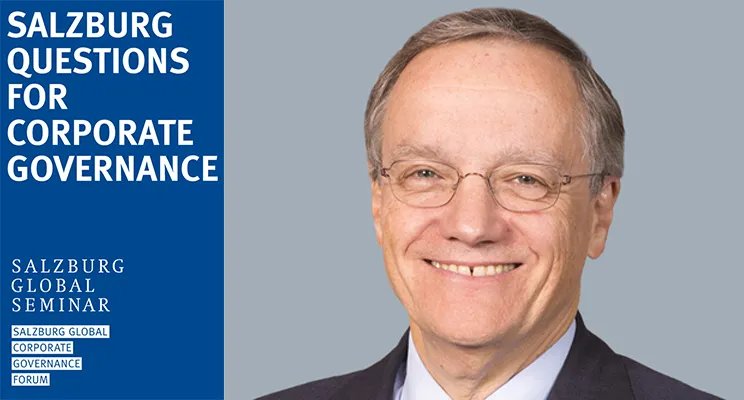
In the latest installment of the Salzburg Questions for Corporate Governance, Simon Dodds, of counsel at Shearman & Sterling, considers corporate accountability
This article is part of the Salzburg Questions for Corporate Governance series by the Salzburg Global Corporate Governance Forum
We posed the question above to participants at the opening plenary session of our recent Salzburg Global Corporate Governance Forum program on Responsible Leadership: How Do We Make Businesses More Accountable? I facilitated a session that engaged current and former members of different countries’ judiciaries, lawyers both in private practice and in-house, corporate directors, investors, civil society voices, and other perspectives. I do not propose to summarise the discussion – it was far too rich to do justice to it in this post – but I would like to highlight three personal takeaways, aspects of the discussion I found particularly thought-provoking.
Should Prosecutors Prosecute Corporations Or Redeploy Those Resources To Prosecuting Senior Executives For Misconduct Committed By Their Corporations?
This question has been a hot topic in the US, driven by the failure to prosecute senior executives of financial institutions for their part in the financial crisis. US prosecutors brought many actions against financial institutions leading to large fines, criminal pleas, and extensive remediation programs. In the UK, where it is harder than in the US to bring criminal prosecutions against corporations, there is pressure to change the law to make corporate prosecutions easier.
The plenary session and regional break-out groups covered this question in-depth, although a consensus view was not reached. Prosecuting the corporate entity and reaching a settlement is clearly an easier route for all involved: prosecutors win their headlines without having to prove their case in court; senior executives close the case without any individuals held to account.
However, there was skepticism about whether corporate prosecutions lead to better corporate behavior, whereas regulatory action against individuals may have a salutary effect. The US Treasury Office of the Comptroller of the Currency (OCC)’s actions against various individuals at Wells Fargo, including the General Counsel, is one sobering example of this. In the UK, the Senior Managers’ Regime, which creates an extensive regulatory framework around the responsibilities of senior managers of financial institutions, has served to enhance the discussion about governance and controls within banks.
Can We Make Up For The Popular Deficit Between Legal Practitioners And Public Opinion?
The debate on whether senior executives should be held liable for wrongs committed by their corporations is one those active in the judiciary, regulators, private practice lawyers, and corporations have engaged in for some time.
Yet, a comment from one participant provided a very different insight. They highlighted that outside our respective bubbles, at least amongst the young people they worked with, the popular view was there was no true accountability for either executives or corporations, and the established system simply does not work fairly.
This observation was an important contribution to the conversation. As we struggle with appropriate ways to make those responsible for misconduct accountable, it is worth reflecting that a considerable segment of society is skeptical of our ability to do so and deeply disillusioned, believing that the cards are stacked in favor of the rich and powerful. This is doubtless one of the long-term effects of the financial crisis, reflecting its scale and how those seemingly responsible suffered less than others.
This observation deserves continued serious consideration by us all. It is critical for legal practitioners to strive to ensure the legal system is explicable to non-lawyers and delivers fair outcomes. There is an educational component to this – legal practitioners need to explain what they do and communicate with non-lawyers – but the delivery of appropriate accountability is fundamental to restoring popular trust in our legal system.
How Can We Ensure That Our Legal And Regulatory Systems Are Designed To Promote Fairness And Accountability?
One of our provocateurs expressed a desire for a broader discussion on the purpose of prosecuting senior executives and the pressing need to consider our sense of how corporates behave and what is expected of leaders. They argued we should develop a framework of responsibility that works for an increasingly complex future, that helps leaders understand what is expected of them. In addition, they added that this is crucial to create norms that align with most senior executives who actually want to behave properly.
This observation, along with the comment about the skepticism of young professionals, struck a chord with me. As we look to the future, we should ensure our legal and regulatory systems are designed to promote fairness and bring accountability where it is merited. While our discussions at the virtual program raised important issues and provoked much reflection, there is much further to go.
As the debate continues, it is critical for governance and other professionals to remain attentive to ensuring their corporations do not fall foul of law and regulation and respond appropriately to their stakeholders.
Have an opinion?
We encourage our readers to share your comments by joining in the discussion on LinkedIn.
Simon Dodds is of counsel in the Financial Institutions Advisory & Financial Regulatory practice in Shearman & Sterling's London office. Simon was formerly co-general counsel at Deutsche Bank AG. Simon's broad experience includes advising the board and senior management on legal and regulatory matters across corporate and investment banking, global markets, asset and wealth management. Simon has also advised on major litigation and regulatory enforcement matters, as well as all types of legal and regulatory matters relating to transactions, sales and trading, bank lending and outsourcing.
The Salzburg Questions for Corporate Governance is an online discussion series introduced and led by Fellows of the Salzburg Global Corporate Governance Forum. The articles and comments represent opinions of the authors and commenters and do not necessarily represent the views of their corporations or institutions, nor of Salzburg Global Seminar. Readers are welcome to address any questions about this series to Forum Director Charles E. Ehrlich: cehrlich@salzburgglobal.org. To receive a notification of when the next article is published, follow Salzburg Global Seminar on LinkedIn or sign up for email notifications here: www.salzburgglobal.org/go/corpgov/newsletter
