

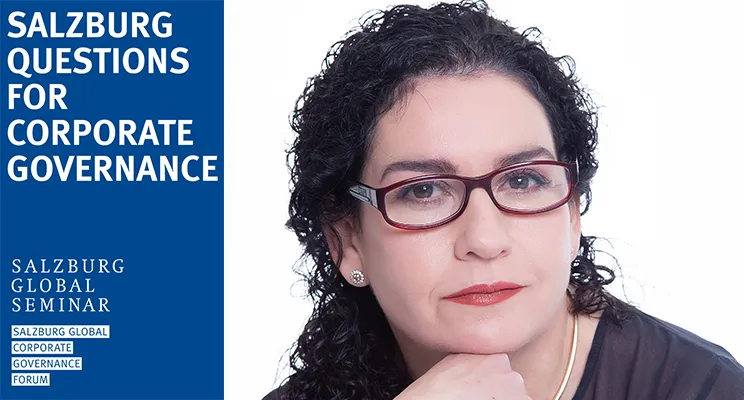
In the latest installment of the Salzburg Questions for Corporate Governance, Ansie Ramalho, chair of the King Committee on Corporate Governance for South Africa, explores the link between accountability and responsible leadership
This article is part of the Salzburg Questions for Corporate Governance series by the Salzburg Global Corporate Governance Forum
This post follows a discussion on responsible leadership and accountability held among participants at the latest Salzburg Global Corporate Governance Forum program held in October 2021. It is an important topic. Accountability is what oils the machinery of the checks and balances that operate as part of corporate governance. The legitimacy of our corporations and economic system depends on it.
Accountability is an elusive concept, though. This post attempts to explain some of its nuances and elements and explore how it affects the boards and directors’ demonstration of responsible leadership.
For What And To Whom Are Directors Accountable?
The answer to this question used to be evident, namely, the body of shareholders on the basis that shareholders (as principles) rely on directors (as agents) to run the company properly. Accordingly, the corporation’s primary purpose was viewed as creating wealth for shareholders.
This stance has somewhat evolved. It is now recognized corporations have a growing impact and may, through their operations, adversely affect the rights and interests of others and even cause outright harm. This recognition has widened the scope of accountability of directors beyond shareholders.
Accordingly, the King IV Report on Corporate Governance for South Africa (2016), for example, advocates for a stakeholder-inclusive approach and represents the duty of directors as one that requires the balancing of stakeholder needs, interests, and expectations in the best interests of the company over time.
Even investors themselves, a notable example being BlackRock, are increasingly supporting the broader accountability of companies and, by implication, the directors of those companies. In this regard, reference was made to the newly released ICGN Global Governance Principles that provide, among others, that boards in promoting the company’s long-term success should protect the interests of not only the shareholders but also the relevant stakeholders.
What Are The Levers For Holding Directors To Account?
When considering the concept of accountability, our thoughts normally veer towards legal accountability with either criminal or civil sanction, or both. It is the most formal and visible form of accountability but not without its challenges as debated during one of the earlier sessions of the Forum, especially if the concern is about holding directors and executives of corporations (as opposed to the corporation itself) liable.
Market forces function as a lever of accountability alongside the legal system. Shareholders of publicly listed companies enforce accountability formally through voting and otherwise exercise their rights on matters as provided for in the company legislation of the jurisdiction. Investors may also simply “vote with their feet” by selling their shareholding if that is a viable option or in the alternative may even opt not to invest at all.
The third lever of accountability results from the more transparent and connected world that we live in. As represented by civil society organizations, journalists, and activists, society is becoming increasingly critical as a voice in holding companies and their directors accountable. This approach is a less formal and, arguably, more flexible and swiftly functioning form of accountability. In accordance with this, corporations and their directors are held to societal norms and expectations, which in most instances are setting a higher bar than legal accountability.
Market forces and social forces are often acting in concert in that investors take social and environmental concerns on board in their activism and engagements with companies.
Voluntary codes of corporate governance such as King IV that include not only guiding standards on the more traditional governance elements such as board composition and independence but also directors’ responsibility for social and environmental matters (i.e., the full complement of ESG factors) establish an objective norm for the market and society in holding directors to account on how they are performing with respect to ESG.
These levers for accountability carry the potential for the sanctioning of companies or their directors, or both – not only legal sanction but also reputational sanction and its consequential effects. This possibility of consequences is a critical element for effective accountability.
What Does Higher Levels Of Accountability Mean For Directors’ Behaviour Inside And Outside The Boardroom?
There is a general misconception in governance discourse that accountability equates to disclosure. However, as Keay and Loughrey explain, disclosure does not constitute accountability per se, although it is one of the necessary steps towards achieving accountability.
Therefore, the mere issuing of annual financial statements and other corporate reports does not dispense with the responsibility to account.
Accountability necessitates the information disclosed should provide explanations and justifications against a set of external values and standards as for example, those contained in a code of corporate governance or a remuneration policy. Unfortunately, many corporate reports fall short of this standard as they resemble the company’s promotional material more than being balanced and informative accounts of the company’s performance - good and less so - and its prospects.
An additional step in the accountability process is there must be an opportunity to challenge and debate the information provided. Again, judging by how AGMs are generally organized and structured to be concluded in the shortest time with as little invitation for engagement as possible, accountability is not the default stance of most public companies.
Conclusion
A failure of accountability is a failure of responsible leadership by directors. True accountability is demonstrated by boards that visibly value it and, therefore, ensure transparency as well as authentic and responsive engagement with shareholders and other stakeholders.
Have an opinion?
We encourage our readers to share your comments by joining in the discussion on LinkedIn.
Ansie Ramalho chairs the King Committee on Corporate Governance for South Africa, where she has served for more than 12 years. She serves as a professional non-executive director and has been conferred the chartered director (SA) designation by the Institute of Directors South Africa (IoDSA). Ansie is a lawyer by training and considered a leading authority on corporate governance, with both deep and broad theoretical and applied knowledge on the topic. From August 2014 to November 2016 Ansie was the appointed King IV project lead with responsibility for the successful finalization of the King IV Report on Corporate Governance for South Africa, 2016. She is a Fellow of Salzburg Global Seminar.
The Salzburg Questions for Corporate Governance is an online discussion series introduced and led by Fellows of the Salzburg Global Corporate Governance Forum. The articles and comments represent opinions of the authors and commenters and do not necessarily represent the views of their corporations or institutions, nor of Salzburg Global Seminar. Readers are welcome to address any questions about this series to Forum Director Charles E. Ehrlich: cehrlich@salzburgglobal.org. To receive a notification of when the next article is published, follow Salzburg Global Seminar on LinkedIn or sign up for email notifications here: www.salzburgglobal.org/go/corpgov/newsletter
