
-
Topics
TopicsOur programs create spaces where open-minded leaders can gather for breakthrough conversations on pressing global issues – each aligned to one of the following pillars:Get Involved
-
Events
EventsExplore the variety of events Salzburg Global hosts within Austria and in the rest of the world. Learn more about our programs and what else happens at Schloss Leopoldskron.Upcoming EventsOct 19 - Oct 22, 2026Peace & JusticeThe Collective Action Problem: How Should Democratic Societies Respond to Increasing State Violence without Exacerbating Polarization and Political Violence?Violent Threats to Democratic SystemsOct 21 - Oct 25, 2026Peace & JusticeDemocracy Across the Frontlines: How Can Democracy Movements Collaborate To Build Resilience Across Borders?Democracy Resilience Forum
- Insights
-
Fellowship
FellowshipSince 1947, more than 40,000 people from over 170 countries have participated in Salzburg Global's sessions. Collectively, these alumni are known as Salzburg Global Fellows.
-
About Us
About UsSalzburg Global is an independent, non-profit organization committed to creating spaces that overcome barriers and open up a world of better possibilities.Our Approach
-
Support Us
Support UsYour generosity helps us gather open-minded leaders for breakthrough conversations, while creating space for dialogue that overcomes barriers and opens up a world of better possibilities.
- Donate

Salzburg Global in Austria
Update
Seizing the Moment, Shaping the Future: The Second Annual Salzburg Global Future Forum
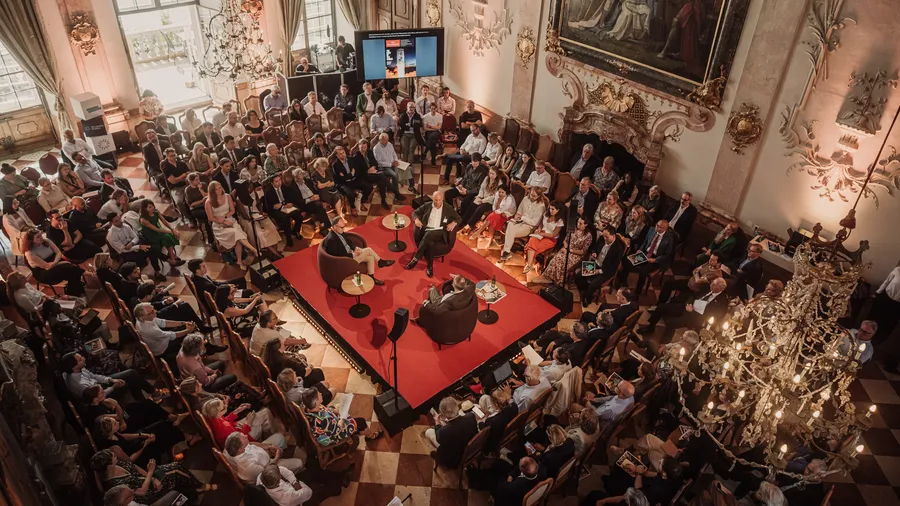
Participants of the Future Forum in the Marble Hall of Schloss Leopoldskron on August 22, 2026. Photo Credit: Richard Schabetsberger
Familiar certainties are being tested, and the global landscape is shifting, raising questions not only about how we can understand change, but how we can respond to it with imagination and purpose. What does it take to meet the current moment with clarity rather than anxiety, and where might the most promising ideas come from? This was the starting point for the second annual Salzburg Global Future Forum, held at Schloss Leopoldskron in Salzburg, Austria.
Aligned with our 2026 Annual Spotlight, “Seizing the Moment, Shaping the Future,” the one-day gathering convened people working to bring the world closer together rather than further apart: Nobel laureates, political leaders, business figures, journalists, diplomats, academics, and other exceptional voices from around the world. The Future Forum created space for these individuals to have candid, in-depth conversations about the changes reshaping our world and the ideas, values, and people that will define the future.
The following excerpts capture some of the key ideas that emerged, offering a glimpse into how the Forum’s distinguished participants are thinking about the moment we are in, and the future we have the opportunity to shape.
Who Believes in Evidence?
The acclaimed Nobel Laureate Serge Haroche explored the role of scientific evidence and critical thinking in understanding the world, from quantum physics and fundamental research to the opportunities and risks of artificial intelligence.
“I think we have to believe and trust in human intelligence…What distinguishes Al from human intelligence is the fact that human intelligence is produced by the brain, which is not a machine. The brain is connected to the outside world, is connected to a long history in evolution, is connected to a lot of chemical processes, which give us pleasure, needs, curiosity, [and] imagination, which I don't think a machine can have...”
- Serge Haroche, Professor Emeritus of Quantum Physics, Collège de France and Nobel Laureate in Physics
More Than a Game: Leadership. Inspiration. Future.
In the wake of the FIFA World Cup, this discussion explored how sports leadership translates into broader lessons for society, inspiring and shaping younger generations.
“I see the support and encouragement I received in my younger years from my family and environment as the reasons I was able to achieve what I have achieved today. Out of this conviction arose the desire to give many children the opportunity to discover and develop their strengths and talents.”*
- Ralf Rangnick, Head Coach, Austria National Football Team
*This quote was translated from German.
Everything You Ever Wanted To Ask About Artificial Intelligence
This interactive discussion allowed participants to engage with the opportunities and risks of AI, including its impact on the environment and the importance of exercising human judgement.
“Keep judgment within your power. Make sure that you exercise that judgment all the time. Never accept an answer but always look at two different classes. It's cumbersome, but it's a great way to get both the cognitive advantage of the technology, but retain your own ability to think, which is, perhaps, the most important humanity you have.”
- Nicklas Berild Lundblad, Independent writer, researcher and public policy expert, former Head of Global Policy and Public Affairs, DeepMind Ltd, former Head of Global Policy Planning, Google
The Last Human Job? AI, Ethics, and the Road Ahead
This discussion explored how AI is reshaping work and human connection, urging us to protect and preserve the relationships, dignity, care, trust, and sense of belonging that make work, society, and life meaningful. Speakers highlighted a key consequence of increasing reliance on technology: the risk of “connective surrender,” which refers to gradually allowing technology to replace the human interactions that sustain relationships, community, and a sense of belonging.
“I actually think we risk, as a society at large, connective surrender, where we're not keeping our eye on the ball, not protecting and preserving something that is what makes us human.”
- Allison Pugh, Professor of Sociology at Johns Hopkins University and author of “The Last Human Job”
A Tour D’Horizon of Geopolitics and Economics
The session explored the human cost and enduring nature of the war in Ukraine, and its wider implications for global security, European defense, and a generation shaped by the experience of war.
During a discussion on political volatility and the unpredictability of policymaking, speakers noted the anxiety created by constantly shifting decisions and uncertainty, in contrast to political decisions reached through an established process:
“The lack of predictability is what's keeping us to our phones watching the notifications and freaking out. Having something that is distasteful to our politics, but actually is done through process, is much more tolerable.”
- Kenneth Cukier, Deputy Executive Editor, The Economist
Discussing the financial and social costs of European rearmament, speakers reflected on the difficult choices governments will face as greater resources are directed towards security instead of funding state services, programs, and the arts:
“In order for Europe to rearm at a level that most Europeans now agree to, these trade-offs are going to get more and more real, and more money is going to be siphoned off from other things - not just arts and culture, but social programs and entitlements."
- Mark Landler, Paris Bureau Chief, The New York Times
The Middle-East at a Crossroads: Regional Dynamics and Global Implications
Speakers focused on the Middle East, examining shifting regional dynamics, the risks of renewed instability, and the wider implications for international security. With the Iran war threatening to continue or escalate, the concern was not only how the conflict might develop, but how difficult it could be to return to stability in the region.
“It is much easier to create an unsafe situation than to recreate a safe situation again.”
- Ali Vaez, Deputy Program Director for the Middle East and North Africa at the International Crisis Group
China and the World: Development, Ambition, and Global Impact
Three experts explored China's growing economic and technological power, examining its manufacturing and innovative advantage, the challenges this presents for Europe, and the prospects for a more constructive relationship between China, Europe, and the Global Majority.
“I think we need to flip this conversation of saying, 'We gave up so much, we helped China so much,' towards: 'No, this was always a partnership. This always rested on the shoulders of workers and laborers who weren't just people executing ideas from the West, but who had skills [and] knowledge.’ That's what I mean by partnership: to think about a partnership between Europe and China starts from taking seriously the workers' expertise.”
- Silvia M. Lindtner, Professor of Information and Director, Center for Ethics, Society, and Computing, University of Michigan
“Even if Beijing restrains some of the most advanced technology from coming to Europe, the very fact that Chinese auto managers are bringing expertise, better managerial practices, new engineering practices, and exposing them to European workers, that in itself is technological learning. By working with the latest tooling and managerial techniques, that will produce improvement in Europe.”
- Dan Wang, Research Fellow, Hoover Institution, Stanford University, Author of “Breakneck: China's Quest to Engineer the Future”
“Immigration is the only plan Europe has for Africa. China has just announced the World Artificial Intelligence Organization, [in which] a third of the new members are African…China has a Global Development initiative, the Global Security Initiative, the Belt and Road Initiative, the Shanghai Cooperation Organization…”
- Eric Olander, Co-Founder and Editor in Chief, China Global South Project
The Salzburg Global Future Forum is an annual one-day gathering hosted by Salzburg Global at Schloss Leopoldskron, bringing together influential voices from around the world to explore pressing global challenges and ideas for the future.
