-
Topics
TopicsOur programs create spaces where open-minded leaders can gather for breakthrough conversations on pressing global issues – each aligned to one of the following pillars:Get Involved
-
Events
EventsExplore the variety of events Salzburg Global hosts within Austria and in the rest of the world. Learn more about our programs and what else happens at Schloss Leopoldskron.Upcoming EventsOct 19 - Oct 22, 2026Peace & JusticeThe Collective Action Problem: How Should Democratic Societies Respond to Increasing State Violence without Exacerbating Polarization and Political Violence?Violent Threats to Democratic SystemsOct 21 - Oct 25, 2026Peace & JusticeDemocracy Across the Frontlines: How Can Democracy Movements Collaborate To Build Resilience Across Borders?Democracy Resilience Forum
- Insights
-
Fellowship
FellowshipSince 1947, more than 40,000 people from over 170 countries have participated in Salzburg Global's sessions. Collectively, these alumni are known as Salzburg Global Fellows.
-
About Us
About UsSalzburg Global is an independent, non-profit organization committed to creating spaces that overcome barriers and open up a world of better possibilities.Our Approach
-
Support Us
Support UsYour generosity helps us gather open-minded leaders for breakthrough conversations, while creating space for dialogue that overcomes barriers and opens up a world of better possibilities.
- Donate

- Published date
- Written by
Share
Salzburg Global in Austria
Update
Decoding What’s Next: The Inaugural Salzburg Global Future Forum
Published date
Written by
Share
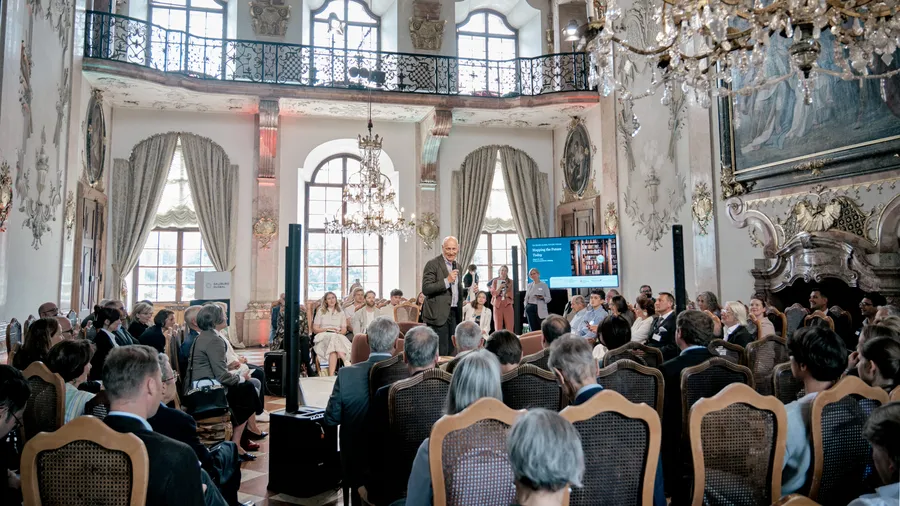
Salzburg Global President and CEO Martin Weiss greeting participants of the Future Forum on August 23, 2025. Photo Credit: Siegrid Cain
The Salzburg Global Future Forum, held for the first time on August 23, 2025 at Schloss Leopoldskron, convened Nobel laureates, business leaders, journalists, policymakers, diplomats, and other distinguished guests. Together, they spent the day examining major global trends in an attempt to decode what comes next: next for transatlantic relations, next for global competition, next for the environment, and next for humanity.
Departing from traditional panel formats, the Future Forum embraced dynamic, in-depth “salon” conversations between a moderator and two featured speakers. The audience of nearly 150 participants actively engaged with questions of their own, fostering a lively, organic exchange of ideas on pressing global issues.
Martin Weiss, President and CEO of Salzburg Global, commented, “The Future Forum 2025 marks a significant step in Salzburg Global’s mission to open up a world of better possibilities. This summer, we wanted to bring a group of world-class, open-minded leaders - including three Nobel laureates - as well as the interested public to Schloss Leopoldskron for a full day of forward-looking conversations. Boy, did we do that! At Salzburg Global, we are committed to challenging assumptions that are near and dear to our hearts and to maybe, just maybe, point out alternative paths forward. You want to forge a better future for us all? The journey begins right here, at Salzburg Global.”
The day began with a focus on evolving transatlantic ties. Steven Erlanger, chief diplomatic correspondent for The New York Times, and Rieke Havertz, international correspondent for Die Zeit, engaged in a conversation moderated by Inka Pieh, deputy editor-in-chief of the ORF Newsteam. Their discussion dissected the shifting partnership between Europe and the United States, with special attention to security, diplomacy, and the impact of changing U.S. administrations.
Competition policy, market fairness, and global economics defined the next conversation. Nobel laureate economist Eric S. Maskin, Adams University Professor at Harvard University, and Natalie Harsdorf, director general of the Austrian Federal Competition Authority, examined the effects of renewed protectionism and digital transformation on global markets. Moderator Marco Riebler of Salzburger Nachrichten guided a dialogue that underscored the interconnectedness between economic competition and regulation.
Later, a book talk with Franz-Stefan Gady, a military and security analyst at the International Institute for Strategic Studies, provided first-hand insights from the frontlines in Ukraine. Drawing on his book “The Return of War - Why We Must Learn to Deal With War Again,” he reflected on modern warfare, geopolitical risks, and how many societies must reframe their understanding of security and resilience.
In the afternoon, environmental futures took center stage. Leonore Gewessler, leader of the Austrian Green Party, offered her political insights on the path to sustainable environmental policies. Under the moderation of journalist Elisalex Henckel-Donnersmarck, the discussion explored the necessity of climate-friendly political agendas.
Shifting to technology, Viktor Mayer-Schönberger, professor at the Oxford Internet Institute, delivered an engaging TED-style talk. He urged the audience to embrace creative and disruptive approaches when envisioning the future of technology for governance and work.
Afterward, Oleksandra Matviichuk, Nobel Peace Prize laureate, and Benedikt Franke, CEO of the Munich Security Conference, confronted the stark realities of war, human rights, and democracy in a conversation moderated by Martin Weiss.
Journalist Elisalex Henckel-Donnersmarck continued the conversation on environmental politics with Nobel laureate astrophysicist Brian P. Schmidt, where they explored how scientific findings can be translated into policy to advance global climate goals.
The program closed with a German-language conversation between Martin Weiss and former Austrian Chancellor Wolfgang Schüssel about his recently published book "Mit Zuversicht: Was wir von gestern für morgen lernen können." He reflected on his experiences navigating complex political issues at both national and European levels, and how these inform his outlook on the future.
As the day drew to a close, speakers and participants gathered for a sunset reception in the Mansbach Garden Parterre of Schloss Leopoldskron, continuing conversations sparked throughout the day.
The Future Forum was made possible through a cooperation with Lindau Nobel Laureate Meetings, an executive partnership with Land Salzburg, and sponsorship by Raiffeisen Salzburg Private Banking and Bankhaus Spängler.
Thomas Gruber, executive director of the Lindau Nobel Laureate Meetings, reflected on the cooperation of two like-minded organizations for this event: "We at the Lindau Nobel Laureate Meetings see in Salzburg Global a kindred spirit, one that resonates deeply with our own mission: to educate, inspire, and connect. Cooperating on the Future Forum has allowed us to join forces in envisioning a more peaceful, prosperous, and better tomorrow. I am especially honored that Nobel Laureates Eric Maskin and Brian Schmidt joined us for this special day, whom we will welcome at the 8th Lindau Nobel Laureate Meeting in Economic Sciences in a few days’ time.”
If the Forum’s format and the intellectual curiosity of its participants are any indication, our most complex challenges demand new ways of listening - and acting. As one conversation gave way to the next, the Future Forum reaffirmed the continuing importance of critical debate, creative partnership, and candid exchange in navigating tomorrow's uncertainties. The conversations left participants with renewed hope that, together, we can rise to meet the challenges ahead.