

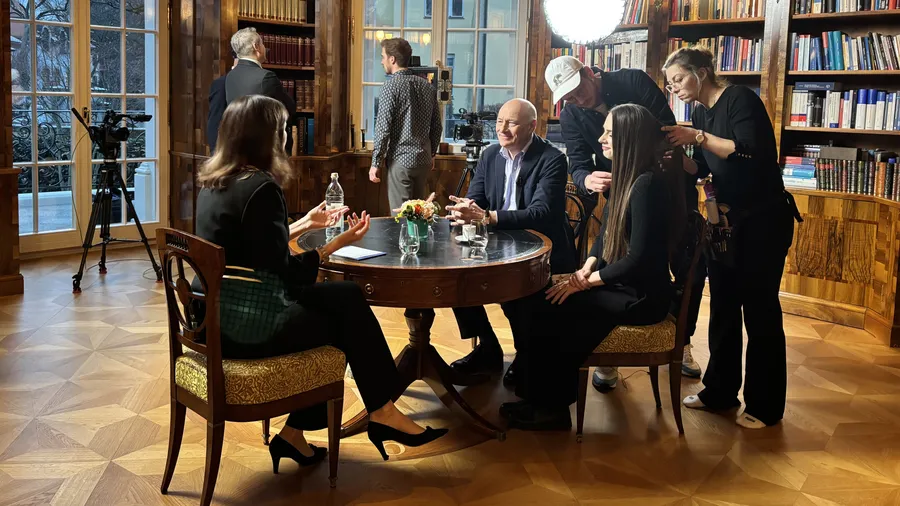
Nobel Peace Prize laureate Oleksandra Matviichuk and Salzburg Global president Martin Weiss discuss democracy, human rights, and conditions for peace in Ukraine
Oleksandra Matviichuk is a human rights defender who works on issues in Ukraine and the OSCE region. She heads the human rights organization Center for Civil Liberties, which was awarded the 2022 Nobel Peace Prize.
Martin Weiss is the president and CEO of Salzburg Global. He previously served as Austrian Ambassador to the U.S. (2019-2022), Ambassador to Israel (2015-2019), Director of the Press and Information Department of the Foreign Ministry (2012-2015), and Ambassador to Cyprus (2009-2012), among other positions.
This interview aired on München.tv on February 17, 2025. Parts of the original interview have been translated from German into English.
Marion Gehlert, Editor-in-Chief, München TV: We are here at the Munich Security Conference, where over 60 heads of state and 150 ministers and representatives from many other organizations are here. I am happy to introduce Martin Weiss, the president and CEO of Salzburg Global, and Oleksandra Matviichuk, a Nobel Peace Prize laureate from Ukraine.
Oleksandra, you studied law and you fight for human rights and human dignity in a country that has been in the middle of a horrible war for three years now. How can you bear that?
Oleksandra Matviichuk, Ukrainian human rights lawyer and Nobel Peace Prize laureate: While this war turns people into numbers, we are returning their names. We believe that people are not numbers, and the life of every person matters. We document Russian war crimes in this very bloody war so that, sooner or later, all those who committed these crimes will be held accountable.
MG: How can you stay so encouraged?
OM: I feel a huge responsibility. I spoke with people who survived Russian captivity, and they told me horrible stories of how they were beaten, raped, smashed into wooden boxes, their fingers were cut, and there were electrical shocks to their genitalia. These people, who went through hell, need to restore not just their broken lives, broken families, and broken vision of the future, but also their broken belief that justice is possible, even if delayed in time.
MG: Do you believe in near-future peace in your home country?
OM: People in Ukraine want peace much more than anyone else because war is horrible. But peace doesn’t come when the country that was invaded stops fighting. That’s not peace. That’s occupation. Occupation is the same war, just in another form. Russian occupation is not just about changing one state flag to another. Russian occupation means enforced disappearances, torture, rape, denial of your identity, the forcible adoption of your own children, filtration camps, and mass graves. That is why, to stop Putin’s war in Ukraine, we all have to design real security guarantees together.
MG: Mr. Weiss, we heard strange comments from Donald Trump before he became president that the war would be ended in 24 hours. Now he has corrected this, as it seems a bit more difficult. For a long time, we have had the feeling that only Trump and Putin speak to each other. He thinks they can do it, but he does not speak with Ukraine. Is that changing now?
Martin Weiss, CEO, Salzburg Global: I really hope so, because that does not work at all. Peace cannot be made over the heads of the Ukrainians. Honestly, Europe also has a voice here. This is a war that is happening at our doorstep. If Vladimir Putin emerges as a victor of this war, he may be encouraged by his great successes, and then we would all pay the price. That will not work.
MG: Could you imagine the war ending soon?
MW: I believe it is possible. Of course, one has to say first that Russia would also pay a high price. They are losing a lot of soldiers, and it costs a lot of money. Even though Vladimir Putin started the war, it cannot be waged forever. Perhaps he also wants a breather. For the Ukrainians, every day is terrible. They are losing people there. [An end to the war] would be possible, but only if it is a logical design where one can believe that it holds and not that it is a break where the war will begin again in three months – that is no solution.
MG: Oleksandra, we were just talking about if peace is possible and how peace is possible. Would you accept territorial losses for Ukraine just to have peace?
OM: Putin started this large-scale war not because he wants to capture just more parts of Ukrainian land. He started this war because he wants to occupy the whole of Ukraine and go further. He dreams of restoring the Russian Empire. Think about the historical legacy. It’s very naive to think that he sees [himself as going down] in world history for occupying Bakhmut or Avdiivka. This war is not just about territories. It’s about something bigger and more essential. We have to take into account that even with territorial compromises, it will only encourage aggressors to go further. There is a Russian proverb: “Appetite grows during lunch.” Secondly, if I may say so as a human rights lawyer: This is not just about territories. It’s about people out there who live under Russian occupation. They have no tools to protect their rights, their freedom, their property, their children, their lives, [or] their loved ones. We have no moral right to leave these people alone without any guarantees [against] torture and death under Russian occupation.
MG: Europe is discussing the right way to deal with Putin. In Germany, we have parties that believe we should be friendlier to Russia. What is your view on this?
MW: The idea that “poor Putin” was driven into war and that he could not do anything else is completely absurd. He started a war of aggression because, at the end of the day, he cannot accept a successful Ukraine that is looking west and getting closer to the EU. Then the Russian citizens would ask Putin, “Why can’t we have what our neighbors have?” For him, a successful Ukraine is something that cannot and is not allowed to happen. Nobody forced Vladimir Putin’s hand. Vladimir Putin decides whether he wants war or not. He has chosen war.
MG: Oleksandra, same question to you: We are discussing in Europe how we should handle contact with Putin and how to treat him. We also have political parties here in Germany that say we should be more friendly. How do you see that?
OM: I think we have to accept reality, even if that reality is horrible, in order to change it for the better. Russia is an empire, and an empire has a center but no borders. An empire always tries to expand. These are not my words - I’m quoting President Putin, who said that the borders of the Russian Empire will never end. To be clear, regardless of whether people in Germany, France, Belgium, or any other European Union country have the courage to admit it or not, they are safe only because Ukrainians are still fighting and they don’t let the Russians attack the next country.
MG: Can the Munich Security Conference help in this situation?
OM: I’m here with a concrete goal. I’m very worried that in all these so-called peace talks around future negotiations, there is no discussion about people. What will happen to the 20,000 Ukrainian children who were illegally deported and literally kidnapped to Russia? What will happen to the thousands and thousands of illegally detained civilians, men and women, who are subjected to regular torture and sexual abuse? What will happen to the women in the occupied territories, who are under constant threat of being raped? What will happen to people in general? I’m here to return this human dimension to the discussion because it’s very easy to speak about politics and interests. It’s always difficult to speak about people.
MG: We also have to talk about democracy in general, because when we look at autocratic leaders like Trump, Putin, and Xi Jinping, is democracy something strong, or something that will not exist for much longer?
OM: We are losing freedom in our world. Last year, 50% of the population globally went to elections. But don’t be naive: 80% of people in the world live in non-free or partially free societies. This means that the people who have a real right to vote for who they want are the minority. And the problem is not just that, in authoritarian countries, the space for freedom is shrinking to the size of a prison cell. The problem is that, even in developed democracies, people are starting to question the Universal Declaration of Human Rights. There is a reason for this. Current generations inherited democracy from their parents. They have never fought for it. They’ve become consumers of democracy. They take human rights for granted. They consider freedom to be the ability to make a choice between different cheeses in a supermarket. But freedom is very fragile. We can’t just attend to human rights once and for all. We make our choice every day.
MG: Considering that many country’s leaders do not find democracy attractive, is democracy a discontinued model?
MW: No, I believe that democracy is certainly a successful model. Many people around the world would like to live the way that we live but they cannot. I believe democracy is worth striving for. The problem is that we often forget that it cannot be taken for granted. One can see this in Russia: While in Germany, the opposition politicians go daily to the federal parliament, hold speeches, and attend meetings, in Russia, opposition politicians like Alexei Navalny end up first in prison and then murdered. I believe that we forget too easily that the freedoms we have cannot be taken for granted. In Russia, a journalist like you who asks critical questions would fall out of a window. For us, this freedom is accepted and self-evident but it cannot be taken for granted.
MG: Across forms of government, we are seeing an increase in intolerance, hate, and violence. People cannot accept that their neighbors do not share their opinions. How can we break this spiral?
MW: I believe this is extremely important. At Salzburg Global, we strive to address this issue. We bring people together who have different opinions, because one should hear how others are thinking. I would gladly hear how someone from the AfD (Alternative für Deutschland) thinks – I would like to know where they are coming from without needing to agree with them. I believe that you gain this ability when you listen and discuss while maintaining respect for each other. To do this, you often must take a step back, otherwise it will not amount to anything.
MG: Oleksandra, we were just talking about how, even in democracies, hate, incitement, and violence are on the rise. What’s your idea about how we can break this spiral?
OM: It’s a very difficult question because when we consider the technological side of the problem, let’s be aware that people now spend more and more time in digital reality. This digital reality is overloaded with fake news and disinformation. This leads to a situation where people lose their ability to distinguish between lies and truth. It creates a situation where it’s very easy to manipulate people externally. Now people, even in small communities, have no shared reality. If you don’t have a shared reality, it means you don’t have common actions. When you have no common actions, you will lose your democracy.
MG: Thank you both for your time and for being here. I wish a lot of success for Salzburg Global and for all the people fighting with you for human rights.
Watch the full interview on München.tv below:
