

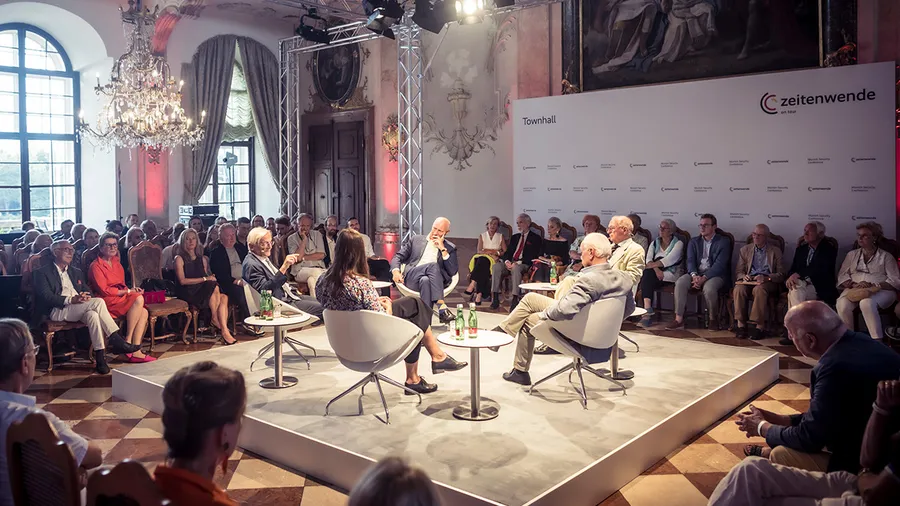
Experts at the Munich Security Conference's "Zeitenwende on tour" discussion at Salzburg Global Seminar urge Europe to unite for self-defense
This article has been translated from German, and was originally published by the Salzburger Nachrichten.
The major crises in global politics were discussed at Schloss Leopoldskron on Thursday, August 15, 2024. Europe is on the brink of a new era, it was said. Former Federal Chancellor Wolfgang Schüssel, for example, criticized the inefficiency of the European Union and called for a common defense strategy, as Europe can no longer rely on the USA.
It was a full house on Thursday evening at Schloss Leopoldskron. The Munich Security Conference made a stop in Salzburg with its “Zeitenwende on tour”. Speakers included the President of Salzburg Global Seminar Martin Weiss, the former Chairman of the Munich Security Conference Wolfgang Ischinger, the former German State Secretary Johannes Ludewig, Salzburger Nachrichten foreign policy editor Gudrun Doringer, and former Federal Chancellor Wolfgang Schüssel.
There is war in Ukraine, Russia, and Gaza, as conflict hotspots are spreading in the Middle East and Asia. There is also terror, increasing racism, and anti-Semitism in Western countries. The global political situation could not be more volatile. A bleak picture was painted on Thursday evening at Schloss Leopoldskron during the “Zeitenwende on tour” discussion that was held in cooperation with Salzburg Global Seminar. There was talk of “Ground Zero” for European security and the limits of diplomacy.
The Munich Security Conference has been touring German cities and provinces with the discussion series since the summer of 2022, after Russia's attack on Ukraine. This series is urgent, emphasized Wolfgang Ischinger, former State Secretary in the German Foreign Ministry, Ambassador, and President of the Board of Trustees of the Munich Security Conference. “There is a need for discussion among citizens, even far away from the big cities,” he commented. The aim is to counteract the misinformation and disinformation that has run rampant. “Back to the facts” is the motto.
Moderator Martin Weiss, President of Salzburg Global Seminar, joined Ischinger on the podium for a discussion with former Federal Chancellor Wolfgang Schüssel, Salzburger Nachrichten foreign policy department head Gudrun Doringer, and Johannes Ludewig, former German State Secretary and ex-Chairman of the Management Board of Deutsche Bahn.
Despite the public holiday and balmy summer evening temperatures, around 100 members of the public came to Schloss Leopoldskron to pose questions to the panel, such as: Why did Europe and the world react so late when Russia annexed Crimea in 2014? Is arming up the right approach and where will this lead? How do democracies deal with threats from within? Would we be prepared to defend our country?
“Europe must protect itself”
Austria's role in global crises came up quickly. As Vice-Chancellor and Foreign Minister, former Federal Chancellor Wolfgang Schüssel initiated Austria's accession to NATO several times. “I think it's a shame that this was prevented. The window back then could have been used, but today it is closed.” As a member state of the European Union, Austria also has an obligation to provide assistance. “Every member state is obliged to help. For this reason, the Austrian constitution was amended at the time, which is hardly known today.” He would like to see more honesty in the recurring debate about neutrality, even if it is not popular. “It doesn't matter at all, I wasn't popular either and still survived,” said Schüssel about his long career as ÖVP (Österreichische Volkspartei) party leader.
With so many conflicts in and around Europe, the question remains whether the US will protect Europe. “We have to protect ourselves,” said Schüssel. He is therefore in favor of Sky Shield, the European initiative for a joint air defense system. The EU has lost itself in micromanagement instead of tackling the major problems, he commented.
Ischinger is also in favor of the EU pursuing a common arms policy. According to Ischinger, the US spends more than twice as much as the 27 EU states combined on armaments, yet the EU has six times as many weapons systems as the US because they are all organized nationally. “That is dramatically inefficient. We should produce together, buy together, and train together.” In the future, a Europe is needed that not only integrates internally but also protects externally.
“We are on the threshold of a completely new era,” said Ischinger. “Europe will not be independent of America, that would be the wrong goal, but we can take greater care of our security. At the moment, we are not capable of defending ourselves, which is embarrassing but true.”
“It's much worse than the first Cold War”
The times we live in are challenging for all of us, emphasized Gudrun Doringer. “Many things are happening that we were not prepared for - from the storming of the US Capitol to canceled Taylor Swift concerts due to the threat of terrorism in Vienna. This has a huge impact on our sense of security.” That's why the term “Zeitenwende” (turning point) is almost too soft for her and is a “soft focus” on what is happening.
Everyone on the panel agreed on this point. For Ludewig, the term sounds too harmless. Ischinger also said: “Turning point - yes, that is almost too weak an expression to describe this fracture that is emerging in the world.” He described the current foreign policy situation as “much worse” than the first Cold War. “Russia wants to restore its territorial status and change borders, whereas in the past it was about maintaining the status quo. The current situation is more dangerous than then. We are facing the ground zero of European security.”
This is what makes populists and autocrats so successful, explained Doringer. “Many people who have lost track of the increasingly complex world like to tighten the borders. This makes them receptive to politicians who promise that everything will go back to the way it used to be.” The longing is understandable, but given the global crises, it is clear that acting alone will lead nowhere. Furthermore, climate change should not be ignored as a major threat.
“There are so many crises happening at the same time that are exacerbating each other.” One solution would be to move away from Russian gas and towards more renewable energy, thus depriving Russia of the economic basis for its actions, Doringer added. “Sometimes it's perhaps not just about doing something, but also about not doing something.”
“No World War III - if we do the right thing”
What does Ukraine want to achieve by attacking Russian territory? “That's the million-dollar question,” said Doringer. In any case, Ukraine has succeeded in changing the narrative of this conflict. Schüssel insisted on diplomacy: “In the current situation, this carnage should be stopped. If you want peace, you have to get involved. If you fail ten times, you have to try an eleventh time.”
However, those who had hoped for an abrupt end to the war were disappointed. Ischinger stated, “Nobody would wish more than me and my professional colleagues that we could stop the wars in Gaza or Ukraine through a diplomatic offensive. But unfortunately, it's not that simple. There is one prerequisite for this: both must be aware that their next military operation will not achieve anything. Are we that far along in one of the conflicts? I'm afraid not.”
Ludewig calls on Europe to show more determination, resolve, and unity. “We have to show a clear edge against autocrats like Putin. If this slips out of our hands, if the European idea goes wrong, we will have lost a lot. We are playing a risky game.” People are dying in Ukraine every day, while the EU is failing to deliver promised ammunition. “We talk a lot but do comparatively little.”
At the end, Schüssel tried to give those present a dose of optimism. There is no reason to despair, he said, as many things are going well, such as in research and development. “And I don't believe that the Third World War will break out - if we do the right thing.” But Europe should wake up, “be less humble and dare to do something”.
