
-
Topics
TopicsOur programs create spaces where open-minded leaders can gather for breakthrough conversations on pressing global issues – each aligned to one of the following pillars:Get Involved
-
Events
EventsExplore the variety of events Salzburg Global hosts within Austria and in the rest of the world. Learn more about our programs and what else happens at Schloss Leopoldskron.Upcoming EventsOct 19 - Oct 22, 2026Peace & JusticeThe Collective Action Problem: How Should Democratic Societies Respond to Increasing State Violence without Exacerbating Polarization and Political Violence?Violent Threats to Democratic SystemsOct 21 - Oct 25, 2026Peace & JusticeDemocracy Across the Frontlines: How Can Democracy Movements Collaborate To Build Resilience Across Borders?Democracy Resilience Forum
- Insights
-
Fellowship
FellowshipSince 1947, more than 40,000 people from over 170 countries have participated in Salzburg Global's sessions. Collectively, these alumni are known as Salzburg Global Fellows.
-
About Us
About UsSalzburg Global is an independent, non-profit organization committed to creating spaces that overcome barriers and open up a world of better possibilities.Our Approach
-
Support Us
Support UsYour generosity helps us gather open-minded leaders for breakthrough conversations, while creating space for dialogue that overcomes barriers and opens up a world of better possibilities.
- Donate

Peace & Justice
Report
Our Key Insights: How Can Democracies Defend Themselves?
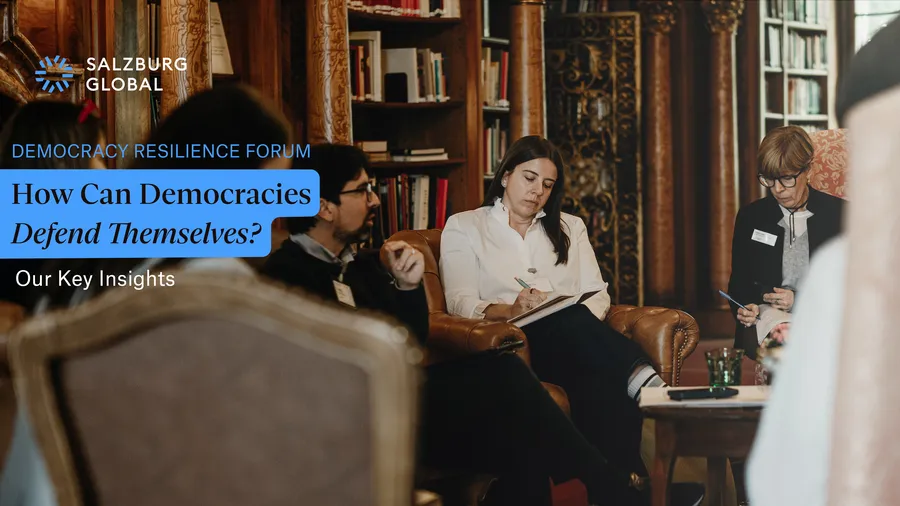
Photo Credit: Richard Schabetsberger
Salzburg Global has launched the Democracy Resilience Forum in 2026 as a focused multi-year initiative to support durable, cross-sector, and cross-border alliances of those leading pro-democracy movements around the world and to develop strategies for safeguarding democratic systems amid rising authoritarianism and democratic erosion. This Forum creates a space for sustained engagement, where democratic actors can share lessons, test ideas, and build relationships that transform isolated experience into collective capacity.
At the inaugural session from April 21 to 24, 2026, “Democracy on the Frontlines: How Can Democracies Defend Themselves?”, we brought together 35 Fellows from across regions and sectors, including lawmakers, journalists, lawyers, academics, and civil society organizers who are on the front lines of protecting, upholding, and building the guardrails of democratic systems.
The discussions did not concern specific policies or issues, but rather how to protect, restore, or build democracy, allowing Fellows to share their own experiences in diverse contexts short of ideological differences. Some Fellows had themselves stood on the frontlines to challenge autocrats and authoritarians in Bolivia, Cuba, and Venezuela; others had creatively mobilized the next generation to demand democracy in Kenya, Nepal, and South Korea; and still others had promoted institutional accountability and the rule of law in Brazil, Hungary, Serbia, and Turkey.
Fellows viewed the situation in the United States as a special matter of concern, both due to its implications within the United States itself, but also because of the influence developments in the United States tend to have elsewhere around the world. Where the United States used to be in the forefront of promoting democracy, Americans were themselves rarely part of global movements. These circumstances allowed American Fellows to explore global examples, importantly without domestic partisan divides.
At root, Fellows converged on a single overarching thread: the need for stronger, more coherent connection – between traditions of practice such as activism and institutionalism, between democracy movements across borders, and between the strands of nonviolent action within countries.
While the conversations themselves took place strictly under the Chatham House Rule, we can here highlight the key insights that emerged from four days of comprehensive and candid discussions.
1. Those defending democratic values do not always align on strategy
Nonviolent democratic resilience and resistance movements draw on two traditions of building people power: mobilizing and organizing. Mobilizing brings out large numbers for moments of mass action; organizing builds durable power for the targeted influence or defense of specific threads of the democratic fabric. Both are powerful, but they have evolved largely in parallel as distinct crafts with different theories of change and few bridges between them. Furthermore, where some mobilizers may seek to bring governing systems down and then reconstruct them, more structural organizers may try to preserve legitimacy of state institutions in order to better manage reform or transition, or to defend the state institutions from authoritarian takeover and abuse. These may or may not work in concert, and divisions over specific goals may undermine the ultimate defense of functional democracy and rule of law approaches.
What is needed:
- A more integrated strategy that brings together the strengths of different mobilization and organization approaches
- Better coordination across diverse groups to support a shared desire for sustainable democratic futures
2. Autocrats are learning from each other and sharing playbooks, so why not democrats?
Autocrats have grown in skill, power, and sophistication by adapting and learning from each other and from history. Democrats need to do the same - through collaboration and solidarity. Leaders working on the front lines of democratic resilience movements across different countries and contexts are facing rapidly advancing democratic backsliding, civic fragmentation, disinformation, and state repression, and often confront similar patterns and pressures. A robust democratic ecosystem holds the power to challenge democratic backsliding before it takes its full authoritarian form. Yet opportunities for democratic movements to learn directly from one another remain limited. Those who have spent years resisting authoritarian consolidation have much to offer their counterparts elsewhere.
What is needed:
- A space for sustained exchange across borders, where democratic actors can share lessons, test ideas, and build relationships that transform isolated experience into collective capacity
- A coordinated approach to building a democratic ecosystem with strong coalitions and strategies across borders and sectors - including activists, academics, lawyers, media, and other civil society actors
3. The defense of democracy in the United States has not been coherent
Within the United States, the strands of democratic movement building — civic action and grassroots mobilization, communities of care and mutual aid, base-building and community organizing, electoral campaigns, and legal action at the state and local level — are each integral to a broader effort to sustain democratic resilience. These factors were also famously highlighted two centuries ago by Alexis de Tocqueville to demonstrate why democracy in America worked. The United States could return to its foundational roots. However, lawyers, electoral advocates, institutional defenders, grassroots organizers, and movement builders who share the same fundamental interest in democratic resurgence tend to coordinate episodically, in specific campaigns and local coalitions, rather than as part of a durable, strategically coherent ecosystem. Movements in the United States must also develop approaches shaped by the distinctive landscape of American democracy, its federal architecture, scale, and depth of civil society. This allows democratic actors to learn from each other, understand what has worked in other countries, and build a strong democratic capacity against authoritarian pressures.
What is needed:
- Greater alignment across these strands of work, enabling coherence, mutual support, and collective strategic impact
4. Creating a culture of democracy
Whereas autocracies flourish when the public is disengaged, inactive, or apathetic, democracy requires constant work to be practiced and preserved. The basis for authoritarianism is established long before autocratic policies take effect: Soft authoritarianism breeds apathy, and inaction leads to increased control. Authoritarian governments are increasingly holding formally free but nevertheless unfair elections – relying on voter suppression tactics, control of media, and lawfare against opposition candidates or parties. In parallel, autocrats balance a sense of invincibility or inevitability with apathy from populations who do not think they can change the results and who therefore confuse a state apparatus that is “democratic” in form with functional democracy, making the opposition also sometimes shy away from democracy or explaining democracy to the next generation, undermining the ability to defend it. It is crucial to resist and hold governments accountable when red lines are crossed.
What is needed:
- Democratic actors must define democratic goals, articulate why democracy is important, and actively work to sustain outlined goals
- Empower and mobilize an engaged public to recognize early signs of democratic backsliding and act to prevent authoritarianism
5. There is a need to shift from polarized politics towards coalitions for mobilization and action
A key use of the power movements build, whether through organizing or mobilizing, is acting on the pillars of support: the businesses, security services, civil servants, and others whose cooperation keeps a backsliding regime running and whose withdrawal can leave it unable to function. Autocrats often also rely on polarization within society, so that democratically-inclined citizens from different groups may not collaborate with each other due to political differences, or so one segment of society might continue to support the autocracy because they fear (or are made to fear) the alternative. Two broad approaches to shifting them sit in tension. One is quiet, persuasive, defection-oriented work, often done by more institutionalist groups, that reaches out to insiders who may be ready to break away. The other is public pressure through mass action: protest, boycott, strike, and other extra-institutional means. Research on eroding democracies suggests the quiet approach shifts loyalties more reliably, while mass action helps most when it aims at clear, specific goals, but can backfire, hardening the regime's coalition and deepening polarization if it is framed poorly or pushes the pillars back toward the regime instead of away from it.
What is needed:
- Broaden democratic alliances to move beyond traditional left-right politics and create space for people of all political ideologies
- Shift towards contextualizing politics over theory, focusing on government competence, fighting corruption, and tangible delivery, including the protection of civil rights and democratic institutions
- Focus on the system, not just the symptom of authoritarianism - such as removing an autocratic leader - and undoing the harm that autocracy does to the political climate, policies, and institutions
- Proactively define and plan for what comes after an autocratic government is replaced, and which goals to work towards as a collective ecosystem
6. Risk mitigation strategies are necessary for democratic actors in authoritarian regimes
Resisting an entrenched autocracy may not be the same task as resisting a democracy eroding from within. Under a consolidated authoritarian regime, a society may broadly oppose the government yet be held in check by fear and by the belief that change is impossible; in a backsliding democracy, competitive elections still matter, polarization often runs high, and the contest may be less over the government than over a divided society whose loyalties remain in play. The tactics used by those doing the eroding can look similar across both settings, yet the tactics of those resisting may need to differ. Where authoritarianism exists, repression of public voices and resistance follows. Democratic actors must be prepared to react strategically with coordinated responses to state aggression and violence.
What is needed:
- A coalition of people across professions to support democratic actors through different mediums and to lower individual barriers and risk to entry
- Risk assessments to premeditate responses to attacks
- Risk mitigation strategies need to be tailored to local contexts, drawing inspiration from other countries and historical precedents
7. The judiciary can be the most effective institutional guardrail
Fellows highlighted the rule of law as both a target for autocrats and a shield for democracy. While the judiciary cannot be seen as a uniform actor across all states and has been overtaken by autocrats in some cases, it serves as a democratic guardrail in challenging autocracy in others. The independence of bar associations and legal professionals is essential, as their capture is a primary red flag of rising autocracy.
What is needed:
- Courts to move from playing a passive role to an active role as guardians of the Constitution and democracy in their countries
- Strategic litigation can stall and resist autocratic measures, not just to win but to expose autocratic measures and challenge them in the public eye
- Treat the judiciary as a non-uniform actor: Even if higher courts are susceptible to state capture, lower courts can be utilized as a line of defense against illegal measures (or vice versa)
8. New technology can be a tool for civic engagement
Technology can no longer be viewed as "good" or "bad," but essential. Tech platforms are increasingly controlled by tech giants, leading to ideological herding or their use as surveillance tools by the state. This needs to be countered, and the democratic camp needs to use technology as a leverage.
What is needed:
- Leverage AI to bridge digital divides across class and generations, such as translating complex legal and political jargon into accessible language for marginalized or less-literate populations
- Strategic conflict mapping tools that track regime actions and resistance responses in real time
- Decentralized information networks to counter ideological herding and closed-loop systems in AI to counter biases and misinformation
9. Sustainable funding and resource resilience
Democratic and civil society organizations often struggle due to temporary or agenda-tied funding. For example, much of the global development sector faced major operational difficulties due to over-reliance on a single donor (i.e., USAID) when the U.S. cut back funding for philanthropic and overseas projects.
What is needed:
- Prioritize institutional funding over project-based funding; funders should focus on building organizational capacity through full-time roles over short-term projects, allowing organizations to sustain themselves
- An increase in democratized funding models, such as intermediary organizations, to reduce the reliance on single donors and minimize the risk of agenda-based funding
Next Steps
If autocracy is the result of civic silence, democracy is the result of collective craft. Maintaining it is a constant process of care and cure.
Democratic resilience begins with understanding the power each individual holds and coming together to make it stronger. It requires collaboration, commitment, and strategy.
Salzburg Global will continue to bring diverse leaders together who are engaged in frontline democratic organizing and institutions which sustain it, as well as others with relevant experiences and expertise. The aim is to strengthen the exchange of strategies, tactics, and resources needed to build greater resilience within democratic movements and to better protect democratic systems and societies around the world. The Forum will continue to have global representation and will also have a deliberate focus on ensuring that those supporting leadership for democracy and the rule of law within the United States are connected with their global counterparts. The Forum welcomes people of different generations, backgrounds, perspectives, and political views who have a commitment to preserving, sustaining, or building democratic societies in their respective countries.
These key insights emerged from the inaugural session of our Democracy Resilience Forum.
