-
Topics
TopicsOur programs create spaces where open-minded leaders can gather for breakthrough conversations on pressing global issues – each aligned to one of the following pillars:Get Involved
-
Events
EventsExplore the variety of events Salzburg Global hosts within Austria and in the rest of the world. Learn more about our programs and what else happens at Schloss Leopoldskron.Upcoming EventsOct 19 - Oct 22, 2026Peace & JusticeThe Collective Action Problem: How Should Democratic Societies Respond to Increasing State Violence without Exacerbating Polarization and Political Violence?Violent Threats to Democratic SystemsOct 21 - Oct 25, 2026Peace & JusticeDemocracy Across the Frontlines: How Can Democracy Movements Collaborate To Build Resilience Across Borders?Democracy Resilience Forum
- Insights
-
Fellowship
FellowshipSince 1947, more than 40,000 people from over 170 countries have participated in Salzburg Global's sessions. Collectively, these alumni are known as Salzburg Global Fellows.
-
About Us
About UsSalzburg Global is an independent, non-profit organization committed to creating spaces that overcome barriers and open up a world of better possibilities.Our Approach
-
Support Us
Support UsYour generosity helps us gather open-minded leaders for breakthrough conversations, while creating space for dialogue that overcomes barriers and opens up a world of better possibilities.
- Donate

- Published date
- Written by
Share
Peace & Justice
Feature
Between Peace and the Front Lines: “In the Event of War, NATO Convoys Would Roll Through Austria”
Published date
Written by
Share
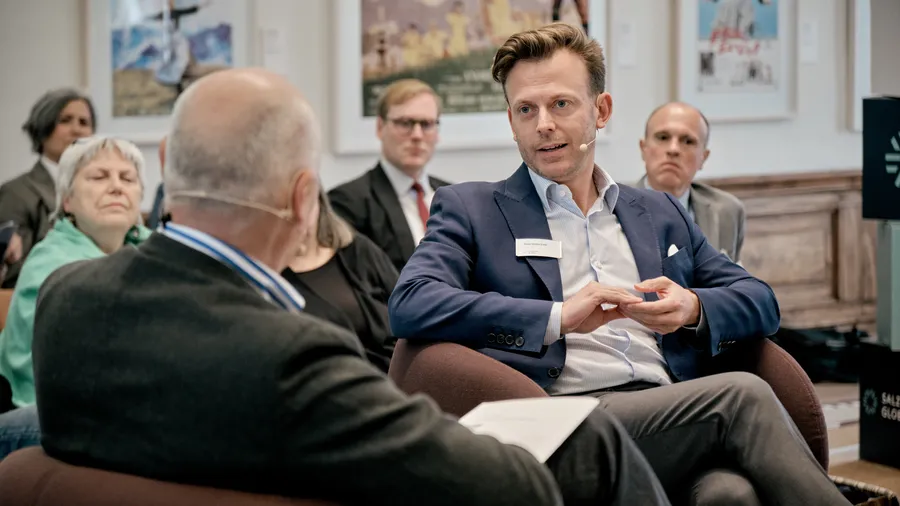
Franz-Stefan Gady speaking at Salzburg Global. Photo Credit: Siegrid Cain
Key takeaways
- In the event of a NATO-Russia war, Austria would very likely become a target of Russian attacks, Franz-Stefan Gady argues, despite its neutrality.
- A ceasefire in Ukraine could give Russia several years to rebuild and retrain its forces - and prepare for another war.
- The Baltic states are NATO’s most difficult military challenge: Russia could seize a small area and use the threat of tactical nuclear weapons to test the alliance’s resolve.
This article has been translated from German and was originally published by Salzburger Nachrichten. The original article can be accessed here.
Birds are chirping. Franz-Stefan Gady squints into the sun. Behind him stands Schloss Leopoldskron. Behind him, figuratively speaking, are also a series a discussions that stand in stark contrast to this fabulous backdrop. At the invitation of Salzburg Global, people from all corners of the globe have traveled to the session “Democracy on the Frontlines: How Can Democracies Defend Themselves?”- people fighting for democracy in Venezuela, Hungary, Serbia, and the U.S. They are sharing experiences and learning from one another. Franz-Stefan Gady is a sought-after military analyst and frequently travels to the front lines of the war in Ukraine. He has just told the plenary session that several armed forces in Europe are planning how to shift more of NATO’s military weight onto its European members.
Salzburger Nachrichten: This is happening because of fears of a confrontation between NATO and Russia. Is that realistic?
Franz-Stefan Gady: There are two major schools of thought. One school of thought argues that Russia’s sole goal is to keep Ukraine within its sphere of influence. Beyond that, Russia has no further ambitions. There is, in fact, zero evidence to support this. In statements by Russian policymakers, in statements by the entire political and military elite in Russia, there is no evidence to support this. A second school of thought argues: Ukraine is a stepping stone for a larger Russian plan aimed at establishing a new European security order. Russia would play a central role in this. There are two major obstacles standing in the way of this goal: the European Union and NATO. In other words, Russia’s goal of achieving this new world order would entail weakening or dismantling NATO and the European Union. There is concrete evidence of this, such as the Russian ultimatums issued to the U.S. and NATO on December 17, 2021.
SN: What is Putin’s idea? What would it look like?
FSG: The idea is a security order among the major powers. Without NATO and the EU, Moscow would work with Berlin, London, Paris, and Washington to devise this security order and make political decisions, bypassing other, smaller European states. It would be a “Concert of Europe,” as was the case in the 19th century.
“If there were a ceasefire in Ukraine, the Russians would have time to prepare for war.” - Franz-Stefan Gady
SN: Why would Russia want that? It hasn’t been able to achieve its goals in Ukraine for four years now.
FSG: I hear that all the time, but it’s like comparing apples and oranges. Russia’s best troops were killed in the first days and weeks of the war because when the Russians invaded Ukraine, they did not expect to encounter a real war. Its best-trained soldiers were wounded or killed there. They’ve never been able to make up for that lack of training. Military strength is defined not only by equipment, ammunition, and weapons, but above all by how well-trained the soldiers are. And in this regard, Russian soldiers have not been well-trained since that initial phase because reservists and “volunteers” were called up. It is no longer the same professional Russian army - at least on the ground. However, if there were a ceasefire in Ukraine, the Russians would have a few years to train more effectively and prepare for war.
SN: Under this new security order, though, Europe would likely have a say in the matter as well. What does Europe have to counter this?
FSG: We often hear about the Baltic scenario these days - that Russia might attack the Baltic states in a few years. We need to draw a very clear distinction between what the Russians are doing in Ukraine, where this really is about territorial expansion - a war along a 1,000-kilometer front, a highly complex war - and the military problem in the Baltics, which would be much simpler because of the geography. Effectively defending the Baltic states is probably the most difficult military task in all of Europe. They are very exposed. Any NATO forces would first have to be deployed to the Baltics – apart from a small spearhead already in place, consisting of forces such as the German brigade stationed there. This would give Russia what is known as “escalation dominance.” That means: The Russians, whose troops are already stationed right there at the border, could attack relatively quickly. Their goal wouldn’t have to be to conquer or overrun the entire Baltic region, but just a part of it, to hold as a bargaining chip. And then say: “Okay, NATO, if you want the Baltic states back, then we might use tactical nuclear weapons. Do you really want to start a war with us to defend the Baltic states?” And if the European response were: “Well, we can’t do that without the Americans.” Or: “Let’s negotiate first.” That would enormously weaken NATO; its credibility would be undermined - as, of course, would that of the EU. Russia would then be one step closer to establishing this European security order through a negotiated solution.
“The United States was the glue that held NATO together.” - Franz-Stefan Gady
SN: Isn’t NATO already lacking credibility when its largest member, the U.S., threatens another member, Denmark, and Donald Trump repeatedly disparages the alliance?
FSG: The United States was, so to speak, the glue that held the NATO structure together for many decades. It is the leading military power. It is no longer clear whether the United States would actually come to Europe’s aid in an emergency. I believe the Americans will continue to come to Europe’s aid in the future. But the big problem is that they won’t be the first responders - that is, the first to spearhead a military operation here. They want the Europeans to do that. But the Europeans can’t do that. And in this respect, NATO’s deterrence has been weakened. Russia will likely interpret this as a unique opportunity to attack in the coming years following a ceasefire in Ukraine.
SN: Your new book is called “Überfall. Wenn der Krieg zu uns kommt” (Invasion: When War Comes to Us). War coming to us – to Austria. That’s not something anyone here wants to hear.
FSG: Many people think it’s implausible that Austria could be attacked. But in the book, I explain that if a NATO-Russia war were to break out in Europe, which doesn’t have to happen if we take the right steps in the areas of deterrence and diplomacy, Austria would then very likely be the target of Russian attacks.
SN: Why?
FSG: For the simple reason that we are located in the heart of Europe and within the strategic depth of NATO’s European territory. In the event of such a war, NATO convoys would pass through Austria. We would isolate ourselves politically if we did not allow them to pass. As a small country, we are completely dependent on our neighbors when it comes to our military security.
SN: Does that mean the convoys would be the target of an attack?
FSG: Russia would likely even launch a preemptive strike against Austria - as well as Germany, the Czech Republic, and Slovenia - before the first major convoys pass through, in order to disrupt supply lines deep in the rear before they could reach a potential theater of war somewhere in Eastern Europe. Russia has developed these capabilities over the many years of war. In this respect, Russia will therefore be a more dangerous adversary at the end of the war in Ukraine than it was before the war. They can now produce millions of drones a year, they have tripled or quadrupled their missile production, and all of these weapons systems can reach as far as Austria.
“Europe's weakness has facilitated Russia's military operations.” - Franz-Stefan Gady
SN: Many people are opposed to rearmament. They say that more weapons lead to more violence. What do you say to them?
FSG: That is what is known as the security dilemma. The problem with that narrative is that, for example, Russia’s 2014 aggression in Crimea took place precisely when European armed forces were at their weakest since the end of the Cold War in 1989, and at the same time, U.S. forces were engaged in other parts of the world. This example contradicts the idea that European rearmament led to this situation. I understand the concerns. But I also believe that we must take the threat seriously. And if you look at the statistics, it is rather Europe’s weakness that has facilitated Russia’s military operations. Furthermore, every Eastern European country that joined NATO immediately cut its military budget after accession - even Poland.
SN: The EU approved a 90-billion-euro loan for Ukraine in April 2026. What difference will that make for Kyiv?
FSG: It could enable Ukraine to continue fighting this war, at least for some time. There was once a saying by an Austrian field marshal named Raimondo von Montecuccoli. What three things do you need for a war? “Money, money, money,” he said. The Ukrainian armed forces can now continue fighting for some time.