-
Topics
TopicsOur programs create spaces where open-minded leaders can gather for breakthrough conversations on pressing global issues – each aligned to one of the following pillars:Get Involved
-
Events
EventsExplore the variety of events Salzburg Global hosts within Austria and in the rest of the world. Learn more about our programs and what else happens at Schloss Leopoldskron.Upcoming EventsOct 19 - Oct 22, 2026Peace & JusticeThe Collective Action Problem: How Should Democratic Societies Respond to Increasing State Violence without Exacerbating Polarization and Political Violence?Violent Threats to Democratic SystemsOct 21 - Oct 25, 2026Peace & JusticeDemocracy Across the Frontlines: How Can Democracy Movements Collaborate To Build Resilience Across Borders?Democracy Resilience Forum
- Insights
-
Fellowship
FellowshipSince 1947, more than 40,000 people from over 170 countries have participated in Salzburg Global's sessions. Collectively, these alumni are known as Salzburg Global Fellows.
-
About Us
About UsSalzburg Global is an independent, non-profit organization committed to creating spaces that overcome barriers and open up a world of better possibilities.Our Approach
-
Support Us
Support UsYour generosity helps us gather open-minded leaders for breakthrough conversations, while creating space for dialogue that overcomes barriers and opens up a world of better possibilities.
- Donate

- Published date
- Written by
Share
Peace & Justice
Feature
Defending Democracy Requires More Than Elections
Published date
Written by
Share
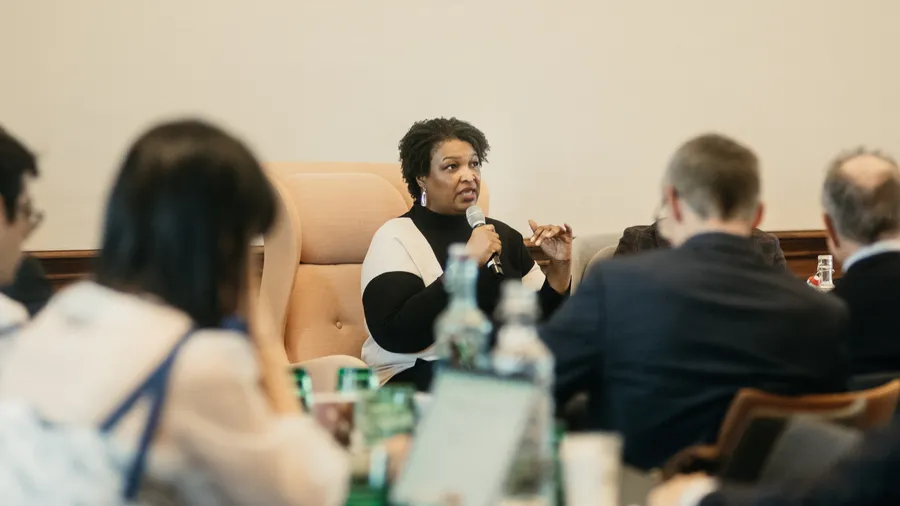
Stacey Abrams speaking at a Salzburg Global session in April 2026. Photo Credit: Richard Schabetsberger
Key takeaways
- Warning against complacency, Stacey Abrams said that “we Americans are quite arrogant” in believing that democratic backsliding cannot happen in the United States.
- “Voting is essential - but it is not enough,” she argued, emphasizing that democracy requires accountability and active civic participation between elections.
- Insisting that “if everyone has to follow the same path, we lose,” Stacey calls for multiple avenues for democratic engagement, from organizing protests to documenting rights violations.
This article has been translated from German and was originally published by Salzburger Nachrichten. The original article can be accessed here.
Many people in the United States - and elsewhere - feel powerless. Violence is not an option; U.S. Democratic leader Stacey Abrams believes there are better ways forward
U.S. Democrat Stacey Abrams calls the Trump administration an authoritarian regime. Waiting for the next elections is not enough for her. That’s why she has outlined ten steps that concerned citizens can take to push back - without weapons.
In 2018, Stacey Abrams became the first African American woman to run for governor of a U.S. state, Georgia. Her nomination alone was historic. Now, U.S. media and politicians consider the attorney one of the country’s most important political figures, as her work as an advocate for voting rights, particularly for marginalized communities, played a major role in the Democrats’ election victory in 2020.
From April 21 to 25, 2026, Stacey Abrams attended Salzburg Global's session on “Democracy on the Frontlines: How Can Democracies Defend Themselves?”, where people from around the world gathered to learn from one another: How can democracy be defended?
Salzburger Nachrichten: Democracy in the United States is under threat. Are people aware of this?
Stacey Abrams: Most people realize that something isn’t right. But many find it difficult to identify exactly what it is. Many attribute it to the current international climate. The world has simply become harsher. Part of my mission is to be clear: The diagnosis is that democracy is under attack. Once people have a diagnosis and a language to process what is happening, they can recognize what’s happening and start to respond to it. But that process takes time. We Americans are pretty arrogant.
“We Americans are pretty arrogant.” - Stacey Abrams
SN: Why arrogant?
SA: The idea of “American exceptionalism”, the uniqueness of America, is widespread. The belief is that we are different from everyone else. And in many ways, that is true: our cultural distinctiveness, the way we built our democracy compared with other democracies - all of that is true. But it has also created a sense of invulnerability. Many people think, “Nothing like that can happen to us.” But it can. Recognizing that creates space for things to improve again.
SN: You have identified ten steps that lead toward autocracy, and ten steps to counter it. Isn’t voting enough?
SA: Voting is essential, but it is not enough. Democracy only works when governments are held accountable and citizens are actively involved. If that is missing - and the wrong people gain power - authoritarianism emerges. Voting is indispensable, but it’s not enough on its own.
SN: Where do you start? What is the first step?
SA: People are hungry for a plan. We are bombarded with chaos, and the intention is to confuse us. So first, we have to recognize what is happening. That comes before everything else. If there are ten steps that lead to autocracy, there are also ten steps in the opposite direction. It begins with being able to name what is happening. Then it is about organizing and mobilizing. We are building an infrastructure rooted in local communities.
“If there are ten steps that lead to autocracy, there are also ten steps in the opposite direction.” - Stacey Abrams
SN: In the United States, there is a long history of struggle - against slavery, racism, and discrimination. Aren’t there many strengths and structures that can be drawn upon now?
SA: Yes. We have the muscles - but we have forgotten how to use them. The “10 Steps” campaign is based on what has worked in the past. But I’m here in Salzburg because it is also important to learn from others.
SN: What can be learned from Hungary?
SA: Although its ethnic diversity is different from that of the United States - it is a more ethnically homogeneous country - it has served as a testing ground for many authoritarian forces, including the misuse of Christianity to justify certain behaviors. Péter Magyar warned that victory is never permanent. He now has the political mandate, but it is a major task to deal with everything that has fallen apart. I’m curious to see how he fulfills his promises. One confirmation of my approach is that he went out and sought contact with people in many small communities.
SN: What still works?
SA: People need the freedom to become active in their own way. If everyone has to follow the same path, we lose. My mission is to give everyone the option to choose the path that makes sense for them - whether that means organizing protests, reading banned books, or filming situations in which civil rights are being violated.
SN: Why do the Democrats seem to be doing so little?
SA: When people have no experience with authoritarianism, everyone is trying to figure out what they can do. Eventually, we will have the person who runs for president. Until then, you are seeing experiments - and people using their respective positions to figure out how to respond. We cannot wait for the person with the greatest responsibility to tell us what to do. We cannot wait until 2028. My impatience with authoritarianism is enormous. We have to get involved. My approach is to speak to the average American and say: “While you’re waiting for the next party leader, let me tell you what you can do right now.”
SN: You say that voting means hoping that something will change. If people do not have that hope, they do not vote. Voting has to make a difference. What, then, are the most pressing needs that a politician in the U.S. must address?
SA: In the United States, core promises of democracy have been broken. Work is losing its dignity because wages are stagnating and costs are skyrocketing - the social contract that honest work provides enough to live on no longer holds true. Access to healthcare is difficult, and national solutions have been deliberately weakened by the current authoritarian administration. We have a housing crisis and structural barriers to access based on skin color, gender, social class, or sexual orientation. What was fought for over decades is being dismantled step by step. This makes people more vulnerable, and this vulnerability is a failure of democracy. Freedom and participation should not depend on who happens to be in power. When democracy can no longer protect its citizens, trust in it begins to crumble.
"Freedom and participation should not depend on who happens to be in power. When democracy can no longer protect its citizens, trust in it begins to crumble." - Stacey Abrams
SN: You are a huge Star Trek fan, and you even appeared in an episode. “Star Trek” is about how different species can live together and find peaceful solutions. Is there something to learn from it?
SA: Absolutely. “Star Trek” conveys the idea that diversity, justice, and inclusion are not only possible but necessary for a society to thrive. Every episode presents conflicts in which that value system is challenged. The adversaries never completely disappear, and victories are never permanent. What I love about “Star Trek” is that we also see depictions of what things could look like if we get it right. I regularly quote “Star Trek” episodes as part of my political philosophy. I think it is a wonderful way to reach many people. One of the examples I use: When I became the Minority Leader in Georgia, they call you “Leader” to make you feel good, but they put “Minority” in front of it, so you know you have no power. You cannot accomplish anything unless others let you.
SN: Were you able to accomplish anything anyway?
SA: When I took over the leadership of my party, we weren’t in a good place. I thought about what I could learn - even from a distant fictional future. One of my favorite episodes is the one featuring Data, the android, a robot. He enters a competition against a brilliant human and plays a logic game - and loses. Everyone asks, “How can a robot lose a logic game to a human?” Data goes through a crisis and wants to shut himself down. The captain tells him: “You’re having a human experience: You try, and you fail. Your job is to find a better strategy.” Data thinks it over, comes back, and defeats his opponent - and here’s how: He begins playing with the sole goal of staying in the game. He isn’t playing to win - he perseveres to wear down his opponent. So sometimes, victory isn’t about beating someone but about holding out long enough until they give up in frustration. And sometimes, victory is simply refusing to let them control the game.
"Sometimes, victory isn’t about beating someone but about holding out long enough until they give up in frustration. And sometimes, victory is simply refusing to let them control the game.” - Stacey Abrams