-
Topics
TopicsOur programs create spaces where open-minded leaders can gather for breakthrough conversations on pressing global issues – each aligned to one of the following pillars:Get Involved
-
Events
EventsExplore the variety of events Salzburg Global hosts within Austria and in the rest of the world. Learn more about our programs and what else happens at Schloss Leopoldskron.Upcoming EventsOct 19 - Oct 22, 2026Peace & JusticeThe Collective Action Problem: How Should Democratic Societies Respond to Increasing State Violence without Exacerbating Polarization and Political Violence?Violent Threats to Democratic SystemsOct 21 - Oct 25, 2026Peace & JusticeDemocracy Across the Frontlines: How Can Democracy Movements Collaborate To Build Resilience Across Borders?Democracy Resilience Forum
- Insights
-
Fellowship
FellowshipSince 1947, more than 40,000 people from over 170 countries have participated in Salzburg Global's sessions. Collectively, these alumni are known as Salzburg Global Fellows.
-
About Us
About UsSalzburg Global is an independent, non-profit organization committed to creating spaces that overcome barriers and open up a world of better possibilities.Our Approach
-
Support Us
Support UsYour generosity helps us gather open-minded leaders for breakthrough conversations, while creating space for dialogue that overcomes barriers and opens up a world of better possibilities.
- Donate

- Published date
- Written by
Share
Health
Feature
Improving Health Outcomes Through Indigenous Data
Published date
Written by
Share
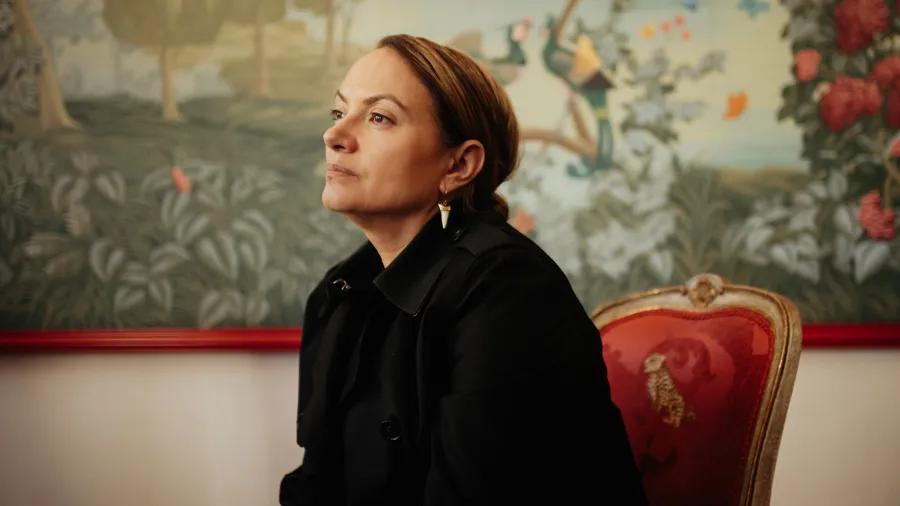
Kirikowhai Mikaere at a Salzburg Global Health session in October 2025. Photo Credit: Richard Schabetsberger
Key takeaways
- Health and well-being must be understood holistically, as human health cannot be separated from environmental and collective well-being.
- Indigenous-led data collection and governance can lead to more effective and equitable health outcomes.
- What we measure shapes what we prioritize - and deficit-focused data can reinforce inequity.
Salzburg Global Fellow Kirikowhai Mikaere is a Maori data specialist and tribal leader in Aotearoa, New Zealand. Her work focuses on using data and information to empower Indigenous community development. As a Salzburg Global Fellow at the session on “Transforming Information Pathways for Health, Well-Being and Equity,” she spoke to Fellow Kitty Eisele about how better data processes and governance can improve Maori health.
This interview has been edited for brevity and clarity.
Kirikowhai Mikaere, Maori data specialist and tribal leader in Aotearoa, New Zealand: I think there's a need to reframe what we mean when we talk about health, wellness, and well-being. For us, the current data that's collected disconnects the conversation of health of people from the health of environment. And they're not disconnected. For us, I can't be well if my lands are not well. I can't be well if my waters are not well. And I think climate change and many of the weather events happening mean we need to take a more holistic approach to this conversation around health, health equity, and health well-being.
Kitty Eisele, Salzburg Global Fellow: What did you come to share here at Salzburg Global?
KM: I came to share, specifically, an Indigenous data governance model that we co-designed with our government, published in 2023, and have been sharing with other Indigenous nations.
With respect to health, equity and well-being, the message is the importance of collecting the right information for all populations. And how you collect, how you analyze, and how you disseminate data and information into communities to empower and to enable them to attain their aspirations with respect to well-being.
KE: Can you give an example of collecting the right information and distributing it into the right hands, that has had an impact on Maori health?
KM: A concrete example is during our COVID-19 pandemic and lockdown, we were able to access vaccination data directly from our Ministry of Health. We created a visualization platform and disseminated that out into the hands of tribal nations, and they used that to inform their vaccination strategies. So, we were able to vaccinate our own people with much higher and faster uptake rates. And we wanted to move fast in terms of looking after our people, and particularly a lot of our elders.
KE: What did that look like?
KM: We created an access index mapping where the clinics were, how far away, and how hard it was for our people to access them. We mapped which communities and houses had vehicles or ability to drive to the clinics. We were able to inform our tribal nations that the issue might not be that there aren't vaccinations in the community. The issue might be the community can't get to the vaccinations. So, it helped inform mobilizing clinics.
We also created a willingness index, where we brought together data and information to show our communities in terms of their civil engagement, their education levels, and how they've participated in health surveys in the past. To show our health workers, it's not just a case of knocking on a door and giving somebody immunization. You actually have to have trusted leaders go out and communicate to their communities to increase willingness.
KE: Is there something you want non-Maori audiences to understand about the perspective you represent?
KM: I am a really big advocate for Indigenous knowledge, for the recognition that it and our knowledge systems should be afforded equal explanatory power at decision-making tables, and how our knowledge systems can be complementary. We're not inferior. Our knowledge system is not inferior. I grew up knowing my house of learning comes from the beginning of time, like most Indigenous nations, and I think if people are willing to listen, there is incredible contribution that our Indigenous nations and Indigenous knowledge systems can make. And one of the greatest things I think we can bring is hope.
KE: What excites you about this?
KM: I think I'm excited that there is hope that our knowledge systems, our traditional Indigenous knowledge systems can bring to this conversation, and can bring to this space for us. But the reason I came here is to try to contribute that into the global conversation as well.
New Zealand is literally at the bottom of the earth and so very far for us to travel. That's one of the reasons I wanted to come to Salzburg Global - to hear what is happening globally. Is there opportunity for us to contribute some thinking? Is there opportunity for us to connect into others’ thinking that might help shape some things at home?
KE: You made a comment about bias in data. Can you speak a little more about that?
KM: Where we come from, the majority of the data that is collected about us is very much from a deficit and deprivation lens. So it has a particular bias about us, as do many of the narratives.
The data that is collected will tell you 50% of our boys leave school with no qualification, we die seven years on average before non-Maori, and over 60% of the prison population is from our community. If all you measure is that type of data, what you measure you manage. At the moment, our country manages misery with respect to our communities. So that's the concern around that bias.
If you don't measure aspirations, if you don't actually measure wellness, but you just measure illness, then how do you know you're heading in the direction you need to head?
KE: Is there a question about health you'd love to have measured for young people in your community?
KM: I would love to change up the collection of data so it's not just about the well-being of an individual, but the well-being of collectives, and the nuance of that is the well-being of a collective is not necessarily the sum of the individuals. There are particular nuanced questions. For us, well-being is around how connected you are to your identity.
KE: What's a question you could ask that might get at that?
KM: I think it’s: Do you know who you are and where you come from? How connected are you? In our country, we have questions around the language you speak, but not necessarily people's understanding around how that is a key component to your knowledge system. We don't ask around your understanding of knowledge systems, and that your language, our language, is the door to that.
I'm trying to bring forward the models and frameworks from our knowledge systems that we've always had, into this modern-day context.
A big part of the work we do for our future generations, and the strategy that we have for our organization, is for an audience seven generations into the future, and it is about us in the data and digital space, maintaining the continuity of our consciousness. We don't want anyone else to program that for us, to create or curate that for us.
We want those grandchildren, seven generations in the future, to be able to, one, be well because of what we've created, and two, to still think like us and speak like us. They might not look like us, but we want our consciousness to still be here.
KE: If in five years, your ideas are completely implemented and everything succeeds, what's different? What does your nation look like? What is your land and health like?
KM: I would hope that, firstly, there's less barriers of access to information, and therefore less barriers of access to health. Secondly, I would also hope that in the reframing of the data ecosystem, we have greater trust. We have a sharing of power and authority over data, and we have an understanding of how interconnected the health of people is to the health of their environment.
Support for this program was provided by the Robert Wood Johnson Foundation. The views expressed here do not necessarily reflect the views of the Foundation.