
-
Topics
TopicsOur programs create spaces where open-minded leaders can gather for breakthrough conversations on pressing global issues – each aligned to one of the following pillars:
-
Events
EventsExplore the variety of events Salzburg Global hosts within Austria and in the rest of the world. Learn more about our programs and what else happens at Schloss Leopoldskron.Upcoming EventsFeb 05 - Feb 07, 2026Peace & JusticeDisruption and Renewal: Charting the Future of the International Rule of Law, Democracy, and PluralismSalzburg Cutler Fellows Law ProgramApr 13 - Apr 18, 2026CultureCreating Futures: Rethinking Cultural Institutions, Infrastructure, and InvestmentCulture, Arts and Society
- Insights
-
Fellowship
FellowshipSince 1947, more than 40,000 people from over 170 countries have participated in Salzburg Global's sessions. Collectively, these alumni are known as Salzburg Global Fellows.
-
About Us
About UsSalzburg Global is an independent, non-profit organization committed to creating spaces that overcome barriers and open up a world of better possibilities.Our Approach
-
Support Us
Support UsYour generosity helps us gather open-minded leaders for breakthrough conversations, while creating space for dialogue that overcomes barriers and opens up a world of better possibilities.
- Donate

Health
Feature
How Kenya Is Designing Climate-Resilient Communities
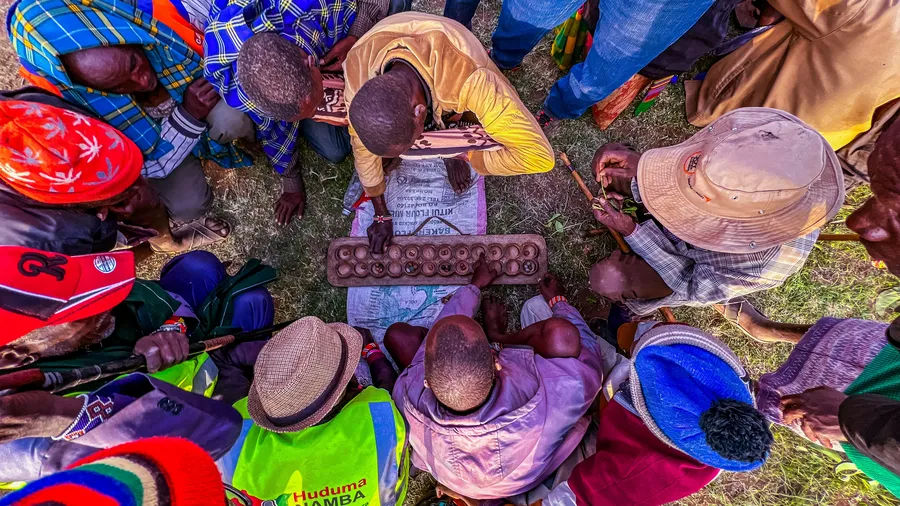
A community gathering in Samburu, Kenya. Photo Credit: Shutterstock.com/2563766603
The stark reality of the climate crisis in Kenya has led to escalating concerns about human-wildlife conflict, property loss and damage, and the effectiveness of insurance tools to address these issues.
Rahab Kariuki and Anne Kamau, who attended the Salzburg Global Health session on “Building Resilient Communities: Insurance Solutions for Vulnerable Individuals and Communities,” shared their experiences implementing community-centered models and leveraging financial tools. Through their work, they are fostering community resilience, building trust, and ensuring a safe coexistence with nature.
Community-Level Organizing
Rahab uses behavioral science, the scientific study of human and animal behavior, to understand how communities have culturally stayed resilient. She believes that for communities to truly understand their risk, they must first recognize that this risk belongs to them. She emphasized seeing the community as a center to measure what services are necessary to complement and strengthen what the community is doing. By empowering communities with the assessment skill they need, they can have the agency to decide what they need rather than having insurance companies dictating it for them.
In addition, insurance plays a role in complementing the needs of the community as it understands how to use risk management tools, including how to assess and diversify risks. These finance tools are available for worst-case scenarios.
“This is where insurance can contribute to what communities are already doing,” she explained.
As an engagement director at Busara, Rahab’s team specifically focuses on studying how people think about their money in the context of uncertainty, and how their perceptions of risk affect their actions. Her work has been inspired by risk-sharing practices from the Global South, such as across the Philippines and India, as she sees similarities in context. Rahab asked, "Why have these communal risk pooling models not been taken up by many people? Why are people not replicating this already?”
Rahab believes that communities should organize themselves in a way that enables the insurance tools to work most effectively. "Insurance doesn't work very well at an individual small group level, but if you start bringing the groups together, then there's an opportunity there to pool funds and diversify the risk as well, which makes it cheaper for everyone because now you're looking at a bigger pool,” she suggested.
Building Trust
Trust has always existed within communities themselves, yet building trust between them and formal insurance companies can be challenging. To leverage insurance, communities must trust these companies to manage their finances - but their distrust often comes from differing incentives and mindsets. “The insurance company exists to make money for its shareholders, while the communities are coming together to help each other, to get through their problems together,” Rahab explained.
Accordingly, communities and insurance need to work together in identifying risks, verifying complaints, and managing money. “When you're working with an insurance company, that money is gone, and this is how people feel about it. But if it belongs to you as a group, then you can make a decision about what you do with your surplus,” added Rahab.
Working With Communities
As a Co-Founder and Executive Director of AB Entheos Limited and a professional insurer, Anne Kamau has worked with communities in different countries to understand their perspective and provide training in adapting insurance to the needs of communities.
As an educator, she uses creative tools to educate communities on insurance, one of which is a game she designed called ResilientMe!.
“ResilientMe! is a card game that trains communities who may not understand insurance very well, or a gamification training tool for anyone who wants to understand insurance but doesn't want to sit in a classroom and go through a PowerPoint presentation,” explained Anne. Anne illustrated the game as a simulation of real-life financial decision making at the household level. It also includes informal risk mitigation mechanisms, formal risk mitigation mechanism through insurance, as well as credit and savings for a 360-degree approach to household financial decisions.
Insurance for Nature and Biodiversity
Currently, Anne is developing and implementing insurance solutions to support and protect nature and biodiversity. Human Wildlife Conflict Insurance encourages and fosters coexistence between humans and ecosystems, wildlife, and biodiversity. Anne explained that “using insurance as a tool to compensate for losses that humans face, eliminates people's motivation to kill wildlife because they are assured of compensation for their losses.” For sustainability of the scheme, the communities are encouraged and required to have some form of protection to keep the wildlife out of their homes. These loss reduction efforts are supported by conservation organizations in those ecosystems.
Taking human wildlife conflict insurance, for example, the term “insurance for nature and biodiversity” signals the need to mitigate losses from wildlife conflicts. “Because you're not looking only at insurance for nature, but it's nature for insurance where you find both of them coming at an intersection where people benefit from nature, and nature benefits from people - this is because people no longer have incentives to destroy nature through retaliatory killings,” Anne explained. She provided an example of increased droughts, which have resulted in wildlife coming into human settlements to look for food and water from human-made irrigation systems.
To ensure that the insurance scheme addresses these challenges, Anne works with the community impacted by wildlife conflict.
“Instead of building solutions for the people, we build with them. Co-creation is the secret behind the Human Wildlife Conflict Insurance scheme that is now adopted by the government of Kenya and is also being piloted in Zambia,” Anne noted.
To design the insurance prototype, Anne worked with communities who live with wildlife in the southern part of Kenya, particularly in the Tsavo ecosystem and the Amboseli ecosystem. She engaged with these communities to discover how they relate to wildlife, where conflicts are, and what solutions they would like. “We realized that 100% of the retaliatory killing is because the people feel disenfranchised when it comes to wildlife. Because when an animal is killed, there are heavy penalties imposed on the people and yet the people kill the animal because it also caused damage or even injured or killed one of them,” Anne explained. She has learned that if someone can compensate for these losses, people will stop killing these animals.
Promisingly, Anne’s work within the human-wildlife conflict insurance scheme can also be replicated and customized for other kinds of nature related loses, for example in marine ecosystems.
Rahab’s and Anne’s work show that leveraging insurance to build community resilience and enable co-existence with wildlife addresses some localized impacts of the climate crisis. When insurance tools are built by and for communities like these, they can contribute to both their health and wealth.
Annual Spotlight: Centering Africa
This article is part of our Annual Spotlight: “Centering Africa." Across our sessions and events in 2025, Salzburg Global is highlighting the central role that the African continent will play in global development now and in the next decades. As demographic trends across much of the world project a future of older and less productive economies, the African continent stands out for its growing youth population, dynamism and innovation. In reimagining an international system that better responds to the needs of the 21st century, it is our hope that Salzburg Global can play a small but meaningful role in centering African ideas, innovations, and perspectives in global forums like ours.
The Salzburg Global session on "Building Resilient Communities: Insurance Solutions for Vulnerable Individuals and Communities" took place from October 5 to 10, 2025. Support for this program was provided by the Robert Wood Johnson Foundation. The views expressed here do not necessarily reflect the views of the Foundation.
