
-
Topics
TopicsOur programs create spaces where open-minded leaders can gather for breakthrough conversations on pressing global issues – each aligned to one of the following pillars:Get Involved
-
Events
EventsExplore the variety of events Salzburg Global hosts within Austria and in the rest of the world. Learn more about our programs and what else happens at Schloss Leopoldskron.
- Insights
-
Fellowship
FellowshipSince 1947, more than 40,000 people from over 170 countries have participated in Salzburg Global's sessions. Collectively, these alumni are known as Salzburg Global Fellows.
-
About Us
About UsSalzburg Global is an independent, non-profit organization committed to creating spaces that overcome barriers and open up a world of better possibilities.Our Approach
-
Support Us
Support UsYour generosity helps us gather open-minded leaders for breakthrough conversations, while creating space for dialogue that overcomes barriers and opens up a world of better possibilities.
- Donate

Health
Feature
Protecting Health and Dignity: Microinsurance as a Tool for Women’s Climate Resilience
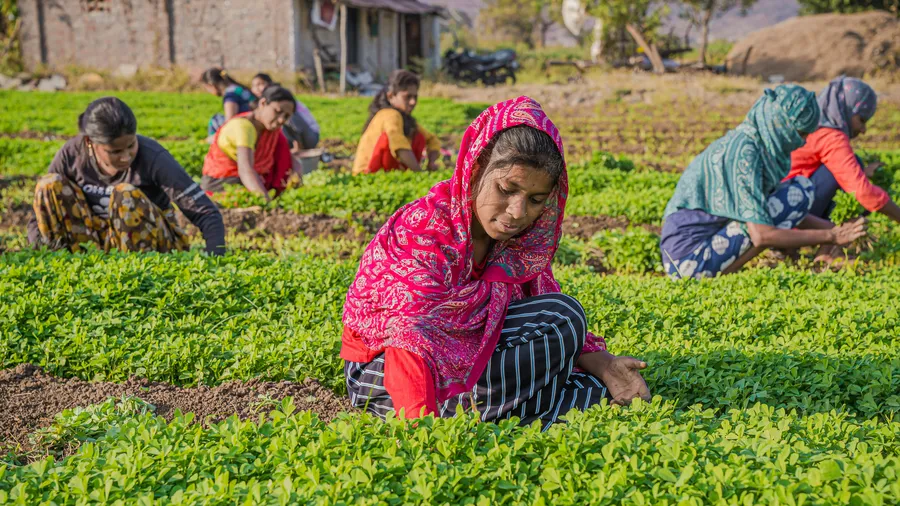
A group of women farming in a field in Nagpur, Maharashtra, India. Photo Credit: Unsplash.com/EqualStock
In April 2025, a heatwave with temperatures reaching up to 46 °C / 114.8 °F hit India and Pakistan, putting enormous strains on the entire population. Especially informal workers, small farmers, and daily laborers felt these rising temperatures first and hardest. In a world where the frequency and intensity of climate shocks are increasing, the question is no longer if vulnerable communities will be affected, but how they can endure and recover from them.
This is a challenge that Reema Nanavaty, Executive Director of India’s Self-Employed Women’s Association (SEWA), is trying to address by providing parametric climate microinsurance to informal women workers. Unlike traditional insurance, which compensates after verifying actual losses, parametric insurance is triggered automatically when certain conditions are met, such as temperatures exceeding a specific threshold, or rainfall reaching a dangerous level. This is especially beneficial for workers like street vendors, construction laborers, and agricultural workers who can’t afford weeks or months of waiting for money. They need quick payouts to buy food, pay school fees, or restart small businesses. These payouts aren’t just a financial relief, they are also a public-health tool, explained Kathy Baughman McLeod, Founder and CEO of Climate Resilience For All. They give women the ability to rest during extreme heat instead of working through illness, to afford treatment, and to avoid taking high-interest loans to cover basic expenses.
In fact, for many street vendors, rising temperatures have made outdoor work increasingly difficult. Longer and hotter days force them to shorten their workdays and accept lower daily income. Each period of extreme heat directly translates into lost income and greater health risks.
India’s First Climate Microinsurance for Women
Launched in 2023 and expanded in cooperation with Climate Resilience for All, SEWA was India’s first parametric climate microinsurance product for informal women workers. It began with 21,000 members across five districts of Gujarat and has since scaled up to reach 225,000 women across seven Indian states. In 2024, after record-breaking heatwaves, 92% of SEWA members received payouts ranging from $0.80 to $7 per person. “Members don’t want charity,” said Kathy, “they want work - and tools that protect their dignity.”
Why Microinsurance Matters
For people living on a few dollars a day, traditional insurance is often out of reach. It is too expensive, too complicated, or simply unavailable. Microinsurance fills that gap by providing protection against everyday shocks, such as illness, crop failure, and accidents, as well as large-scale disasters like floods, cyclones, and heatwaves. It offers insurance coverage specifically designed for low-income or vulnerable populations.
Microinsurance is not only about financial compensation, but also about agency. It allows people to plan, save, and recover with dignity as well as prevent a temporary setback from becoming a permanent slide back into poverty, stressed Reema.
Elaben Bhatt, SEWA’s founder, once called poverty “the worst form of violence, perpetuated with the consent of society.”
Today, that violence is being accelerated by climate change. Every new shock, such as a heatwave, a flood, or an unseasonal drought, pushes informal workers further into precarity. “We lift them out of poverty,” Reema said, “and then climate shocks hit - and they are poor again.”
Without safety nets, families borrow from moneylenders at interest rates that trap them in debt for years. That’s where climate microinsurance comes in: a mechanism to stabilize livelihoods and allow people to recover on their own terms.
Toward Dignity and Agency
In many ways, SEWA’s model is a blueprint for what community-based resilience could look like worldwide. It shows that financial protection and social justice don’t have to compete but can reinforce each other. By training women from poor communities as local insurance agents, SEWA is also turning microinsurance into a livelihood opportunity. In doing so, it reframes climate adaptation not as a top-down intervention but as a bottom-up movement, where those most affected by the crisis design and drive the solutions.
The Salzburg Global session on "Building Resilient Communities: Insurance Solutions for Vulnerable Individuals and Communities" took place from October 5 to 10, 2025. Support for this program was provided by the Robert Wood Johnson Foundation. The views expressed here do not necessarily reflect the views of the Foundation.
