
-
Topics
TopicsOur programs create spaces where open-minded leaders can gather for breakthrough conversations on pressing global issues – each aligned to one of the following pillars:Get Involved
-
Events
EventsExplore the variety of events Salzburg Global hosts within Austria and in the rest of the world. Learn more about our programs and what else happens at Schloss Leopoldskron.Upcoming EventsSep 06 - Sep 11, 2026EducationA Tale of 2000 Days: New Partnerships in Early ChildhoodEducation for Tomorrow's WorldOct 05 - Oct 07, 2026Finance & GovernanceA Multipolar & AI-Driven World: Are New Approaches Needed To Preserve Profit and Public Trust?Salzburg Global Corporate Governance Forum
- Insights
-
Fellowship
FellowshipSince 1947, more than 40,000 people from over 170 countries have participated in Salzburg Global's sessions. Collectively, these alumni are known as Salzburg Global Fellows.
-
About Us
About UsSalzburg Global is an independent, non-profit organization committed to creating spaces that overcome barriers and open up a world of better possibilities.Our Approach
-
Support Us
Support UsYour generosity helps us gather open-minded leaders for breakthrough conversations, while creating space for dialogue that overcomes barriers and opens up a world of better possibilities.
- Donate

Health
Statement
The Salzburg Statement on Equity-Centered Health Science Knowledge Systems
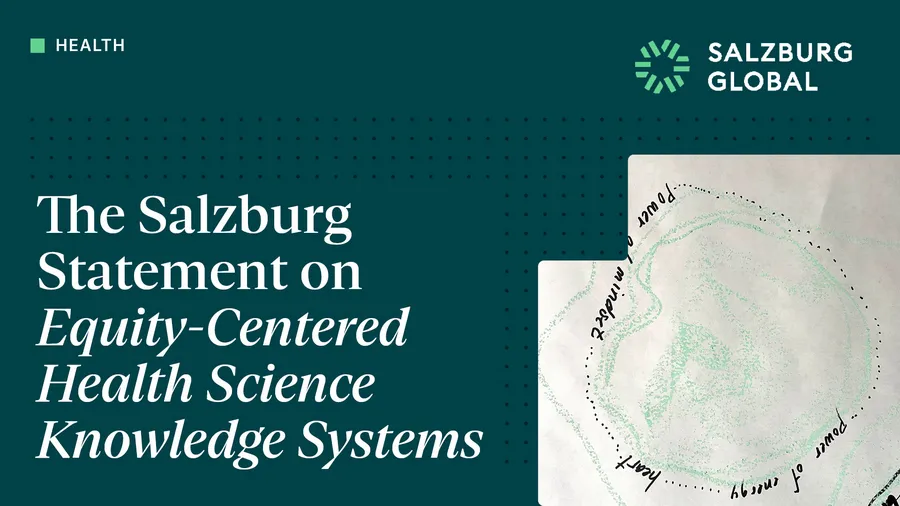
The image pictured was created through visual scribing by Déline Petrone.
Health and well-being are dynamic and historical processes that extend beyond the mere absence of disease. Yet global health science knowledge systems remain entrenched in reductionist biomedical frameworks that often do not consider knowledge from different ontologies. This includes different understandings of health, healing, and wellbeing, as well as the unique contexts of individuals and communities. This focus sidelines a diversity of perspectives, including traditional, Indigenous, and community-based knowledge systems.
The Salzburg Statement on Equity-Centered Health Science Knowledge Systems calls for a reframing that understands health and well-being as health knowledge production’s goal, driven by equity, contextualization, and diversity of human experience. This requires that health science learns from and integrates other forms of knowledge production, methodologies, and ways of knowing.
In this Statement, Salzburg Global Fellows propose a reimagining of health science knowledge systems through five principles that advance equity, justice, and diverse health knowledge production:
1. Health and well-being are holistic and interconnected: Embracing an expansive view of health that includes physical, mental, social, cultural, spiritual, and environmental dimensions.
2. Justice and knowledge pluralism: Recognizing and incorporating diverse health knowledge systems, especially those grounded in Indigenous traditions and local communities.
3. Decolonization of health research and practice: Actively dismantling colonial power imbalances in health education, research, and governance.
4. Equity and human rights are the foundational goal: Embedding human rights into health science research and practice, adopting anti-racist, feminist, ecological, and anti-colonial approaches.
5. Community-driven leadership and collaboration: Engaging communities as co-creators of knowledge, ensuring participatory approaches in health interventions.
"This powerful statement from the Salzburg Global Fellows reflects the deep commitment and collaboration of participants from the Salzburg convening we supported last year. It’s a timely response in the current moment – and it provides a roadmap for the key transformations needed to build a global health knowledge system rooted in equity," says Alonzo Plough, Program Chair and VP, Research-Evaluation-Learning & Chief Science Officer at Robert Wood Johnson Foundation, USA.
Achieving a pluralistic and equity-centered health science knowledge system is not just aspirational, it is imperative for global health, environmental sustainability, and social justice. The urgency of this transformation demands collective responsibility and bold action from all sectors: policymakers, researchers, health institutions, civil society, and communities.
The Salzburg Statement on Equity-Centered Health Science Knowledge Systems reflects a consensus among Salzburg Global Fellows who attended the Salzburg Global session on "Centering on Equity: Transforming the Health Science Knowledge System." In collaboration with Taofeekat Adigun, Salzburg Global Impact Fellow for Health, these Fellows generously offer their own knowledge, experience, and will to build the spaces, mechanisms, and instruments to make these recommendations viable.
The Statement was launched at the World Health Assembly in Geneva on May 24, 2025.
View the publication on ISSUU:
Download The Salzburg Statement on Equity-Centered Health Science Knowledge Systems as a PDF.
The Salzburg Global program on "Centering on Equity: Transforming the Health Science Knowledge System" was held from October 7 to 12, 2024. Support for this program was provided by the Robert Wood Johnson Foundation. The views expressed here do not necessarily reflect the views of the Foundation.
