-
Topics
TopicsOur programs create spaces where open-minded leaders can gather for breakthrough conversations on pressing global issues – each aligned to one of the following pillars:Get Involved
-
Events
EventsExplore the variety of events Salzburg Global hosts within Austria and in the rest of the world. Learn more about our programs and what else happens at Schloss Leopoldskron.Upcoming EventsOct 19 - Oct 22, 2026Peace & JusticeThe Collective Action Problem: How Should Democratic Societies Respond to Increasing State Violence without Exacerbating Polarization and Political Violence?Violent Threats to Democratic SystemsOct 21 - Oct 25, 2026Peace & JusticeDemocracy Across the Frontlines: How Can Democracy Movements Collaborate To Build Resilience Across Borders?Democracy Resilience Forum
- Insights
-
Fellowship
FellowshipSince 1947, more than 40,000 people from over 170 countries have participated in Salzburg Global's sessions. Collectively, these alumni are known as Salzburg Global Fellows.
-
About Us
About UsSalzburg Global is an independent, non-profit organization committed to creating spaces that overcome barriers and open up a world of better possibilities.Our Approach
-
Support Us
Support UsYour generosity helps us gather open-minded leaders for breakthrough conversations, while creating space for dialogue that overcomes barriers and opens up a world of better possibilities.
- Donate

- Published date
- Written by
Share
Education
Opinion
Created For Everybody, By Everybody
Published date
Written by
Share
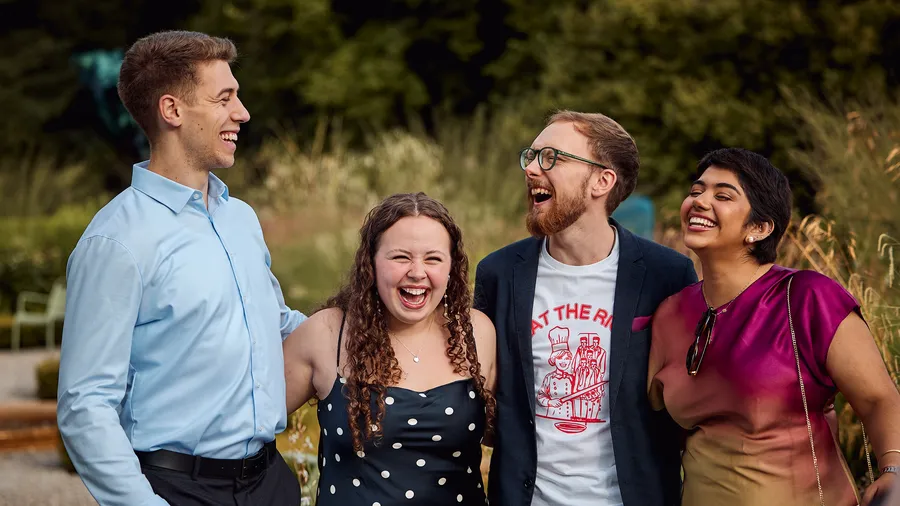
Moritz Denkmayr (pictured left) with other Fellows at the Salzburg Media Academy in July 2025. Photo Credit: Christian Streili
This article was originally featured on Medium, which includes more coverage from the Salzburg Academy on Media and Global Change session on “Local Media Futures and Democratic Health.”
The Salzburg Academy on Media and Global Change is an annual program that convenes emerging leaders in media fields to build networks for positive change. If you would like to find out more about the Academy, please email Paul Mihailidis, Faculty Chair and Program Director.
At this year’s Salzburg Academy on Media and Global Change, which focused on the topic of “Local Media Futures and Democratic Health,” we were given a unique challenge: choose a place - real or imaginary - where no local media exists and design a concept for a local media initiative that strengthens democratic health within the community. With only about 20 hours to work, time was scarce, yet each group produced remarkably sophisticated and creative concepts.
Looking back, I’ve realized something about my group’s work that likely holds true for the others as well: These concepts weren’t simply the result of what we’ve learned at university. They were shaped just as much, if not more, by our personal experiences with local media and, perhaps most significantly, by what we experienced together during the Salzburg Global Media Academy.
The perfect example to explain my thinking is the project my group created, Laal Stadt. Right from the beginning, it was our goal to come up with a local multimedia model that is not only applicable in our imaginary place, but rather in a real-world setting. With our diverse cast of group members, we had the once-in-a-lifetime opportunity to draw upon a well of global experiences with local media. So, everybody, from Hong Kong to Brazil, identified the problems of their local media. And trust me, the list was long.
Rather remarkably, something stood out for us. These places are thousands of kilometers apart, separated by languages and cultures, but if you boil these problems down to their core, in one way or the other, they apply to every place. No matter if you live in India or somewhere else, minorities or unhoused people tend to be portrayed negatively in media. No matter if you live in the U.S. or somewhere else, outlets depend on funding and oftentimes adjust their content accordingly. No matter if you live in Hong Kong or somewhere else, the elites will try to influence the news coverage. No matter where you live, these aspects diminish trust in media.
In order to tackle these fundamental (local) media problems in our Laal Stadt concept, it took the individual personalities, mindsets, and skills of every single group member, no matter their origin or their field of study. Unbeknownst to me, there was another major point of influence that made its way into our Laal Stadt project: the lectures and conversation we had with faculty. Alex Tang reminded me in his lecture of media’s dependence on reach and, thereby, advertising money. Or how a talk with Jessica Roberts and lecture by Sangita Shresthova both showed me the importance of feeling connected to a community and how this could be achieved with solution journalism or events. Len Apcar’s session on writing with voice made me think about my own writing style and how seeking an unusual perspective may be worthwhile. Manuel Guerro exhibited the importance of our ability to imagine a better tomorrow. Chris Harris‘s lecture revealed many personal and intellectual insights I can apply at work and life in general. Overall, the lectures were filled with valuable ideas that not only influenced our project but will also stay with us long after our time at Salzburg Global.
There’s so much I’ve learned from working on this project and from the people that helped me on the way. The thing that will probably stick with me the most, is the importance of one another. In my future career, I want to carry this mindset into every team I am part of, knowing that diverse perspectives not only enrich ideas but also build stronger, more resilient solutions. No matter how different we appear, we are not as different as we seem. We need each other. We are better together than apart - as a community, as people, or even as just a group working on a project.