-
Topics
TopicsOur programs create spaces where open-minded leaders can gather for breakthrough conversations on pressing global issues – each aligned to one of the following pillars:Get Involved
-
Events
EventsExplore the variety of events Salzburg Global hosts within Austria and in the rest of the world. Learn more about our programs and what else happens at Schloss Leopoldskron.Upcoming EventsOct 19 - Oct 22, 2026Peace & JusticeThe Collective Action Problem: How Should Democratic Societies Respond to Increasing State Violence without Exacerbating Polarization and Political Violence?Violent Threats to Democratic SystemsOct 21 - Oct 25, 2026Peace & JusticeDemocracy Across the Frontlines: How Can Democracy Movements Collaborate To Build Resilience Across Borders?Democracy Resilience Forum
- Insights
-
Fellowship
FellowshipSince 1947, more than 40,000 people from over 170 countries have participated in Salzburg Global's sessions. Collectively, these alumni are known as Salzburg Global Fellows.
-
About Us
About UsSalzburg Global is an independent, non-profit organization committed to creating spaces that overcome barriers and open up a world of better possibilities.Our Approach
-
Support Us
Support UsYour generosity helps us gather open-minded leaders for breakthrough conversations, while creating space for dialogue that overcomes barriers and opens up a world of better possibilities.
- Donate

- Published date
- Written by
Share
Education
Opinion
Impressions: A Principle for Salzburg
Published date
Written by
Share
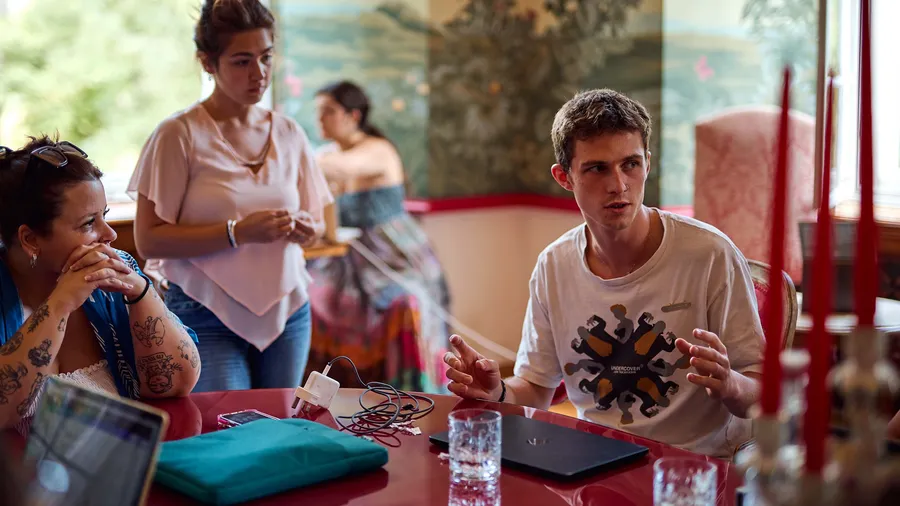
Photo Credit: Christian Streili
This article was originally featured on Medium, which includes more coverage from the Salzburg Academy on Media and Global Change session on “Local Media Futures and Democratic Health.”
The Salzburg Academy on Media and Global Change is an annual program that convenes emerging leaders in media fields to build networks for positive change. If you would like to find out more about the Academy, please email Paul Mihailidis, Faculty Chair and Program Director.
On the Wednesday that we left the Salzburg Academy on Media and Global Change, I sat at the foot of the Leopoldsbrunnen fountain in Vienna and watched the city afternoon happen around me.
The sun rested on €7 ice creams and the Latin inscriptions etched into the stone edifices of the Grabenstrasse. Tour guides doubled as standard-bearers and late lunch was had under red Stiegl umbrellas.
Above Leopold and me, the afternoon light adorned terracotta rooftops and copper domes tainted by their verdigris teal.
Sat on his fountain steps, I wrote with a black pen in blue ink about the peace and joy of those I’d shared company with, the places we’d been, and the perspectives that had shifted my own.
These are those words and thoughts.
The summer I walked the banks of the Salzach river and alleys of the Old Town, I often found myself looking down, behind, or even beneath, rather than looking up.
Instead of relishing in the beauty of the Domplatz and its Untersberg marble in the evening light, hearing the cathedral’s seven bells toll across the city, my eyes were on the city’s bins and behind its street signs - glued to traffic lights and exposed concrete.
I saw insignias. Emblems. Symbols of love and hate. I found the work of fans of Derby County and Palmeiras, of junglists and “Smoking Crews” and “Ganja Haters” (albeit ironic ones). There were pronouncements to fight for the climate and declarations to fight against the right. One peeling imprint stated: “I want to be with you everywhere.”
What I saw were stickers. Stamped and imprinted upon Salzburg’s skeleton.
In his lecture, “The Hyper-Democratization of Storytelling,” Sanjeev spoke of Gaby Bruna, the photojournalist who began documenting the stickers that she found adorned and punched on lamp posts, street signs, and doors in cities across the world.
In Copenhagen, Bruna began to understand the stickers that marked the city as an expression of feeling for socio-cultural affairs, politics, and conflict - a people’s own impression of the world around them, made semi-permanent with label and adhesive.
The stickers I saw came from southern Brazil and from the English Midlands, from Munich, Tokyo, and Saarbrücken. All had made their own impression upon the city - left their mark.
A global imprint upon Salzburg.
As our time at the Media Academy came to a close, I began to feel as if we had enacted that same effect upon each other.
There’s no uniform toolkit or compass for your time in Salzburg - we’re all too different for that.
There is a principle, though: you must seek to be impressed upon.
In the summer you spend at the Schloss Leopoldskron, you will not be able to help but be surrounded by people with a brilliant love for what they do, what they know, and who they are.
People with colossal and intentional hearts for those less fortunate than them. Reporters who have bled for their reporting. You’ll be confronted by men and women whose ardent vocation to educate will stir and shape you anew. Wrestle with the notion of a boxer in a bar fight. Dissect “articulate commonality” and “political imagination.” Question the concepts you think are just lots of words.
Do not leave Salzburg without taking with you some part of the experiences of others. Let them shape you, mold you, and leave you changed.
Ask questions - and if you feel that you can’t do so during a lecture, then ask after. You are here because you are brilliant. Let the brilliance of others add to you.
I shared a room with Rain. He’d just graduated from the Chinese University of Hong Kong. I’d just done the same in Bournemouth. He taught me Cantonese card and hand games, and I continued to lose at them. We shared our music and talked about the places we’d traveled. I taught Rain the phrase “happy days.”
Arrive at breakfast tired. Speak long into the night with your roommate. Learn and laugh at each other’s stories. They might just be one of the loveliest people you’ll meet.
Speak and share smiles with all those you can - people from Hong Kong, from Bangalore, from Rio Grande do Sul and Nevada, from Salzburg itself and from Buenos Aires. You don’t know when you may see them again.
Sometimes an impression can be made halfway across the room. They’re often made by those whom you sit next to. It might be through words on a postcard or a gift on your last morning.
Smiles make impressions, as do eyes. Words and acts and moments can all imprint upon you a part of someone else.
Sometimes, they won’t even require a word.
Seek to be impressed upon in Salzburg. Be desperate to be shaped and have grace for everyone you meet. Learn the names of the hotel staff and speak to them whenever you can - they are just as brilliant.