-
Topics
TopicsOur programs create spaces where open-minded leaders can gather for breakthrough conversations on pressing global issues – each aligned to one of the following pillars:Get Involved
-
Events
EventsExplore the variety of events Salzburg Global hosts within Austria and in the rest of the world. Learn more about our programs and what else happens at Schloss Leopoldskron.Upcoming EventsOct 19 - Oct 22, 2026Peace & JusticeThe Collective Action Problem: How Should Democratic Societies Respond to Increasing State Violence without Exacerbating Polarization and Political Violence?Violent Threats to Democratic SystemsOct 21 - Oct 25, 2026Peace & JusticeDemocracy Across the Frontlines: How Can Democracy Movements Collaborate To Build Resilience Across Borders?Democracy Resilience Forum
- Insights
-
Fellowship
FellowshipSince 1947, more than 40,000 people from over 170 countries have participated in Salzburg Global's sessions. Collectively, these alumni are known as Salzburg Global Fellows.
-
About Us
About UsSalzburg Global is an independent, non-profit organization committed to creating spaces that overcome barriers and open up a world of better possibilities.Our Approach
-
Support Us
Support UsYour generosity helps us gather open-minded leaders for breakthrough conversations, while creating space for dialogue that overcomes barriers and opens up a world of better possibilities.
- Donate

- Published date
- Written by
Share
Culture
Update
Coming Together To Rethink Cultural Institutions, Infrastructure, and Investment
Published date
Written by
Share
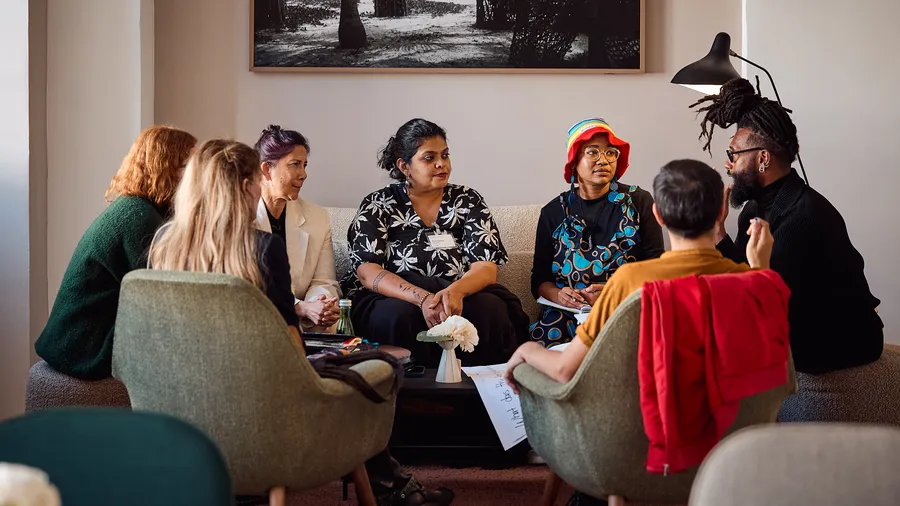
Fellows discuss together during the Culture, Arts and Society program in April 2025. Photo Credit: Christian Streili
As Salzburg Global prepares to convene its upcoming Culture, Arts and Society program, “Creating Futures: Rethinking Cultural Institutions, Infrastructure, and Investment,” a growing number of cultural leaders and funders are asking a fundamental question: How can cultural systems evolve to meet the demands of a rapidly changing world?
Globally, the conditions shaping culture are shifting, raising fundamental questions that sit at the heart of this program. How cultural value is defined and funded is increasingly contested, as traditional investment models struggle to keep up with evolving realities. At the same time, institutions are facing growing pressure to transform their governance structures and become more responsive, participatory, and accountable. Questions of labor and recognition are becoming more urgent, as many cultural practitioners navigate precarious working conditions and unequal access to resources and visibility. And in a fragmented global landscape, the need for more connected and collaborative cultural ecosystems is becoming ever more apparent. What emerges is not a series of isolated challenges, but the need for systemic transformation of how culture is valued, organized, and sustained.
Responding To Current Challenges
Cultural ecosystems worldwide are being reshaped by political pressure, economic fragility, and structural inequality. In many places, state influence over cultural institutions and funding bodies has intensified, narrowing space for dissenting perspectives. UNESCO’s “Re|Shaping Policies for Creativity” report highlights a continued decline in artistic freedom alongside widening inequalities in cultural economies. Only 9% of artists and culture workers report adequate or strong protection of their economic and social rights.
In other places, artists and cultural practitioners face rising polarization, regulatory constraints, and declining public investment, often compounded by volatile private and philanthropic funding streams. Public funding for culture remains critically low at under 0.6% of GDP worldwide, even as the sector’s economic and social importance grows. At the same time, cultural workers face increasing precarity, with global revenue losses of up to 24% projected for some creative sectors by 2028. These developments point to a broader pattern: The infrastructures that sustain cultural life are under strain worldwide.
Redefining Sustainability
A growing number of cultural leaders are now challenging the idea that sustainability can be reduced to funding alone. As reflected in discussions already happening among Salzburg Global Fellows, the future of culture depends not only on how much funding is available, but on how systems are designed to support long-term resilience, creative freedom, and fair conditions for those working within them.
This requires a shift away from short-term, project-based financing toward models that are more context-driven, locally rooted, and responsive to the realities of cultural practitioners. Sustainability, in this sense, is not merely financial - it is structural. It is about whether institutions are equipped to adapt to a changing world, whether artists can sustain their work, and whether cultural ecosystems can operate with a degree of autonomy and stability.
Reimagining sustainability also means recognizing culture’s broader role in society. Cultural institutions are not physical spaces or sites of production, but spaces for dialogue, memory, and social imagination. Yet they are often evaluated through narrow metrics that fail to capture these wider contributions. A more holistic approach is needed: one that connects funding to governance, labor conditions, and ecosystem design.
Creating Futures: Convening for Systemic Change
In response to current developments, Salzburg Global is convening 45 institutional leaders, policymakers, cultural funders, private sector actors, and creative economy practitioners from April 13 to 18, 2026. Together, they will engage in conversations about the future of cultural infrastructure and reimagine how culture is supported, organized, and positioned within broader societal systems.
Salzburg Global Fellows will tackle the following five themes, which were identified together through online co-creation meetings:
- What Is Culture Worth? Reimagining Value, Capital, and Investment
- What Would It Take for Institutions to Transform? Redesigning Governance, Participation, and Institutional Models
- Whose Labor Counts in the Cultural Sector? Rethinking Generational Power, Recognition, and Access
- How Do We Build Connected Cultural Ecosystems? Reimagining Collaboration, Shared Power, and Collective Intelligence
- Will AI Reinforce Inequality or Redistribute Value? Rethinking Cultural Labor, Compensation, and Power in the Age of AI
Within these themes, Fellows emphasize that meaningful change requires more than incremental adjustments. They point to the need to fundamentally shift how the cultural sector is understood and positioned, reframing creativity as a form of capital that extends beyond monetary value and enables engagement with regenerative and diverse financing models. At the same time, they highlight the importance of rethinking institutional mandates and accountability structures: building stronger alliances beyond the cultural sector, diversifying income streams, engaging with markets and external actors, and drawing on a wider range of knowledge systems and stakeholders. Together, these perspectives underscore a need to shift toward more adaptive, inclusive, and interconnected cultural systems that are better equipped to navigate present and future complexities.
From Uncertainty To Possibility
At the heart of this convening lies the shared recognition that existing investment models and governance approaches are no longer sufficient. Across public, private, and philanthropic sectors, current systems are often misaligned with both present-day challenges and long-term needs. "Creating Futures: Rethinking Cultural Institutions, Infrastructure, and Investment" aims to position culture not as a static sector, but as a dynamic force, capable of shaping more cohesive, resilient, and forward-looking societies.
To implement sustainable change, Fellows are coming together for deeper collaboration across global cultural ecosystems and a willingness to rethink foundational assumptions of cultural value, ownership, and responsibility.