
-
Topics
TopicsOur programs create spaces where open-minded leaders can gather for breakthrough conversations on pressing global issues – each aligned to one of the following pillars:Get Involved
-
Events
EventsExplore the variety of events Salzburg Global hosts within Austria and in the rest of the world. Learn more about our programs and what else happens at Schloss Leopoldskron.Upcoming EventsOct 19 - Oct 22, 2026Peace & JusticeThe Collective Action Problem: How Should Democratic Societies Respond to Increasing State Violence without Exacerbating Polarization and Political Violence?Violent Threats to Democratic SystemsOct 21 - Oct 25, 2026Peace & JusticeDemocracy Across the Frontlines: How Can Democracy Movements Collaborate To Build Resilience Across Borders?Democracy Resilience Forum
- Insights
-
Fellowship
FellowshipSince 1947, more than 40,000 people from over 170 countries have participated in Salzburg Global's sessions. Collectively, these alumni are known as Salzburg Global Fellows.
-
About Us
About UsSalzburg Global is an independent, non-profit organization committed to creating spaces that overcome barriers and open up a world of better possibilities.Our Approach
-
Support Us
Support UsYour generosity helps us gather open-minded leaders for breakthrough conversations, while creating space for dialogue that overcomes barriers and opens up a world of better possibilities.
- Donate

Culture
Feature
More Than Funding: Rethinking Sustainability for Art and Culture
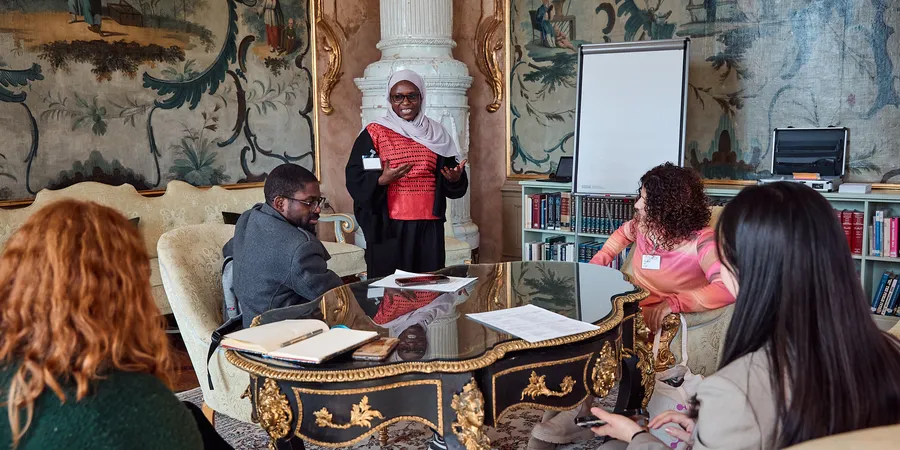
Sumayya Jaeh Iliyasu at the Salzburg Global session "Creating Futures: Art of Narrative" in April 2025. Photo Credit: Christian Streili
As we are living in times marked by polarization, distrust, and shrinking civic space, artists and cultural practitioners have stepped up to strengthen social cohesion and expand the imaginative space in which democratic futures can be negotiated. Yet as audiences, institutions, and funders demand more impact and visibility from artists and their work, the pressure on creators increases.
Through the session “Creating Futures: Art of Narrative,” Salzburg Global gathered artists and cultural practitioners to explore how storytelling can reshape social realities. Fellows reflected on the following questions: How can artists access the resources they need while protecting the creative freedom that gives their work its power and impact? And how can artistic independence survive in an environment where funding is increasingly scarce and often comes with expectations attached?
Sustaining Art and Culture Requires More Than Funding
What resonated strongly among many Fellows is that artistic and creative expressions play a crucial role in creating space for complex, human-centered stories that rise above polarized discourse and help combat mistrust and distrust. But this is only possible if funding structures allow artists and cultural practitioners to remain in charge of their own narratives rather than producing work to satisfy donor expectations.
As Sumayya Jaeh Iliyasu, a Nigerian curator, program manager, and creative director of Open Arts, stressed,
“If artists are given a little freedom to decide how to use the funding, the outcome is likely to be far more impactful than if they are constrained and told exactly what they must do.”
In the current funding crisis, impact and visibility of artists will depend more and more on collective resourcefulness. “Funding is a very, very big issue since the world is turning topsy-turvy”, explained Sumayya. Shrinking grant opportunities mean that organizations must become resourceful and think of other ways to look for support. For her, the most powerful solution lies in collaboration: “When you collaborate, then the resources are put together. Maybe one [organization] has the resources, another has the people and the skills.” She argues that rather than each institution “reinventing the world,” working together enables them to do much more with the few resources available.
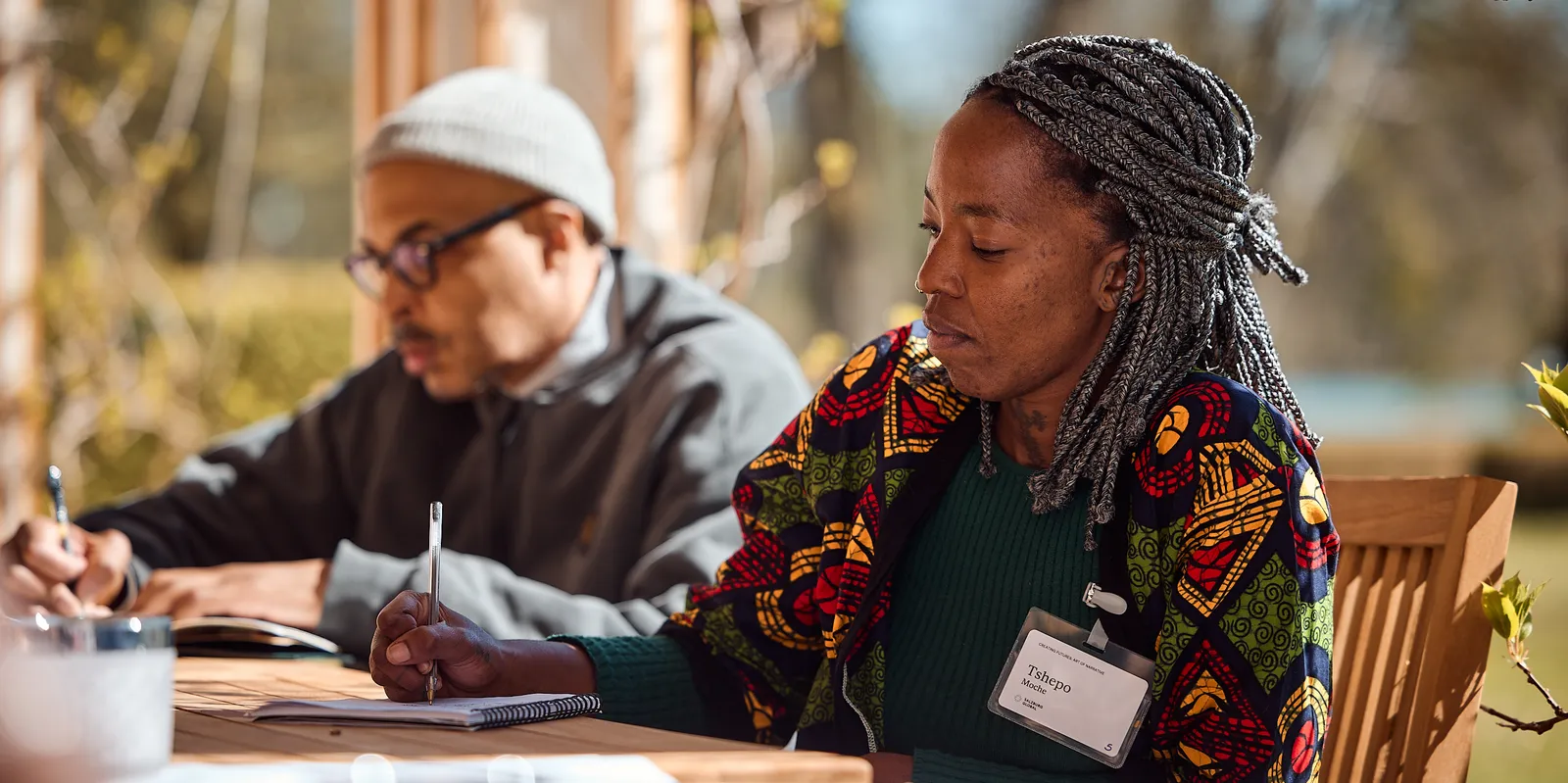
Tshepo Moche, writer, director of WATA, developer, and partner at Playnice Pictures Development Hub, added that another way to build more equitable relationships between funders and creatives is by bringing more creatives into the funding room. However, what should never get lost, she emphasized, is artistic uniqueness. Often artists adjust to funders’ priorities instead of sticking to their actual ideas and creative truth.
“I know many funders have a lot of criteria and the market might demand things of us, but what I've learnt is that a lot of it actually does come back to creativity and uniqueness,” Tshepo added.
Collaboration as Cultural Sustainability
Both Sumayya and Tshepo agreed that the sustainability of the cultural and artistic sector will depend not on competition for limited funds, but on collaboration, skill-sharing, and on ensuring that creative autonomy stays at the core of artistic practice.
Tshepo augmented this idea, asserting that collaboration is not only strategic but possible, even while remaining financially independent. Collaboration does not have to rely on donor money: Skill exchange, shared knowledge, tools, and platforms can expand creative communities without increasing costs. While funding is one possibility to keep art alive, there are many other ways to support artists and cultural workers in the long term beyond traditional grantmaking. For Tshepo, durability begins with flexibility: flexible working arrangements, flexible commissioning, and flexible institutional expectations that allow artists to sustain their practice alongside other income streams. She also stressed the importance of bringing artists into policymaking and funding spaces, not as beneficiaries but as decision makers, arguing that cultural longevity grows when those shaping budgets and frameworks understand the lived realities of artists.
Sumayya highlighted another layer: showing up for artists and “putting your money where your mouth is” not only by financing them but by actively engaging with their work. Buying art, attending screenings, resharing, and amplifying artistic output all build the space and possibilities for artists and cultural workers to thrive and continue their important work. Support, she argued, also means handing over a platform, not only money, by offering space to rehearse or exhibit, hosting residencies, and partnering across artistic communities.
At the core of Sumayya and Tshepo’s statements are simple but urgent principles: Every act of solidarity, whether financial or practical, helps move culture closer to social justice, equity, and humanity, and therefore to a better world.
Our 2025 Annual Spotlight
This article is part of our 2025 annual spotlight on “Centering Africa."
