

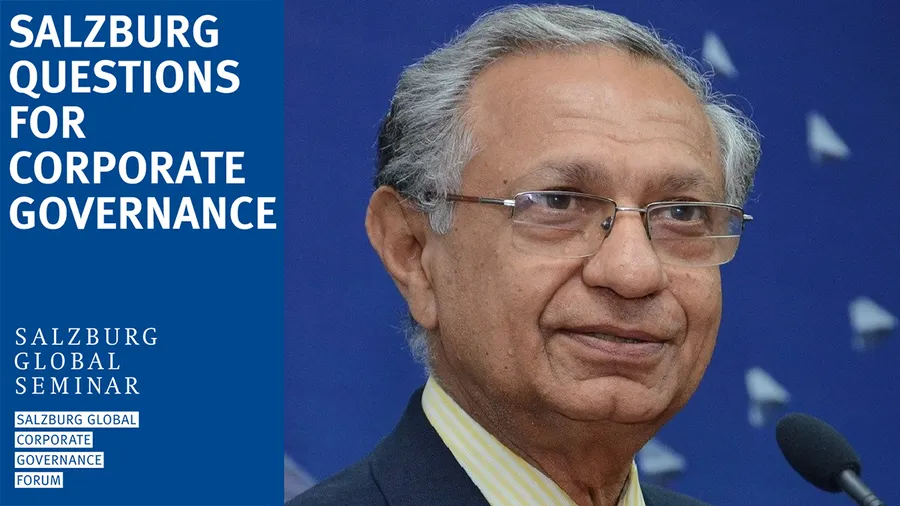
In the latest installment of the Salzburg Questions for Corporate Governance, former chairman of Tata Group companies Ravi Chaudhry advises how CEO and Boards can move further toward responsible leadership and entrepreneurship
This article is part of the Salzburg Questions for Corporate Governance series, facilitated by the Salzburg Global Corporate Governance Forum
It is a prevalent norm that for a business to run as usual, the compliance team must ensure that the corporation is not found culpable for being on the wrong side of the law in the jurisdictions in which it operates. But equating good compliance with good governance is a flawed premise. Good governance is not about whether an institution follows the laws or not; good governance is about what an institution does beyond the laws. That is what eventually determines whether civilizations advance or retract. We are so used to an entrenched culture of evading the legal framework that mere law abidance, in itself, is considered commendable. When expectations have reached such a low, it is unlikely that the reality can improve.
It is time to change the narrative from corporate governance to governance of the corporation. Beyond corporate compliance to corporate character. Beyond making money to how money is made. Beyond corporate lobbying to corporate acknowledgment that society matters and nature matters, more than all the global corporations put together.
I am not raising this because I think corporations need to become more altruistic or more philanthropic. I am flagging this because the glaring fault lines that have been laid bare during the COVID-19 pandemic have also clearly highlighted the imperative for corporations to observe and acknowledge the unmistakable new tenets that demand transition from leadership to responsible leadership and from entrepreneurship to responsible entrepreneurship.
Three hundred years ago, the Enlightenment and the Industrial Revolution completely demolished the foundations of an ancient order. Long prevailing kings, tribal chiefs, feudal lords, and religious heads – were all shaken up. Today, in the aftermath of the pandemic, we pass through a similar threshold moment in the history of the human race. A multiplicity of new forces is re-configuring our world all over again. Nothing may ever be the same. No industry and no business will be spared the impact. Some will disappear. Some will revive and recover. A few may thrive.
The new set of winners will emerge among those who unconditionally accept the new realities and unequivocally understand that this is perhaps a once-in-a-lifetime opportunity to completely transform and reinvent oneself as a person, as a leader. The new winners are likely to be those who understand and abide by the new tenets of responsible leadership: decisive stakeholder primacy over shareholders, social and environmental justice, equality for women and minorities, responsible consumption, ethical corporate citizenship, support for youth activism, regard for trade unions, and above all, transparency and humility.
It is in this context that I believe it is time to face the truth – the hard facts that have been tangibly visible, but we failed to see, and the voices of the victims of the culture we have created, which we failed to hear. Chief executive officers (CEOs)and Boards of corporations know it better than anyone else that it is impossible even to attempt to find a solution to the issues unless one is fully aware of the real ground realities. In practice, our past beliefs, prejudices, and habits make it difficult to accept reality because most of the time, we notice only the things that are important for us. Other things - we look at but ignore.
Awareness, complete awareness, is the need of the moment. The key to that lies in the trait of wholeness – the ability and readiness to observe and understand the complete reality.
We all live under the same sky, but have a different view of the horizons. Usually, the view one sees is from the perceiver’s vantage, with reference to her mind, and processed in her intellect. Typically, we feel satisfied with a partial 180-degree or even a 120-degree view. A complete 360-degree view is difficult, and yet, even if one thinks one has it, it is only half the job – because this view is from one’s own perspective only.
Each of our decisions and actions has an impact on others – directly or indirectly. Complete wholeness comes when we take an additional 360-degree view, as perceived by others, with reference to their minds and as processed in their thoughts. Wholeness, therefore, is a 720-degree view.
A 360-degree view excludes; a 720-degree view includes those who are excluded. A 720-view is the only significant criterion of inclusive societal growth.
Plainly, wholeness means open hearts and widened minds, connecting with the unconnected, and removing artificial barriers that blind one's faculties.
Typically, most of our attention goes to what we are looking at. We must also pay attention to where we are looking from. When we do that – it becomes easier to take in a good 720-degree view. That also makes us more amenable to modify our beliefs, disown our prejudices, and alter our habits.
Entrepreneurs who take cognizance of this 720-degree view and refrain from taking any action with any adverse impact, on any constituent of their vision, will still make money, even lots of it. And they will do so with dignity, without any fear or concern about any opposition from any quarters. They will create a sustainable entrepreneurial model and leave behind a lasting virtuous legacy. Quite effortlessly, they would have created a triple top line of joy, peace, and contentment, not only in their own lives but also in all the lives that their institution touches.
This process also enables CEOs to determine whether their role as the governor of the governance process in the organization contributes positively or negatively to society and nature.
New issues and new questions start emerging - for both CEOs and the Boards:
- What has led to the societal conviction that ultra-capitalism, as practiced, is concerned only with itself and obsessed with growth and profit; why is it blind, if not deliberately hostile, to social and environmental contexts?
- Why there is an outcry that the leadership practices in vogue are no longer sustainable; what has led to the perception that leadership does not have a problem, leadership is the problem?
- People are yearning for meaning in their lives; societies need a bigger meta-story. Could corporate leaders, perceived to be the drivers of the business-politics nexus, lead the transformation to a new narrative? What could happen if the top twenty thousand corporate CEOs of the world were to collectively evolve a new holistic purpose and put it into practice?
These are the thoughts that should be playing upon the minds of all CEOs and Boards, all the time.
In this background, at this critical threshold moment in human history, may I directly pose three specific questions to the corporate CEOs in every nation?
- Are you ready to take on the mantle of responsible entrepreneurship, as a responsible leader, by pursuing the path of 720-degree vision?
- If not us, then who?
- If not now, then when?
Let there be no doubt that corporate CEOs and corporate Boards collectively hold within themselves the power to steer human destiny to its next summit; let us seize this opportunity with courage and humility.
This piece is an edited excerpt from the new book I'm presently writing on issues relating to "Reinventing Democracy and Leadership."
Have an opinion?
We encourage readers to share your comments by joining in the discussion on