

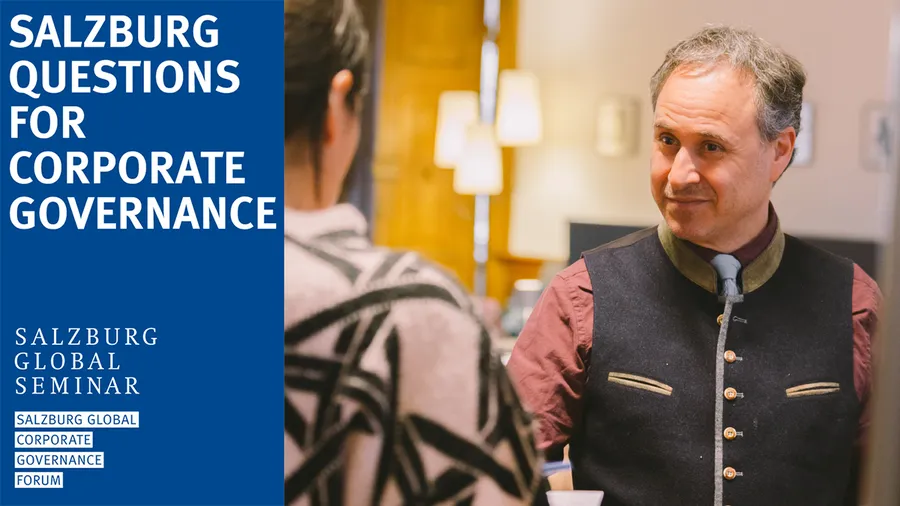
In the latest installment of the Salzburg Questions for Corporate Governance, Charles Ehrlich, a program director at Salzburg Global Seminar, reflects on the history and impact of the Corporate Governance Forum
Salzburg Global Seminar was founded in 1947 in the ruins of the Second World War. We brought together a diverse group who normally would never have had the opportunity to interact, to seek a better future for Europe and the world. We have carried on this desire for diversity of experience, background, and viewpoint – spanning geographies, sectors, and generations – for 75 years.
We remain a neutral institution in politics and geopolitics, preferring to allow people to discuss their legitimate differences and bridge their divides. Throughout the Cold War, this institution was one place where people from both sides of the iron curtain (and from the third world) could gather and speak openly and candidly with their peers on common issues and concerns. After the Cold War, Salzburg Global Seminar was instrumental in working with partners in Russia and the former Soviet-dominated countries to build up university systems, civil society organizations, and others interested in opening global dialogue and peace.
But we are not neutral on our morals. Russia's recent unprovoked invasion of Ukraine, with death and destruction, apparently perpetuated as objectives of the war and not merely its consequences, is illegitimate in all respects. The farcical justification that Russia needs to "de-nazify" Ukraine is as offensive as it is untrue, coming from a country that has intentionally obscured its own history of mass atrocity and has a history of covering up the Holocaust as well (see my chapter in this 2021 book published together with several Fellows of Salzburg Global Seminar) – including at Babi Yar, whose memorial was damaged in the opening period of the current war, and a leader who has praised the pact his country signed with Nazi Germany.
Corporations face an array of questions every day. However, we would hope that corporations, too, are not neutral on their morals. Corporations today are scrambling to deal with new sanctions regimes. But some have gotten out ahead of official sanctions and are reevaluating their dealings with Russia. What more could they do? And, in hindsight, what more should they have done before the most recent Russian invasion of a peaceful neighbor?
Different stakeholders may argue alternative views, and wise corporate leadership must consider these viewpoints. By bringing diverse perspectives to the off-the-record discussion, the Salzburg Global Corporate Governance Forum ensures that corporate leadership does take the wider view.
We had launched our Corporate Governance Forum in 2015 in response to turmoil across the globe which called into question long-standing corporate governance practices and had energized critics of the corporate governance status quo. Since then, we have hosted candid, off-the-record discussions, bringing a select number of directors of multinational corporations into an intimate, retreat-like setting where they can meet a variety of additional voices representing constructive but divergent views. These have included senior managers; judges, regulators, and policymakers; lawyers; thought leaders and academics; investors; and representatives of key civil society interest groups. Participants so far have come from 26 countries on six continents.
Our aim is to help these directors return to their boardrooms with new ideas which they can implement and with new partnerships and insights so that they themselves can become thought leaders and change-makers for the coming decades.
Starting in 2018, we have curated a series of blog-style posts by Fellows participating in our Corporate Governance Forum to bring to a wider public some of the rich ideas which have emerged during our off-the-record meetings.
Appropriately disruptive, Anastassia Lauterbach launched the series, setting out a series of questions Boards should be asking about artificial intelligence as a checklist for directors looking into an uncharted future.
Some authors have focused on board functionality. These have included:
- Michael Ling, Deputy Corporate Secretary at China Light and Power, asking how a sustainability committee could better look at potential risks;
- Aerospace executive and board member Jeffrey Grant exploring if boards of directors are better prepared for disruptive events if they include scientists and engineers;
- Nicole Lew, Legal Director at Alibaba, describing how companies should filter out the "noise" from stakeholder engagement;
- Roland Deiser, Chairman of the Center for the Future of Organizations, addressing business ecosystem leadership;
- Ravi Chaudhry, a former chairman of Tata Group companies in India, asking about how boards might provide responsible leadership for governance beyond compliance; and
- Gigi Dawe, Director of Corporate Oversight for Chartered Professional Accountants of Canada, suggesting how boards can effectively operate within a digital environment.
While the fundamentals of corporate governance led the corporate governance guru Bob Mundheim (the force behind the creation of this Corporate Governance Forum) to reflect on the significance of the Business Roundtable Statement on the Purpose of a Corporation, ESG issues have increasingly come to the fore. Among the key issues our Fellows have highlighted have been:
- Professor Stephanie Bertels of Simon Fraser University Beedie School of Business explaining why it is increasingly important for boards to signal their position on ESG;
- Jim Killerlane, Corporate Secretary of Bank of New-York Mellon, wanting us to ask what an "ESG-proficient" director is; and
- Mathilde Mesnard, Deputy Director of Finance and Enterprise Affairs at the OECD, exploring whether ESG reporting might lead to a shift in corporate governance.
Some questions looked at narrower specialist topics with broader implications:
- Chris Lee, a board director who splits his time on both sides of the Pacific, wanted to know if the rise of index funds was at odds with good corporate governance;
- Myeong Cho, a professor at Korea University Business School and an experienced member of several Korean boards, looked at a new draft law in his country and asked if audit committee members should be elected independently of other directors; and
- Professor Barak Orbach of the University of Arizona Law School investigated the impact of the COVID-19 pandemic on antitrust risks faced by companies and executives.
And when the COVID pandemic hit, boards found themselves confronted by another set of challenges. Among these:
- Nick Allen, who sits on the boards of CLP, Lenovo, and other companies, investigated whether independent non-executive directors could remain the guardians of good governance in times of COVID-19;
- John Cannon, who chairs the Corporate Governance Advisory Group of law firm Shearman & Sterling, revisited the Business Roundtable Statement in light of COVID and Black Lives Matter;
- Margaret Beazley, Governor of New South Wales and a distinguished former judge, reflected on if corporate practice and culture need to change;
- Catherine Brenner, a veteran of numerous Australian boards, explained how non-executive directors might look to the future while navigating extreme unpredictability; and
- Kayla Winarsky Green, at the time an advisor at the Danish Institute for Human Rights, reminded us how a human rights approach might help corporations build back better.
The frequency of questions increased during the pandemic, but so did the reach of our programs as we moved online, enabling more participants to join in the discussions in person.
As we go beyond the pandemic, our in-person retreats in Salzburg will resume, but we will also maintain a virtual presence. We have thus decided to move into the next phase of our programming, designed to expand the Corporate Governance Forum's participation and impact further outwards. As we build a dedicated pillar on economic development and finance, we will also transform the communications strategy, which will affect the series of "Salzburg Questions for Corporate Governance" as well as the "Salzburg Questions on the Future of Finance." In the transition phase over the following months, we will instead be highlighting the accomplishments of our Fellows who are making an impact in their work and inviting new Fellows to join these exclusive conversations in Salzburg, online, and in locations around the world.
We look forward to seeing you!
Have an opinion?
We encourage our readers to share your comments by joining in the discussion on LinkedIn.
Charles E. Ehrlich joined Salzburg Global Seminar as a program director in May 2014. He has particular responsibility for designing, developing, and implementing programs on justice, democracy, economics, and rule of law. He has practical experience in legal development working in over a dozen countries, including in the Balkans, the Caucasus, and the Russian Federation, advising governments and public institutions on strategic planning, drafting legislation, and implementing comprehensive reforms in the justice sector, public administration, property rights, freedom of the media, and constitutional law. Charles has also worked as legal counsel for the Organization for Security and Cooperation in Europe (OSCE) in Kosovo, in Georgia, and at its Secretariat in Vienna. At the Claims Resolution Tribunal in Switzerland, he adjudicated claims to Nazi-era bank accounts. He remains affiliated with Wolfson College, Oxford, and has published a book, Lliga Regionalista - Lliga Catalana, 1901-1936 (in Catalan), and numerous academic articles on constitutional law, justice, and political history. Charles holds an A.B. in history and classics (Latin) from Harvard University, a J.D. from the College of William and Mary, an M.Sc.Econs. in European studies from the London School of Economics, and a D.Phil. on contemporary Spanish history from the University of Oxford.
The Salzburg Questions for Corporate Governance is an online discussion series introduced and led by Fellows of the Salzburg Global Corporate Governance Forum. The articles and comments represent opinions of the authors and commenters and do not necessarily represent the views of their corporations or institutions, nor of Salzburg Global Seminar. Readers are welcome to address any questions about this series to Forum Director Charles E. Ehrlich: cehrlich@salzburgglobal.org. To receive a notification of when the next article is published, follow Salzburg Global Seminar on LinkedIn or sign up for email notifications here: www.salzburgglobal.org/go/corpgov/newsletter
