-
Topics
TopicsOur programs create spaces where open-minded leaders can gather for breakthrough conversations on pressing global issues – each aligned to one of the following pillars:Get Involved
-
Events
EventsExplore the variety of events Salzburg Global hosts within Austria and in the rest of the world. Learn more about our programs and what else happens at Schloss Leopoldskron.Upcoming EventsSep 06 - Sep 11, 2026EducationA Tale of 2000 Days: New Partnerships in Early ChildhoodEducation for Tomorrow's WorldOct 05 - Oct 07, 2026Finance & GovernanceA Multipolar & AI-Driven World: Are New Approaches Needed To Preserve Profit and Public Trust?Salzburg Global Corporate Governance Forum
- Insights
-
Fellowship
FellowshipSince 1947, more than 40,000 people from over 170 countries have participated in Salzburg Global's sessions. Collectively, these alumni are known as Salzburg Global Fellows.
-
About Us
About UsSalzburg Global is an independent, non-profit organization committed to creating spaces that overcome barriers and open up a world of better possibilities.Our Approach
-
Support Us
Support UsYour generosity helps us gather open-minded leaders for breakthrough conversations, while creating space for dialogue that overcomes barriers and opens up a world of better possibilities.
- Donate

- Published date
- Written by
Share
General
Feature
Why Global Engagement Is the Leadership Skill of the 21st Century
Published date
Written by
Share
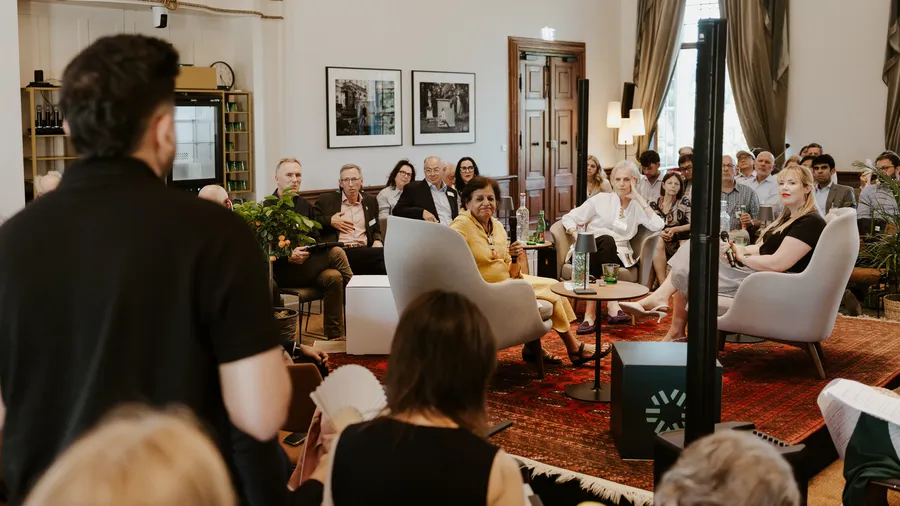
Ziyaan Virji (pictured left with back turned) poses a question to Vishakha Desai (left on stage) and Amy Stursberg (center on stage) at the 2026 Salzburg Global Weekend. Photo Credit: Julian Artner
Declining public trust and increasingly fragmented information environments have made it easier to retreat into familiar perspectives than engage with those that challenge our thinking. At the same time, artificial intelligence is transforming how we work and communicate, placing even greater value on the distinctly human qualities technology cannot replicate. The defining challenges of our time, including climate change, technological disruption, migration, public health, and political polarization, also do not stop at national borders.
Yet at this very moment when international cooperation is becoming more urgent, opportunities for meaningful engagement are becoming harder to find. How can we prepare ourselves, and our leaders, for a world where cross-cultural cooperation is essential, but increasingly difficult?
Participants at the 2026 Salzburg Global Weekend emphasized that 21st century leaders are those who can listen across differences, challenge their assumptions, and build relationships for sustained collaboration. Across discussions and panels, conversations reflected a shared conviction that global engagement is an indispensable leadership skill for everyone.
Global Engagement Shapes Us
Throughout the weekend, participants returned to a key idea: Leadership qualities are developed through engagement with people whose experiences, cultures, and perspectives differ from our own.
Amy Stursberg, Founding Executive Director of Schwarzman Scholars and CEO of the Stephen A. Schwarzman Foundation, sees this transformation unfold every year as students from around the world come together to live and study in Beijing.
"You might not listen to someone who you don't agree with on your college campus," she observed. "But now you're actually living with people who have completely different values, cultures, [and] interests — and you're sort of forced to figure out how to do that."
Sharing experiences with people from different countries and cultures exposes participants to perspectives they might never otherwise encounter. More importantly, it requires them to engage with those differences every day.
That, Amy believes, is leadership education.
As she tells the Schwarzman Scholars, even small choices become opportunities to practice leadership.
"Every decision you make... is a leadership decision," Amy tells scholars. "Who you sit with in the dining room - is it the person you're most comfortable with or someone you've never spoken to before?"
These daily choices, she believes, shape how leaders understand the complexity of others and the world around them.
Ziyaan Virji, Co-founder and CEO of Leaders of Today, described the value of personal connections in a world where information is already abundant. “When you see it and experience it firsthand, it opens your eyes to what’s possible,” he reflected. “It gives you the chance to have difficult conversations and to meet people from industries, geographies, and backgrounds you wouldn’t otherwise engage with.”
The result is not always agreement, but a greater capacity to empathize, ask thoughtful questions, and cooperate with people whose experiences differ from ours.
The Qualities That Matter Most
Leadership starts with a willingness to understand new perspectives. For Vishakha Desai, Senior Fellow at Columbia University's Committee on Global Thought and President Emerita of Asia Society, the qualities required for leadership have remained remarkably constant, but are even more essential today.
"In order to be an effective leader, no matter where you are, and if you want to lead a diverse group of people," she said, "you better have curiosity, empathy, and a willingness to not only hear differences, but, out of that, forge something new.”
Those qualities become more valuable as new technologies like artificial intelligence transform the way we work and make decisions. "People are talking about human-centered intelligence," Vishakha reflected. "But what is it that we are going to emphasize in a leader that AI cannot do?... Ethics, empathy, collective leadership, team building... You almost have to double down on those human qualities that make you a leader."
For younger generations, Ziyaan believes this shift is changing what leadership looks like. "Any leader, or anyone in a position who wants to engage with young people, really just needs to be authentic and show up," he advised.
His experience challenges the idea of leadership as individual performance.
"People think of the leader as the star in the middle," Ziyaan said. “The way I think of it, the leader is actually part of the circle, and what's in the middle is the collective vision we work towards.”
In his view, a leader’s role is to create the conditions in which people from diverse backgrounds can contribute to a shared purpose.
From Connection to Community
These conversations at Salzburg Global also highlighted the importance of bringing together open-minded leaders who embody these qualities. Global engagement expands what people can accomplish together: a conversation can become a trusted relationship, a new collaboration, or the beginning of a network that continues working across borders.
Vishakha emphasized the value of creating time and space for these personal relationships to form. "There is no substitute for an unhurried, intense couple of days of conversation," she said. "You develop friendships... layered conversations, and therefore more substantial engagement with people."
Those relationships become the foundation of something larger: a network of people who understand one another well enough to collaborate across borders, sectors, and disciplines.
For Ziyaan, this network is one of the most valuable outcomes of his own international experiences. "There are people I've met through Salzburg Global that I would never have imagined crossing paths with," he said. "It would be genuinely hard to meet them, and yet I end up sitting right next to them at a table."
Leadership Through Engagement
The challenges leaders face today have changed - shaped by new technologies, geopolitical realities, and global pressures – making the qualities required to face them even more necessary.
"Openness, curiosity, the willingness to be wrong, the willingness to be uncomfortable, the willingness not to have an answer," Amy reflected, are qualities each one of us needs to navigate an increasingly interconnected and fragmented world.
A defining leadership skill of the 21st century is the ability to engage across differences. In today’s world, a leader is anyone who is curious enough to learn from others, humble enough to listen across differences, and empathetic enough to understand how others experience the world.