-
Topics
TopicsOur programs create spaces where open-minded leaders can gather for breakthrough conversations on pressing global issues – each aligned to one of the following pillars:Get Involved
-
Events
EventsExplore the variety of events Salzburg Global hosts within Austria and in the rest of the world. Learn more about our programs and what else happens at Schloss Leopoldskron.Upcoming EventsSep 06 - Sep 11, 2026EducationA Tale of 2000 Days: New Partnerships in Early ChildhoodEducation for Tomorrow's WorldOct 05 - Oct 07, 2026Finance & GovernanceA Multipolar & AI-Driven World: Are New Approaches Needed To Preserve Profit and Public Trust?Salzburg Global Corporate Governance Forum
- Insights
-
Fellowship
FellowshipSince 1947, more than 40,000 people from over 170 countries have participated in Salzburg Global's sessions. Collectively, these alumni are known as Salzburg Global Fellows.
-
About Us
About UsSalzburg Global is an independent, non-profit organization committed to creating spaces that overcome barriers and open up a world of better possibilities.Our Approach
-
Support Us
Support UsYour generosity helps us gather open-minded leaders for breakthrough conversations, while creating space for dialogue that overcomes barriers and opens up a world of better possibilities.
- Donate

- Published date
- Written by
Share
Education
Feature
Sustaining a Media Movement: The Radical Experiment of the Salzburg Media Academy
Published date
Written by
Share
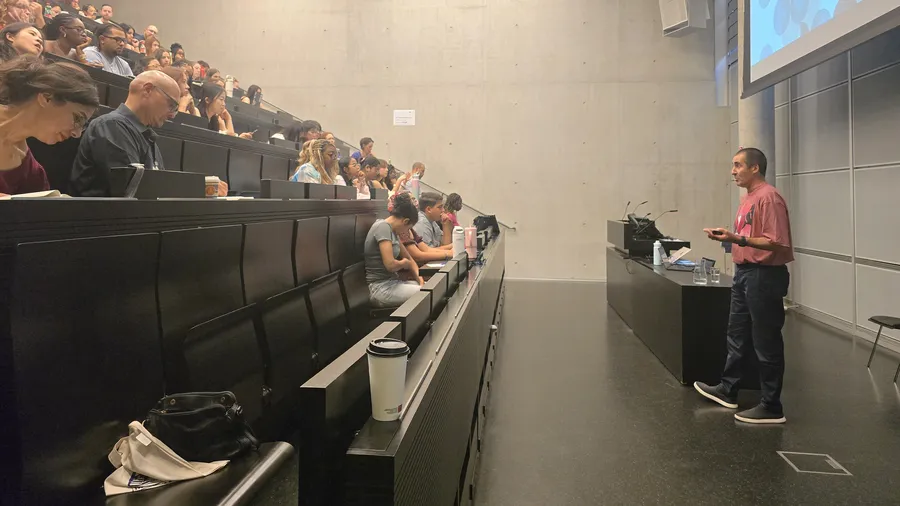
Paul Mihailidis delivering the Eck Lecture on July 31, 2026. Photo Credit: Universität Salzburg
Key takeaways
- The Media Academy is a living, evolving movement sustained by the relationships, ideas, and actions participants carry into their communities.
- Over the past 20 years, it has evolved from building media literacy to cultivating the agency and imagination needed to create meaningful solutions.
- Small acts of intentionality can sustain a growing circle of care, courage, and imagination across communities and generations.
“Why are we looking back to look forward, and what does it take to sustain a media movement?”
- Paul Mihailidis, faculty chair and director of the Salzburg Academy on Media and Global Change
Participants at this year’s Salzburg Academy on Media and Global Change grappled with this question, and many others, as they reflected on “distinct media moments” from the past to imagine the media landscapes of the future. At the two-week-long session centered on the theme “Created Histories, Creative Tomorrows: Distinct Moments that Shape Media Futures,” participants reconsidered how media shapes the soul of democracy and the imagination of the future.
Paul Mihailidis, faculty chair and director of the Salzburg Academy on Media and Global Change, delivered the annual Bailey Morris-Eck Lectureship on International Media, Economics, and Trade. He used the occasion of the lecture to commemorate the 20th anniversary of the Media Academy, approaching it both as a celebration and a chance to understand its enduring value in a media landscape continually reshaped by technological disruption, political polarization, and declining trust.
For Paul, the answer lies in understanding the Media Academy not simply as an educational program, but as a movement designed to evolve, adapt, and build a growing network of international media leaders worldwide. As Paul explained,
“We don't consider this a classroom. We don't consider this one program. We consider this a movement. It is radical because it is interested in getting to the root of ideas, and it's a movement because we never stop. We don't stop when this ends, we don't stop when we go home. We think about this as something that lives and breathes and continues.”
This philosophy has guided the Media Academy since its inception in 2006, when a simple but ambitious mission was established: to bring together young people from around the world to collectively explore how media can respond to challenges across borders, cultures, and divides.
In its early years, the program’s mission centered on media literacy. Participants learned to analyze media messages, compare perspectives across cultures, and develop practical toolkits they could take back to their home institutions. At a time when social media platforms were only beginning to emerge, these skills reflected the pressing questions of a rapidly expanding digital world. As digital platforms became increasingly personalized and polarized, the Media Academy confronted an uncomfortable reality: understanding media was no longer enough. Participants could identify misinformation, recognize manipulation, and critically examine media systems, but they would also need to be equipped with the skills and agency to develop solutions.
Over time, learning moved beyond seminars and workshops to encompass living libraries, collaborative art and music, movement, film clubs, storytelling, and informal encounters. These became spaces where participants could build relationships across cultures, perspectives, and lived experiences while developing the skills, confidence, and agency needed to turn mutual understanding into meaningful solutions.
The emphasis on agency is particularly significant for participants of the Media Academy, all of whom are beginning careers as scholars, artists, and storytellers who want to make media more ethical, equitable, and empathetic. Paul explained how sustaining a media movement begins with the capacity to act where one is, with people around them, and to recognize that small acts of intentionality can contribute to a larger culture of civic participation. The scale of someone’s action does not have to match the scale of the problem, as what matters most is the capacity to begin, participate, and continue building.
That responsibility now passes to a new cohort of Media Academy participants. Looking towards the future, their challenge is to take what has been created in Salzburg and allow it to evolve in the places they return to, including their universities, newsrooms, communities, and creative spaces. The connections sparked through the Media Academy may lead them to pursue new collaborations, projects, or paths - as it has for many participants before them.
For Jacqueline Ho of The Chinese University of Hong Kong, looking towards the future of the Media Academy, she sees "a fellowship radiating kindness, bound not by proximity, but by purpose, a community continuing to expand its “circle of care, courage, and imagination." She imagines future generations gathering in ever greater numbers, carrying Salzburg Global’s mission “with joy, conviction, and a profound sense of possibility.”
As these emerging media leaders return to their communities around the world after spending two weeks co-imagining media futures in Salzburg, they carry with them the possibility to extend that circle of care, courage and imagination. The movement of the Media Academy continues in the stories shared, the connections made, and the small acts of intentionality that, over time, are becoming something much larger.
The Bailey Morris-Eck Lecture is an annual lecture on international media, economics, and trade which was established in 2004 through the generosity of former Salzburg Global Board of Directors member Bailey Morris-Eck and her family.
The Salzburg Academy on Media and Global Change is an annual program that convenes emerging leaders in media fields to build networks for positive change. If you would like to find out more about the Academy, please email Paul Mihailidis, Faculty Chair and Program Director.