
-
Topics
TopicsOur programs create spaces where open-minded leaders can gather for breakthrough conversations on pressing global issues – each aligned to one of the following pillars:Get Involved
-
Events
EventsExplore the variety of events Salzburg Global hosts within Austria and in the rest of the world. Learn more about our programs and what else happens at Schloss Leopoldskron.Upcoming EventsSep 06 - Sep 11, 2026EducationA Tale of 2000 Days: New Partnerships in Early ChildhoodEducation for Tomorrow's WorldOct 05 - Oct 07, 2026Finance & GovernanceA Multipolar & AI-Driven World: Are New Approaches Needed To Preserve Profit and Public Trust?Salzburg Global Corporate Governance Forum
- Insights
-
Fellowship
FellowshipSince 1947, more than 40,000 people from over 170 countries have participated in Salzburg Global's sessions. Collectively, these alumni are known as Salzburg Global Fellows.
-
About Us
About UsSalzburg Global is an independent, non-profit organization committed to creating spaces that overcome barriers and open up a world of better possibilities.Our Approach
-
Support Us
Support UsYour generosity helps us gather open-minded leaders for breakthrough conversations, while creating space for dialogue that overcomes barriers and opens up a world of better possibilities.
- Donate

Education
Update
The 20th Salzburg Academy on Media and Global Change Looks to the Past To Shape Media Futures
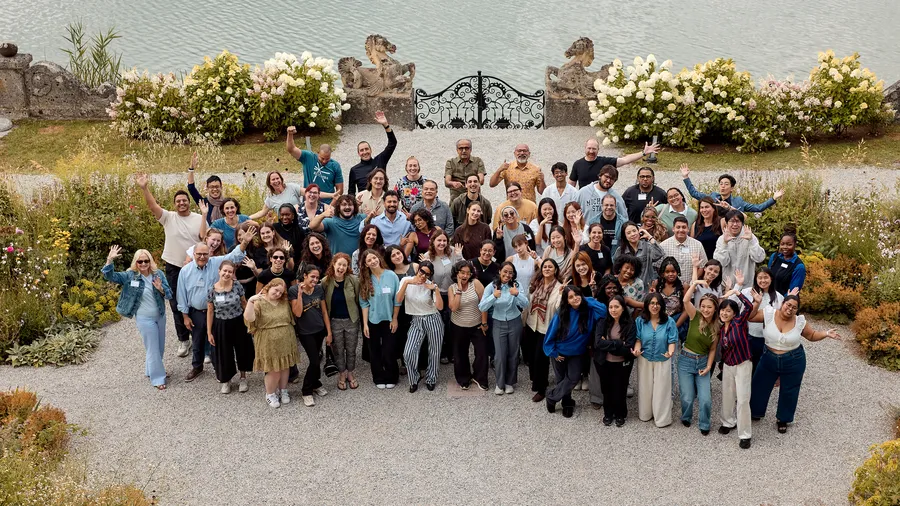
Participants and faculty of the 2026 Salzburg Academy on Media and Global Change. Photo Credit: Christian Streili
From July 20 to August 4th, 2026, over 75 people from across the world gathered at Schloss Leopoldskron for the Salzburg Academy on Media and Global Change. The 48 session participants included undergraduate students, graduate students, and early- to mid-career media professionals. They were joined by 30 faculty members, including visiting guests, speakers, experts, and scholars. All together, they represented Hong Kong, the U.S., India, Argentina, Thailand, Spain, the UK, Mexico, Qatar, Lebanon, China, Brazil, Portugal, Austria, and many more countries.
This truly international group gathered to explore the topic, “Created Histories, Creative Tomorrows: Distinct Moments that Shape Media Futures,” which invited participants to conceive and explore global media models that nurture a healthy society, whilst being sustainable for media practitioners.
This year’s session marked the 20th anniversary of the Salzburg Academy on Media and Global Change, which is notably one of Salzburg Global’s longest-running programs. For two decades, the program has brought together emerging media leaders to build lasting networks, collaborate on solutions to social challenges, and develop the skills needed to shape a more informed and engaged future. The 2026 session stands as both a reflection and a renewal – a moment to honor the Academy’s long-standing mission to cultivate media leaders who can think critically, act creatively, and communicate responsibly in a fractured world.
Faculty chair and director, Paul Mihailidis, echoed the Academy’s mission of fostering resilience and purpose within its participants:
“In a world that marches towards cruelty, this project, for two decades, has explored how we can understand and build media that creates reservoirs of goodwill; that are intentional in their pursuit of inclusive and just futures, and that embrace a radiance that conspires towards joy, connection, and compassion."
Participants attended lectures taught by professors from institutions around the globe, workshops led by visiting experts, and excursions to the UNESCO World Heritage site Gosausee and the Dokumentation Obersalzberg Museum. They also attended the third annual Shumow Symposium, hosted by the Universität Salzburg on their local campus. This day of lectures, film screenings, and dialogue was held in memory of late faculty member Moses Shumow.
Recounting her time at the Media Academy, Whitney Fry, founder of Flame Tree Story, said,
“The Media Academy has been a wonderful experience of connecting with people from all over the world who are working in creative media spaces. I learned so much from Fellows and faculty about how to carry this work forward into my practice of community storytelling and podcasting, [and] building community in my local and global spaces of influence.”
The international cohort collaborated in small groups throughout the duration of the two-week-long session. In these groups, participants conceptualized how society might interact with digital media 20 years into the future, and how these future digital mediums could look and feel. Their final concepts were presented to peers and faculty on the final day of the Media Academy. The six concepts include:
- Connectus Sphere: A community-owned, location-based discovery tool for helping people find and host in-person gatherings around shared media experiences.
- Platform G: One social media platform, for everything and everyone, designed to prioritize authentic and diverse content without algorithmic engagement.
- Hayven: A decentralized, open-source platform that gives users democratic control over their algorithms through AI-assisted curation, authenticity filters, and privacy boundaries.
- Community Tapestry: A “participatory form of civic media” where users gather to explore each other’s creativity and expression, serving as an antidote to loneliness, apathy, and toxic online environments.
- Timeless Magazine and The Thinking Cap: A community-focused lifestyle magazine accessible through “The Thinking Cap,” a single-purpose, reading headset that utilizes interactive holographic projections to improve tactility and restore attention spans.
- Deform: A language used by humans to protest mass AI use and digital censorship by organizing protests and signaling AI-generated content.
Participants’ full media outputs and other materials will be shared soon in the cohort’s digital publication, “Back to the Future,” on the online platform Medium.

To learn more about the Salzburg Academy on Media and Global Change, please email Paul Mihailidis, Faculty Chair and Program Director, or email Surya HK, Program Lead.
