-
Topics
TopicsOur programs create spaces where open-minded leaders can gather for breakthrough conversations on pressing global issues – each aligned to one of the following pillars:Get Involved
-
Events
EventsExplore the variety of events Salzburg Global hosts within Austria and in the rest of the world. Learn more about our programs and what else happens at Schloss Leopoldskron.
- Insights
-
Fellowship
FellowshipSince 1947, more than 40,000 people from over 170 countries have participated in Salzburg Global's sessions. Collectively, these alumni are known as Salzburg Global Fellows.
-
About Us
About UsSalzburg Global is an independent, non-profit organization committed to creating spaces that overcome barriers and open up a world of better possibilities.Our Approach
-
Support Us
Support UsYour generosity helps us gather open-minded leaders for breakthrough conversations, while creating space for dialogue that overcomes barriers and opens up a world of better possibilities.
- Donate

- Published date
- Written by
Share
Education
Opinion
What Language Do Students Bring to School?
Published date
Written by
Share
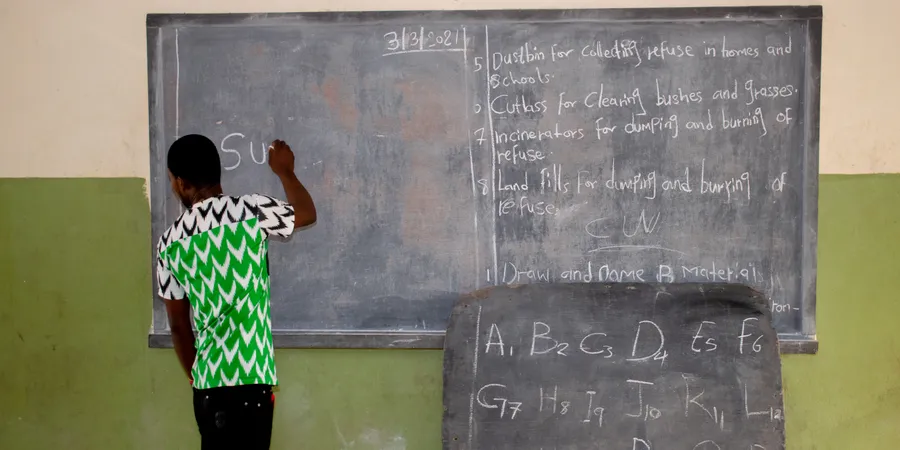
Photo Credit: Shutterstock.com/1972560875
This op-ed article was written by Thelma Obiakor, a writer in residence with the Salzburg Global Center for Education Transformation in 2025.
Imagine an education map that doesn’t trace school buildings or infrastructure, but the sounds of children’s first words - the languages they carry into the classroom. If policymakers in multilingual contexts like Nigeria could see learning this way, they might design language of instruction differently. Empirical evidence has long shown that children learn best in the language they understand, and several countries in sub-Saharan Africa have policies prioritizing mother-tongue instruction in early years of schooling. What remains missing is not policy or proof, but visibility - a clear understanding of where linguistic diversity actually lives within the education system.
The Missing Data
In multilingual, postcolonial education systems, one of the most consequential yet least examined challenges in implementing language-of-instruction policy is epistemic rather than material: We do not know, in any systematic way, what languages children actually speak at home. Many of these systems were shaped by colonial legacies that privileged a single dominant language - English, French, Portuguese, or Spanish - while hundreds of Indigenous languages remained confined to homes and communities. This has left education planners with only a partial view of the linguistic realities that shape learning.
Some countries have taken important steps toward recognizing and documenting linguistic diversity. South Africa, for instance, formally recognizes eleven languages and has introduced teaching materials in several of them. Yet even there, many additional languages are spoken in homes and classrooms beyond the official framework. Across much of sub-Saharan Africa, education data systems capture enrolment, infrastructure, and performance, but seldom the linguistic realities that underpin comprehension in the classroom.
This creates a policy paradox. Governments consistently affirm the importance of learning in familiar languages, yet they lack the data to determine where it is feasible - or to plan the training, materials, and curricula that would make it possible. Without knowing where each language is spoken, education systems cannot translate the promise of mother-tongue instruction into effective practice or tangible learning gains.
The Case of Nigeria
Nigeria illustrates this paradox with particular clarity. Since the first National Policy on Education in 1977, the country has formally required that the child’s mother tongue or the “language of the immediate environment” be used in the early years of schooling - a provision reaffirmed and extended through all six years of primary education in the 2022 revision. Yet implementation remains limited. Evidence shows that, despite renewed policy emphasis, instruction in most classrooms continues to default to English, especially in urban and linguistically diverse settings.
The reasons commonly cited - insufficient resources, uneven teacher preparation, and the dominance of English in examinations - are real but secondary. The deeper constraint is informational: Nigeria has never had a reliable picture of where different languages are spoken, or how linguistic diversity varies across schools and communities. In Akwa Ibom State, for instance, researchers have identified more than twenty distinct languages, many mutually unintelligible. Without knowing which languages predominate in which localities, assigning a single “language of the immediate environment,” as policy prescribes, becomes an act of approximation.
This absence of linguistic visibility weakens every other aspect of education planning. Without knowing where particular languages dominate, policymakers cannot judge where mother-tongue instruction is feasible, how to align teacher deployment with linguistic need, or decide which materials to produce and distribute. In a country with over five hundred languages, the challenge is not simply diversity - it is the absence of systematic knowledge about it. Until language becomes visible within the education system, policy will remain aspirational rather than operational.
The Language Diversity Index for Education
To make linguistic diversity visible for education planning, I developed a metric that summarizes the language realities learners bring into school. The Language Diversity Index for Education (LDI-Edu) is a composite measure designed to quantify linguistic diversity within schooling contexts. Adapted from classical diversity indices used in ecology and economics, the LDI-Edu captures both the number of languages present in each area and the balance among them - that is, whether one language overwhelmingly dominates or several coexist in near-equal proportions.
Using available school-level data and demographic information from five states in Nigeria – Akwa Ibom, Anambra, Enugu, Jigawa, Oyo - I mapped the range of languages spoken within local communities. The exercise was necessarily partial, limited by the data that exist, but even these fragments revealed patterns that most policy discussions have overlooked.
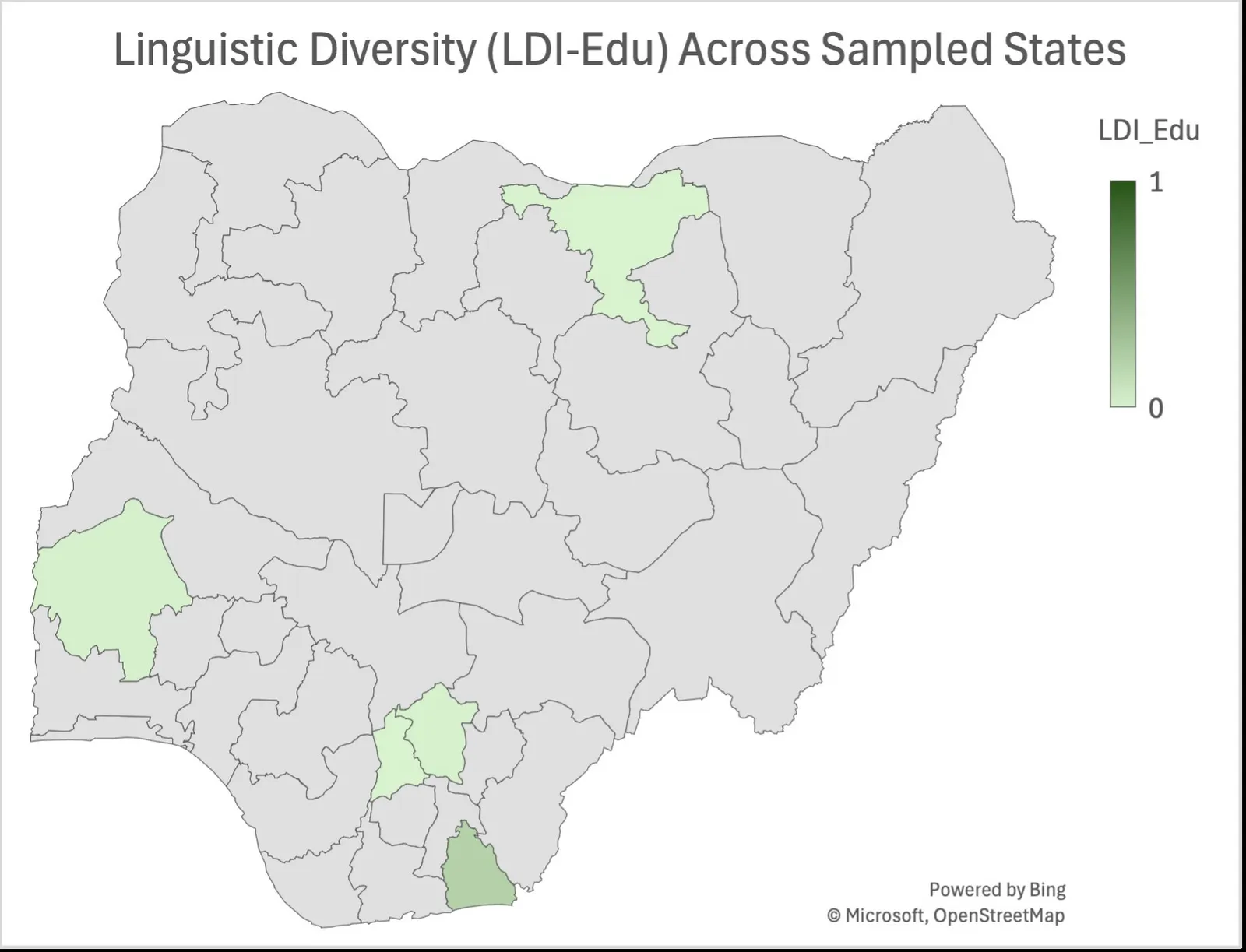
Applied to the five Nigerian states, the index produced an instructive picture, as shown in Figure 1 below. Four of the five states appeared largely linguistically homogeneous, with more than 80 percent of learners sharing the same home language - conditions that make mother-tongue instruction both feasible and cost-efficient. One state, Akwa Ibom, displayed a more complex linguistic profile, with multiple languages represented across schools and no single language prevailing. This contrast illustrates why exercises like this are essential: They generate contextual evidence that can inform policy decisions at the right scale. While Nigeria is among the most linguistically diverse countries in the world, mapping at the subnational level reveals pockets of homogeneity where local-language instruction is realistic, and others where multilingual strategies may be more appropriate.
Such differentiation matters. Where linguistic concentration is high, the path toward mother-tongue education is clearer and more cost-effective; where diversity is dense, more adaptive bilingual or bridging models may be necessary. By turning linguistic realities into measurable data, the LDI-Edu offers a way to move beyond broad generalizations about “multilingual Nigeria” and toward evidence-based language planning within Nigeria’s own system.
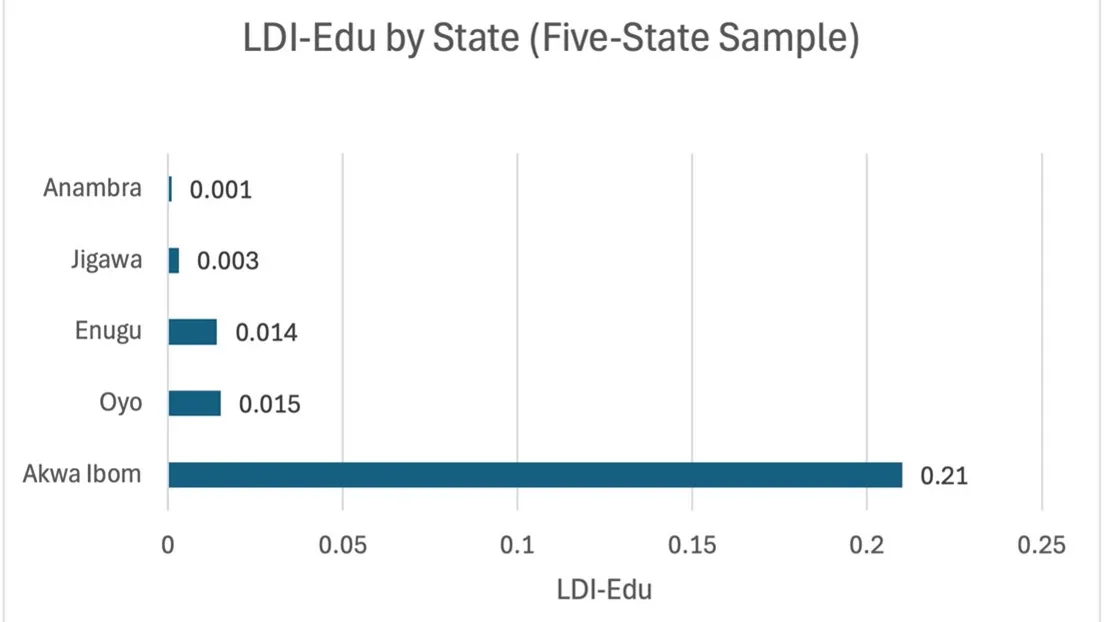
Figure 1: LDI-Edu scores by state. Values are shown on a truncated 0–0.25 scale to improve visual differentiation, as observed LDI-Edu values cluster at the lower end of the index. Higher values indicate greater linguistic diversity and weaker dominance by a single home language. Four states exhibit very low levels of linguistic diversity, while Akwa Ibom is notably higher.
Rethinking Policy Through Data
If language is the medium through which all learning occurs, then understanding the languages children bring to school should be as fundamental to education planning as knowing how many teachers or classrooms exist. With clear information on where linguistic diversity begins and ends, countries like Nigeria could design language-of-instruction policies that reflect reality rather than assumption. Homogeneous areas could invest in sustained mother-tongue instruction, while linguistically mixed areas could pilot bilingual or transitional models tailored to local patterns. Such differentiation would allow policy to become responsive and adapt to the diversity.
Collecting and analyzing linguistic data should therefore be treated as a policy priority, not an academic exercise. Just as school censuses track enrolment or teacher deployment, education systems should map the linguistic composition of classrooms at regular intervals. Doing so would illuminate not only which languages are spoken where, but how they overlap, shift, and coexist over time - laying the groundwork for more equitable planning in teacher recruitment, materials development, and curriculum design.
The implications extend far beyond Nigeria. Every multilingual system carries its own linguistic geography, whether shaped by a few dominant languages or by hundreds of smaller ones. Mapping that geography is not about ranking or redrawing hierarchies, but about recognizing where comprehension begins. When policymakers can visualize the linguistic contours of their classrooms, they can design curriculum that meets learners where they are.
This is the deeper promise of data in education: not only to measure what exists, but to reveal what has been unheard. For too long, the language-of-instruction debate has been framed in the grammar of policy - what to teach, when to transition, which language to privilege. The first step toward a more equitable future is deceptively simple: to ask, systematically and at scale, what languages children speak at home - and to listen to what the answers reveal.
The Salzburg Global Center for Education Transformation offers writing residencies at our inspiring home of Schloss Leopoldskron to thought leaders and educationalists working to advance the agenda of education transformation.
We invite partners who are interested in supporting these writing residencies to email Dominic Regester, director of the Center for Education Transformation at Salzburg Global.
Support Our Writing Residencies
The author acknowledges financial support from the Partnership for Economic Policy (PEP) and the Global Education Analytics Institute (GEAI), through funding provided by the Yidan Foundation.