
-
Topics
TopicsOur programs create spaces where open-minded leaders can gather for breakthrough conversations on pressing global issues – each aligned to one of the following pillars:Get Involved
-
Events
EventsExplore the variety of events Salzburg Global hosts within Austria and in the rest of the world. Learn more about our programs and what else happens at Schloss Leopoldskron.Upcoming EventsOct 19 - Oct 22, 2026Peace & JusticeThe Collective Action Problem: How Should Democratic Societies Respond to Increasing State Violence without Exacerbating Polarization and Political Violence?Violent Threats to Democratic SystemsOct 21 - Oct 25, 2026Peace & JusticeDemocracy Across the Frontlines: How Can Democracy Movements Collaborate To Build Resilience Across Borders?Democracy Resilience Forum
- Insights
-
Fellowship
FellowshipSince 1947, more than 40,000 people from over 170 countries have participated in Salzburg Global's sessions. Collectively, these alumni are known as Salzburg Global Fellows.
-
About Us
About UsSalzburg Global is an independent, non-profit organization committed to creating spaces that overcome barriers and open up a world of better possibilities.Our Approach
-
Support Us
Support UsYour generosity helps us gather open-minded leaders for breakthrough conversations, while creating space for dialogue that overcomes barriers and opens up a world of better possibilities.
- Donate

Culture
Report
Our Key Insights: Creating Futures: Rethinking Cultural Institutions, Infrastructure, and Investment
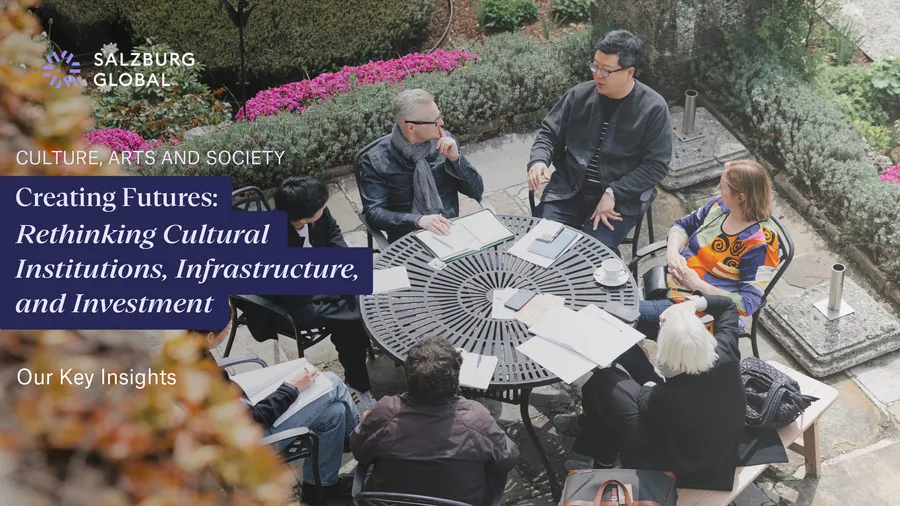
Over the course of a week at Salzburg Global, around 45 institutional leaders, cultural funders, policymakers, and creative-economy actors from over 25 countries collectively grappled with a fundamental question: What does cultural infrastructure that is sustainable, sovereign, and equitable actually look like?
The Culture, Arts and Society session “Creating Futures: Rethinking Cultural Institutions, Infrastructure, and Investment” moved from diagnosis to visioning to prototyping: Opening discussions identified the structural problems the field has stopped naming out loud, mid-week thought experiments and workshops stress-tested alternative futures, and the closing days produced concrete tools and outputs designed to be adapted, tested, and scaled in global and local contexts.
The resulting digital publication showcases a variety of resources from the session. It includes insights shared by Fellows, several ideas for the future, and a reflection on three years of the “Creating Futures” program series.
Of the many ideas shared by Fellows, the following four insights emerged as key threads tying together conversations throughout the session.
Our Key Insights
1. Culture is civic infrastructure, not a sector to defend
Fellows consistently urged for a shift away from a narrow view of “culture-as-sector” toward a more comprehensive view of “culture-as-infrastructure.” Instead of justifying the value of culture to ministries, funders, and markets in purely economic terms, culture should be recognized for its foundational role in civic life on a similar level to transport, education, environment, or public health. This is a strategic shift, not merely a rhetorical one. If culture is infrastructure, it is no longer a discretionary line item; it is a precondition for cohesive, resilient societies that the rest of policy agendas depend on. The idea that “art is not a sector, it’s embedded across sectors”, was translated by a working group into a proposed Cultural Intelligence Platform: a tool to map cultural assets, track value beyond economic indicators, and make culture legible to policymakers and planners as infrastructure rather than as charity.
What’s Needed:
- Re-pitching and repositioning culture in, and as, integral to cross-sectoral conversations: trade, urban planning, health, education, climate… not just inside cultural ministry budget cycles.
- Treating “intangible” assets (imagination, ritual, empathy, connection, intergenerational knowledge) as core and fundamental infrastructure, not just “soft” add-ons or nice-to-haves.
- Building shared measurement: the Cultural Intelligence Platform proposal exists precisely because policymakers cannot fund what they cannot see or measure.
2. Sustainable funding means building the ecosystem, not just moving capital
Fellows shifted the conversation surrounding funding from “how do we get more money” to “how do we change the conditions under which money flows.” Three threads converged here. Cultural Sovereignty: whoever funds you defines you. When external capital sets an agenda, it influences identity and direction. Resource-Mobilization Literacy: the field lacks a shared vocabulary for discussing funding, which keeps practitioners trapped in a donor-grantee logic that limits ambition and leverage. Ecosystem capacity: data, coalitions, and investable enterprises cannot be called upon once funders arrive. Building this form of infrastructure should be a constant and continuous priority in order to be able to utilize new funding as efficiently as possible. One working group codified this into a three-pillar methodology: making the case, building coalitions, and mobilizing capital. The insights were applied first to Tunisia and Malta as test contexts, and explicitly framed as iterative rather than sequential.
What’s Needed:
- Moving from grant-tinkering to systemic decentralization by handing decisions and funds to regional, artist-led partnerships.
- A market-side example was raised of a creator-marketing platform that has demonstrated fair -pay, and fair -algorithmic infrastructure on the for-profit side: 24-hour creator payments, minimum pricing to prevent under-bidding, and dozens of objective ranking criteria designed to correct demographic bias.
- A tool, such as the ecosystem-building matrix produced by one of the working groups at this gathering, which will be adapted locally to map case-making, coalitions, and investable enterprises in unique contexts.
- Coordinating across ministries so culture is budgeted alongside trade, finance, and reconstruction, and sharpened by voices from post-conflict, post-revolution, and high-emigration contexts.
3. Governance is not neutral: Power must be made visible, and actively redistributed
Across the week, governance was reframed not as structural, but rather as relational and political. Who holds power, when, and at whose cost? Fellows articulated that power must move: “it’s not a static state… at different times, different groups must hold the power.” But power that moves also requires someone willing to release it. It is emotional work as much as procedural, and discussions displayed it as the genuine sticking point within many institutions. Fellows reflected on feeling powerless at times in their work. Two instruments emerged from the working groups: a Hidden Agenda game that surfaces the competing accountabilities sitting silently around any board table, and Groundwork Griot, a trust diagnostic that scores institutions differently depending on which community is answering by design. Both are conversation-forcing instruments, built on the wager that you cannot design guaranteed honesty into a structure, but design tools that make it costly to avoid.
What’s Needed:
- Identifying and supporting trust before designing the process. It’s crucial to see that an institution's trust is not a single score but multiple factors, depending on which community is answering. Trust assessment becomes a precondition for governance reform, not its by-product.
- Addressing varying accountabilities, not suppressing them. Every board sits on competing loyalties, such as staff protection, donor comfort, artist visibility, government caution, or legal caution. Good governance design is not about removing these tensions but about making them visible before decisions are taken.
- Bring missing voices into the room before bold decisions, not after. Ideas and projects often end up with less impact than anticipated, because the communities they affected weren't represented at the decision point. The implication is structural: representation precedes ambition.
- Treating internal critique as part of governance, not a threat to it. The discussions surfaced two adjacent silencing dynamics: sectoral "go along to get along" solidarity, and self-censorship by leaders trying to keep institutions afloat. Both are real and unsolved, and both undermine governance honesty. Cultures of speech inside institutions are the cultural complement to the design decisions above.
4. Invisible labor must be named, valued, and protected
The question of “whose labor counts?” is central. Fellows raised a major gap that needs to be addressed: markets do not see, measure, or reward cultural labor, and the people who hold the field together are systematically disposable. Invisible labor here refers to the unpaid, informal scaffolding that holds the cultural field together: the producers, connectors, mentors, intermediaries, and translators whose work is expected as a personal commitment to the field rather than recognized as a profession.
The cost is not evenly distributed. This labor is disproportionately performed by women, racialized workers, those from the Global South, and early-career professionals; the people who lack the salaried base from which “personal commitment” becomes possible. And because the work is relational rather than transactional, markets struggle to see, measure, or reward it. The people who hold the field together remain systematically disposable, even as they become more essential. The shift Fellows proposed is structural rather than aspirational. Move this work from invisible to named, because, as one Fellow put it, you cannot defend what has no name. Labor needs to shift from informal to contracted, and from individual sacrifice to structurally protected.
What’s Needed:
- Naming the value chain: The professions that hold the field together are under-researched and unnamed; without a clear perspective, there is no advocacy.
- Building practical infrastructure, not declarations: Fee calculators, IP toolkits, fair-pay benchmarks, and contract templates should be distributed multilingually and embedded in existing cultural networks.
- Financially supporting cultural workers to attend trainings, conferences, and convenings. The rooms where the field shapes its own future cannot be reserved for those whose salaries already cover the travel. Funded participation is a precondition for representative decision-making, not a perk.
What Comes Next
A distinguishing feature of this Salzburg Global session was that it did not stop at principle. By the end of the week, every working group had a prototype on the table, not finished products, but instruments that Fellows will continue to adapt, test, and scale in local contexts.
- Cultural Intelligence Platform: making cultural assets legible as civic infrastructure.
- Ecosystem-Building Matrix: case-making, coalition-building, and capital mobilization, applied first in Tunisia and Malta as test contexts.
- Groundwork Griot: a multi-stakeholder trust diagnostic in survey and card-deck formats.
- Hidden Agenda: a board game that exposes the competing accountabilities inside cultural governance.
- Fair Culture campaign: a multilingual movement frame with practical tools for fair pay, contracts, and IP.
The session’s closing framing was deliberate: participants left as Salzburg Global Fellows, with a shared commitment to take this work into their own institutions, networks, and policy environments. The session’s most important sentiment, in the end, is one of the simplest:
“These are exactly the times where we need people who dare to hope, dare to dream, dare to think differently, and connect across differences.”
Digital Publication
We invite you to explore more resources from “Creating Futures: Rethinking Cultural Institutions, Infrastructure, and Investment.”
The Culture, Arts and Society series harnesses the transformative power of the arts to shape a better world. Through future-focused programs and projects, it raises the profile of culture and the arts in policy agendas, catalyzes exchange across disciplines and sectors, and sustains a unique creative community across continents.
