

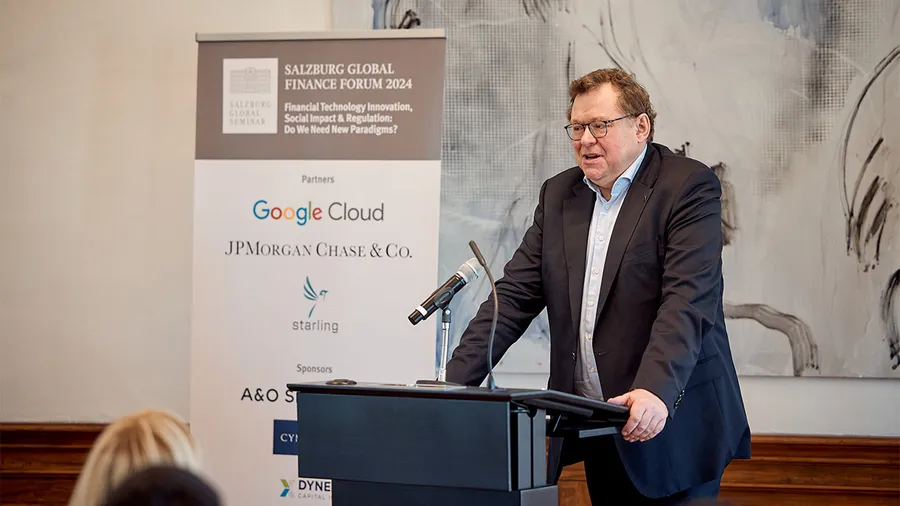
Jean-Paul Servais, chair of IOSCO and FSMA, explains how financial regulators are keeping up with fintech innovations
Jean-Paul Servais is the chairman of the board of the International Organization of Securities Commissions (IOSCO) and additionally chairs the IOSCO European Regional Committee. Concurrently, he serves as the chairman of the Belgian Financial Services and Markets Authority (FSMA).
Audrey Plimpton, Salzburg Global Communications Associate: How would you explain "emerging financial technologies" and financial technology (fintech) innovation to someone unfamiliar with the concepts?
Jean-Paul Servais, Chair of IOSCO and FSMA: There is no unique understanding of what constitutes an emerging financial technology. The definition of fintech provided by the Financial Stability Board provides a good anchor: “technologically enabled innovation in financial services that could result in new business models, applications, processes or products with an associated material effect on financial markets and institutions and the provision of financial services”.
It means that many recent developments in the financial sector can fall under the fintech umbrella and that there is no monopoly on who can provide fintech services; players in the fintech area can be small start-ups, BigTech companies, or incumbent financial institutions.
A good example of fintech development in the securities sector is the ability that retail investors now have to buy or sell financial instruments via their smartphone, at the swipe of a finger. Some people might be surprised by the fact that such a service, which seems only natural in our society right now, would be considered a fintech development. This example illustrates that what we consider as fintech is most of the time part of a natural evolution in the provision of financial services, linked to the technological developments that we experience in our daily lives and society as a whole. We have not encountered so far the truly disruptive revolution that some commentators have described as the main characteristic of fintech.
AP: How do new forms of financial, monetary, and technology-driven innovation affect the approach to financial regulatory and supervisory systems?
JPS: Fintech developments have been under the radar of financial supervisors for the last ten years. At a national level, most supervisors have developed various types of innovation hubs, to stay in touch with developments happening in their respective jurisdiction. At the EU level, the European Supervisory Authorities have set up standing committees and task forces which are dedicated to evolutions in digital finance.
Within IOSCO, we launched several networks two years ago, including the FinTech Network and ICO Network, which have now morphed into a board-level Fintech Task Force. This FinTech Task Force has focused its initial work on crypto markets, which were considered a priority given the risks that had materialized during the so-called “crypto winter” that began in the autumn of 2022. This has led to the publication of two sets of recommendations addressing crypto and digital assets, and decentralized finance. IOSCO will maintain momentum on the crypto-assets front by monitoring and promoting timely and effective implementation of the crypto-asset recommendations across IOSCO’s membership. In this respect, IOSCO continues to develop its capacity-building program to support members in making their jurisdictional choices as to how to respond to these important global developments, liaising with other global bodies where this is helpful.
While the work has now begun on the implementation of those recommendations by individual jurisdictions, the FinTech Task Force has already started its work on two new workstreams: tokenization and artificial intelligence.
It is part of the mandate of both regulators and supervisors to analyze developments in the sectors under their remit, to make an assessment of the risks and benefits of new products, services, or business models, and to take appropriate measures if needed based on this assessment.
IOSCO’s Objectives and Principles of Securities Regulations provide more clarity on this; principle seven refers specifically to this expectation and has recently been reviewed with the results due to be published in the coming period.
Supervisors not only observe how new technologies are deployed in the markets that fall under their remit, but they also make use of the same technologies in their daily supervision, through what is known as “SupTech” tools. For instance, artificial intelligence is being implemented for the detection of market abuse, natural language processing helps to better extract the information that is contained in financial reporting, and webscraping techniques are used in order to detect potential fraudulent provision of financial services.
As would be expected, not all financial supervisors are at the same level of implementation of those new tools and techniques, in part because the level of development of new technologies is not uniform throughout the world. This is where IOSCO can make a difference by providing its members with many knowledge-sharing opportunities where best practices are exposed and can be adopted by the other regulators.
Jean-Paul Servais served as the co-chair of the Salzburg Global Finance Forum on "Financial Technology Innovation, Social Impact & Regulation: Do We Need New Paradigms?".
