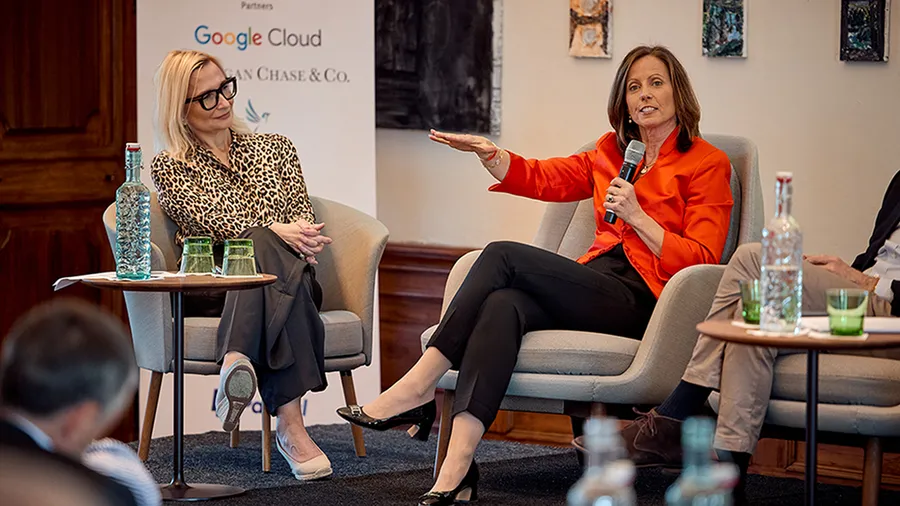
Salzburg Global Fellow Adena Friedman, Chair and CEO of Nasdaq, on Financial Technology, Regulation, and Inclusion
Adena Friedman is CEO of Nasdaq and is Chair of the Board of Directors. She brings more than 20 years of industry leadership and expertise and is credited with driving Nasdaq’s transformation into a leading global exchange and technology solutions company serving the financial industry. Adena has served as a Class B director to the Federal Reserve Bank of New York since December 2018. In January 2024, Adena was elected to the Business Roundtable (BRT) Board of Directors and currently serves as the Chair of the BRT's Technology Committee. She was elected to the Board of Directors of FCLTGlobal in January 2020. Adena earned an M.B.A. from Owen Graduate School of Management, Vanderbilt University and holds a B.A. in political science from Williams College.
Audrey Plimpton, Salzburg Global Communications Associate: How can we understand "emerging financial technologies"? Could you explain financial technology innovation to someone who is unfamiliar with the concept?
Adena Friedman, Chair and CEO of Nasdaq: Emerging financial technologies are innovative solutions, leveraging the latest commercial technology available at the beginning of their adoption curve, that reduce friction and make the financial industry more efficient and effective in serving global consumers and investors. Financial technology innovation is all around us – including the digital transformation of the markets, the development of new technology to process global payments faster and more efficiently, and the use of software to make compliance with regulation easier. There also continues to be promise from blockchain technology to reduce friction and facilitate global payments.
The potential of AI continues to be pervasive across the financial industry, from being leveraged to enable more effective strategies for rooting out criminals in the financial system, to predicting market moves and facilitating smarter investment decisions, to driving more financial inclusion. These technologies represent promising growth areas for the industry, that will improve productivity, and will power the future backbone of our financial system.
AP: What measures can be taken to ensure that financial innovation leads to broad-based prosperity and financial inclusion rather than increasing economic disparities?
AF: Supporting and empowering responsible leadership can help enable broad-based prosperity and inclusion generated from financial innovation. If embraced responsibly, new technology can quickly advance the financial well-being of society – improving access, reducing cost, and minimizing friction across the financial system, but its development needs to be closely monitored by responsible leaders to ensure gains are realized equitably. It is essential we protect the integrity and security of the financial system and maintain trust across all its core stakeholders. Leaders - from CEOs to regulators to policymakers to community leaders - will benefit from an embrace of financial innovation if they are mindful that new rules and regulations may be appropriate as the technologies are adopted. Navigating this important balance is core to the debate about the future of these innovations – including development of new payment rails as well as the use of AI – and will be critical to our collective growth.
AP: In your opinion, what is the right balance of regulation and innovation needed in the financial system for emerging technologies?
AF: The right balance of regulation and innovation can be struck through an inclusive rule-making process and agreement that regulation benefits from being tailored to the specific risks and opportunities of a new technology. Key to this process is taking an evidence-based approach: proposed changes benefit from being underpinned by data and will help avoid changes that create unnecessary complexity. Further, a productive regulatory approach benefits from robust engagement and collaboration with many stakeholders across the financial community and ensures a full understanding of the potential impact new regulation may have on our society. The most effective regulatory approach is an iterative one. It is critical that regulators remain adaptive as the technology itself develops and as the use of the technology evolves. Therefore, smaller, purpose-driven regulatory steps that can be tested and adjusted will be most effective. What will emerge from this kind of engagement is regulation that is well-tailored and inclusive of the opinions of all stakeholders that will be affected.
AP: What have you gained from the Salzburg Global Finance Forum? How can global forums like these contribute to enhancing international cooperation and the development of more effective regulatory frameworks?
AF: Through the Salzburg Global Finance Forum I’ve gained critical insights, fostered new relationships, and exchanged ideas with some of the world’s top finance leaders. It is a unique forum that brings together a diverse set of perspectives, including from regulators, policymakers, and private-sector leaders, and further deepened my understanding of dynamics currently affecting the global financial markets. Forums like Salzburg Global are critical to driving more effective international understanding and cooperation.
Adena Friedman attended the Salzburg Global Finance Forum on "Financial Technology Innovation, Social Impact & Regulation: Do We Need New Paradigms?" in June 2024.