

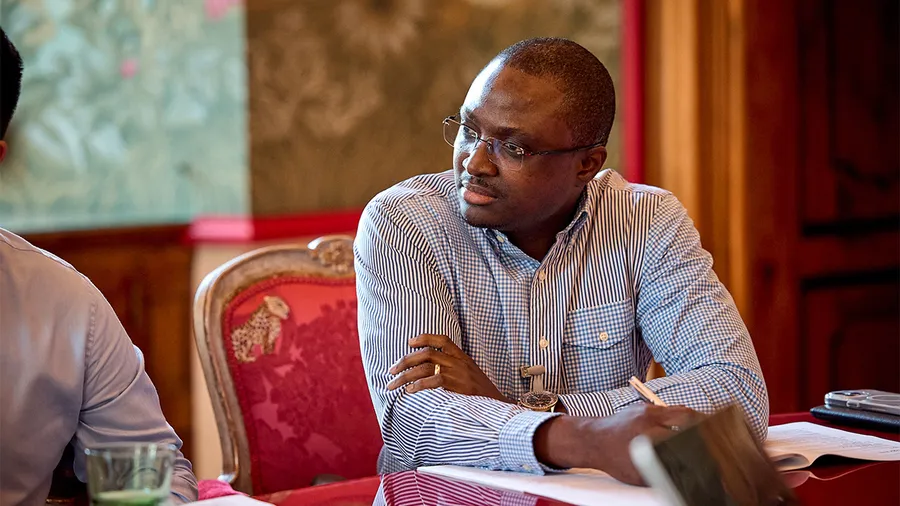
Salzburg Global Fellow Kwame Oppong on balancing progress and regulation in the financial technology landscape of African countries
Kwame Oppong serves as the head of fintech and innovation at the Bank of Ghana. His responsibilities include overseeing the licensing and supervision of the mobile money ecosystem and payment service providers. He also regulates fintech activities and leads the country’s exploration of Central Bank Digital Currency (CBDC) initiatives.
Stephanie Nicole Jura, Salzburg Global Communications Intern: How can regulators, especially in African countries, strike a balance between the need to protect consumers and preserve financial stability and the need to promote innovation in financial technology (fintech)?
Kwame Oppong, Head of Fintech and Innovation, Bank of Ghana: It is the only function within the bank's supervisory structures that both supervises and promotes fintech innovation. It is a policy view that, just like anything else that has been innovative, it has its drawbacks. But overall, when you examine the potential of fintech space, it has a net positive impact. There is sound judgment in aiming to promote it while putting safe guardrails around it. It is not an easy balance to strike, but neither is the reality of supervising the traditional financial sector. It challenges the regulatory institutions to have more capacity in certain areas in terms of human capacity, expertise, and tools. If you take a step back and adopt a risk-based mindset, you realize that some of these principles that have been time-tested remain relevant and can be applied in the supervision and management of the fintech space in a way that requires regulators and supervisors to think differently about how to achieve some of these key goals.
SNJ: What are the main policy goals that should direct the creation of fintech frameworks, and how can those frameworks be crafted to foster innovation and social impact simultaneously?
KO: Look at it from the perspective of innovation having a net positive impact, like an investment. It has benefits in employment and inclusion. Like any other innovation, how do you leverage the good sides and mitigate the risk associated with its drawbacks? The other dimension of balancing innovation with social impact is about how you use the policy framework to encourage it. Because this is the first time, regulators and supervisors are going to have to be more active in interacting and engaging with the sector than they did before. You need to craft a policy and incentivize the balance of leveraging innovation to drive social impact, whether it is ESG (Environmental, Social, and Governance) goals or core financial inclusion matters. You can achieve that on two levels: one, at the policy framework level, and two, at innovation management level.
SNJ: What new regulatory models or approaches could be explored, especially in Ghana and the wider African context, to effectively manage the benefits and risks connected with fintech advancement?
KO: There is a peer learning opportunity. We are all dealing with the same problems in different shapes and forms. Regulatory collaboration is one approach, and another is a significant reliance on data. This means standardizing data, structuring data better, and building the tools with the capability to analyze data and extract new meaning. Generative artificial intelligence is an important discussion as part of the leveraging data model.
The critical tools now have a focus on Suptech (supervisory technology) and Regtech (regulatory technology) more broadly; Regtech from the perspective of supervised entities leveraging it to be compliant, and Suptech from the perspective of supervisors needing to build or develop the necessary tools to help better supervise the sector.
SNJ: How can fintech programs be designed to ensure the inclusion of marginalized groups?
KO: Fintech programs can be openly deliberate about that through incentives, and it does not have to be financial incentives. As a regulatory body, you can call for innovation papers, or a sandbox opening. We did something similar to hackathons. […] We made it clear that we were looking for innovations that target an exclusion area, like credit delivery. Secondly, we ran our own CBDC (central bank digital currency), and did an offline version focusing on merchant payments, because MSMEs [Micro, Small, and Medium Enterprises] are a big component of our economy and the majority are owned by women. Another more active way that we addressed some of these issues is through guidelines we put in place for mobile money.
SNJ: What strategies can regulators in African countries adopt to promote healthy competition in the fintech industry and ensure the playing field is even for new entrants?
KO: It is becoming a problem, especially with the success of the early innovators creating unfortunate monopolies in some markets. It is a very delicate matter because the unspoken truth is that competition has changed. In Ghana's case, at some point, one player was a leading provider with significant market share but was consistently on its toes because of the one challenge coming with a much smaller market share, but was aggressively putting out products that required the market leader to respond. Competition and market structure may not necessarily always have a linear correlation.
It is necessary to keep track of the market structure itself and the dynamics and intervene in a policy standpoint through one statutory body. We have a payment system advisory committee that includes banks and fintechs. We table open issues like this and discuss them particularly in markets that do not have competition authorities. […] Secondly, we ensure that the key principles of fair market practice and competition are embedded in the whole regulatory framework, to prevent it from happening. Post-intervention, once we already have a market structure as we do, [we] leverage key statutory bodies to intervene with policy measures to ensure a balanced playing field.
SNJ: How can global forums like Salzburg Global contribute to enhancing international cooperation and the development of more effective regulatory frameworks?
KO: There is a real growing trend around the world, and we are seeing two things: the commonality between the broader markets and the misalignment between the developed and emerging world. Given the interconnectedness of the global economy, it is important that we identify some of these threats very quickly and begin to appreciate their implications as early as possible. These are some of the dynamics that I think we have to look at and forums like Salzburg Global are important to bring all the different voices [together] to figure out how we can manage it better.
Kwame Oppong attended the Salzburg Global Finance Forum on "Financial Technology Innovation, Social Impact & Regulation: Do We Need New Paradigms?" in June 2024.
