

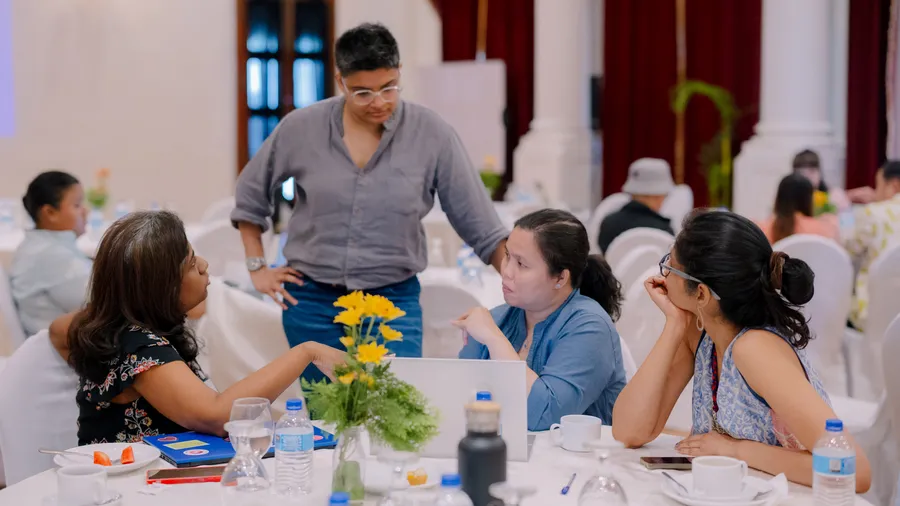
Salzburg Global Fellows met in Colombo, Sri Lanka to accelerate six peacebuilding initiatives across Asia
Salzburg Global successfully hosted a Project Acceleration Workshop for the Asia Peace Innovators Forum in Colombo, Sri Lanka. From February 10 to 14, 2025, this dynamic workshop brought together six selected project teams comprising 30 innovative peacebuilders, including lawyers and human rights advocates, civil society activists, academic researchers and educators, media and communications experts, and public sector officials and advisors.
These teams had previously formed during in-person meetings of the Asia Peace Innovators Forum in Salzburg, Austria, in which Fellows self-organized to conceptualize unique peacebuilding project ideas. This Project Acceleration Workshop in Colombo aimed to equip these Fellows with the necessary knowledge, tools, and strategies to enhance the impact of their peacebuilding projects across the region. Salzburg Global established the Asia Peace Innovators Forum in 2020 in partnership with The Nippon Foundation.
Masato Seko, Senior Director of The Nippon Foundation, highlighted that the organization is happy to see peacebuilding work thriving in the Asia region. “We would like to see an active and robust network of passionate and committed people making peace a reality in Asia and beyond,” he added.
The Asia Peace Innovators Forum is dedicated to promoting peace and reconciliation across Asia. It provides capacity-building opportunities and a dynamic platform for promising mid-career professionals to collaborate on regional peace initiatives. Through cross-sector engagement, the program fosters knowledge exchange, strengthens networks, and supports community-driven approaches. The program enhances peer learning and innovation through practical workshops, online sessions, and in-person engagements, empowering a new generation of peace leaders.
The Project Acceleration Workshop was an immersive experience, fostering collaboration and innovation on working group projects. Throughout the workshop, participants engaged in multiple sessions focused on developing concrete roadmaps, refining execution plans, validating project objectives, and designing outreach strategies to engage potential partners and stakeholders.
Dr. Charles Ehrlich, director of Peace and Justice programs at Salzburg Global, emphasized the importance of bringing the project teams to Colombo: “This workshop provided them with an essential space to evaluate their projects’ merit and learn how to engage potential partners for successful implementation.”
Fostering Peer Learning and Mentorship
A key aspect of the workshop was the personalized mentorship provided to each group. Mentors, including Fellows participating in other program cohorts as well as in different Salzburg Global programs, shared their expertise and experiences, offering valuable insights to refine project strategies. This peer-learning approach enabled participants from Australia, Cambodia, Canada, India, Indonesia, Japan, Kenya, Myanmar, Nepal, the Philippines, Spain, Sri Lanka, Thailand, Vietnam, and the United States to exchange knowledge and collaborate on regional peace initiatives.
Salina Kafle, Executive Director of the Human Rights and Justice Centre in Nepal, mentioned that the workshop provided a transformative opportunity to reflect on the direction of peace initiatives and reinforce collective efforts. She described the experience as "an introspective journey that allowed me to critically evaluate existing frameworks while leveraging the collective strengths of lawyers, activists, and political advisers. Through strategic collaboration, our team worked on integrating our expertise to develop a stronger, more actionable pathway toward sustainable peace."
The workshop also placed a strong emphasis on amplifying marginalized voices, a theme that deeply resonated with Kayla Winarsky McKenzie, a business and human rights advisor and Salzburg Global Fellow. Working closely with a team focused on the rights of Indigenous coastal women in Indonesia, she emphasized that "this workshop has been such an important opportunity to center the voices of the people affected by business activities. Understanding the impact on these communities is crucial, and I've been so impressed by how each project team is ensuring that human rights are respected in their work."
Expanding Skills and Practical Applications
Another core feature of the workshop was the enhancement of practical skills in peacebuilding and nonviolent communication. Participants engaged in interactive sessions that bridged theory and practice, allowing them to explore real-world applications. Worrawan Jirathanapiwat, Managing Director of FN Educon Co., Ltd., Thailand, found the hands-on approach particularly valuable. She noted, "This acceleration workshop has enhanced my skills and knowledge related to peace and how to use our knowledge in peacebuilding to resolve problems in our communities. The opportunity to learn from expert mentors and peers has significantly enriched my understanding of nonviolent communication."
Mentorship played a pivotal role in guiding project teams through strategic decision making and long-term planning. As a returning Fellow from the program’s first cohort, Rina Alluri, Assistant Professor and UNESCO Chairholder of Peace Studies at the University of Innsbruck, Austria, highlighted the importance of balancing pragmatic approaches with ethical responsibilities. She commented, "It’s a wonderful opportunity to be here with a new cohort of Fellows, witnessing how they are developing their projects, coming together as a team, and reflecting on their role in future peacebuilding. I have had the chance to work closely with one particular group and encourage them to think pragmatically but also with care about how they want to continue their work while also opening up new opportunities for research, practice, and advocacy."
Six Groundbreaking Peacebuilding Initiatives
Defending the Rights of Indigenous Women
This initiative empowers Indigenous women in Rampang, Indonesia, who face human rights violations and encroachments on ancestral land due to arbitrary development initiatives. The project fosters leadership, economic independence, and advocacy capacity for marginalized women while ensuring Indigenous voices are heard in development planning.
Rina Shahrullah, a senior lecturer at Universitas International Batam, emphasized: “This project strengthens Indigenous women’s ability to defend their rights and preserve their native land.” Fellow team member Nukila Evanty added: “Many Indigenous women fear displacement and uncertainty about their future. This initiative is a timely intervention to safeguard their rights.”
We Are Not Just Numbers
This project amplifies the voices of women in conflict zones, emphasizing feminist peacebuilding in India, Kenya, Myanmar, the Philippines, South Africa, South Korea, and Sri Lanka. The project treats women’s participation as integral to peacebuilding, and not just as statistical markers.
Lynette Grace Tagalo from the Philippines stated: “For too long, women in conflict have been reduced to numbers—casualties, refugees, and statistics. But each has a story that must be told.” Sri Lankan team member Thilina Madiwala added: “This initiative creates a safe digital space for women to share their experiences beyond national boundaries.”
South-to-South Knowledge Mobilization Through Peace Books
This project empowers young adults between the ages of 18 and 35 years old in conflict-affected regions through peace books—arts-based tools for storytelling, healing, and peacebuilding. It is being piloted in Sri Lanka to document experiences, perspectives, and aspirations for peace through visual and creative expression.
Staci B. Martin, an assistant professor at Portland State University, USA, explained: “Our research explores how knowledge mobilization supports young peacebuilders’ mental health through a multi-country, mixed-methods approach.” Oshan Gunathilake from Sri Lanka highlighted: “This initiative has the potential to evolve into a global youth-led peacebuilding movement through creativity and collaboration.”
Access to Justice (A2J) Youth for Myanmar
Following the 2021 military coup, Myanmar’s youth continue to face systemic repression, harassment, and human rights violations. This project raises awareness of legal rights, provides legal aid, and fosters dialogue through digital and grassroots platforms.
Mohammed Jamalul Giducos from the Philippines underscored the urgency: “Since the coup, thousands of young activists have been arrested, facing unfair trials and inhumane detention.” Legal professional Kyaw Min San from Myanmar emphasized: “Legal aid is essential—it prevents torture, arbitrary detention, and even the death penalty. It’s not just about law; it’s about justice.”
Bridging Indigenous Norms – The BINHI Initiative
This initiative preserves and promotes Indigenous peoples' agricultural practices, recognizing their vital role in climate adaptation and food security.
Jerome Bactol from the Philippines stated: “For centuries, Indigenous farmers have nurtured the land with knowledge passed down through generations. Today, these practices are at risk of disappearing.” Robert Budianto from Indonesia added: “Our project bridges indigenous wisdom with modern agricultural practices, fostering resilience against climate change.”
Promoting Harmony and Safe Migration Between Myanmar Migrants and Thai Hosts
This initiative aims to reduce tensions and mitigate the negative impacts of migration along the Thai-Myanmar border by addressing critical issues such as human trafficking, promoting safe migration, and fostering interfaith and social harmony. By engaging both Myanmar migrants and Thai host communities, the project employs a comprehensive strategy focused on community-driven solutions.
Looking Ahead
The Project Acceleration Workshop in Colombo reaffirmed Salzburg Global’s commitment to fostering regional collaboration and empowering peacebuilders with the skills and networks necessary to drive meaningful change. Fellows left the workshop with strengthened strategies, refined objectives, and valuable connections that will support them in advancing their peace initiatives. By integrating mentorship, community-driven approaches, and interdisciplinary perspectives, the accelerator workshop plays a vital role in shaping the future of peacebuilding in Asia and beyond.
Read about more projects developed through the Asia Peace Innovators Forum. We invite peacebuilding organizations, donors, and supporters to engage with these transformative projects and explore opportunities for collaboration. For further inquiries and partnership opportunities, please email Charles Ehrlich at cehrlich@salzburgglobal.org.
