

Two Salzburg Global Fellows are using everyday experiences to foster understanding and reconciliation across divides
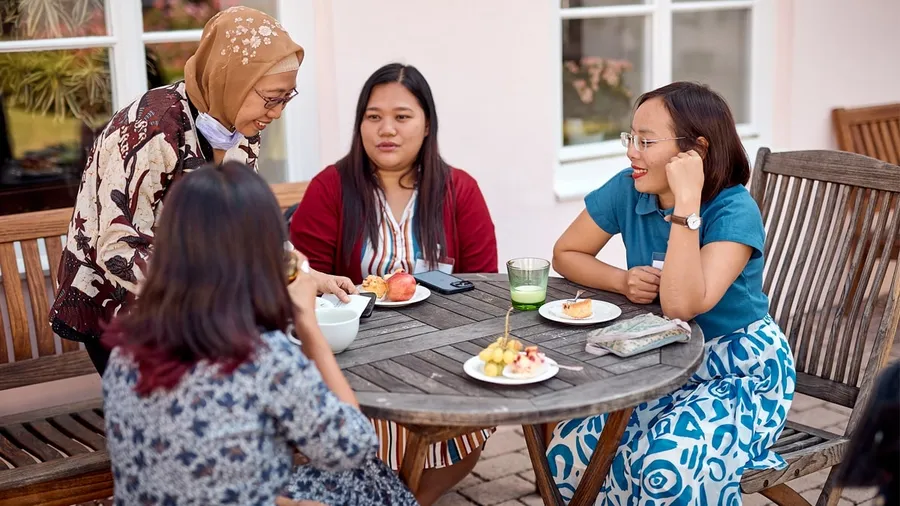
In times of conflict, where can we find common ground? For Salzburg Global Fellows Dr. Elaine Pratley and Denise Rafaeli Cadorniga, the answer lies in everyday experiences – sharing meals and creating art. At the Asia Peace Innovators Forum, they shared their experiences of encouraging human connection and bringing diverse communities together through art and food.
Dr. Elaine Pratley is the founder of Peace Inc. and Peace Kitchen in Australia. Through these local initiatives, she facilitates meaningful conversations over meals to promote mutual understanding and empathy-raising across differences. She explained, “I use food as a topic sometimes, but I use [it] also as a dialogical approach so that people understand that they have a common humanity.”
While Elaine uses food, Denise Rafaeli Cadorniga, an artist and creative director from the Philippines, uses art to encourage human connection. Denise believes that art and culture is an important part of peacebuilding because it is “the storytelling of advocacy.” She shared that “art is sort of the soul that makes everything come together.”
Strengthening Human Connection
For both Elaine and Denise, human connection is strengthened through open communication between people from diverse backgrounds. Their work extends across communities to foster thought-provoking and meaningful conversations.
”Lately, I've been doing a lot of interfaith dialogues between Jewish communities, Christian theologians, and migrant groups. Through food, I ask them ‘what are the ways that your food customs create conflict and exclusion?’ And how might we tweak them so that it doesn't lose its essence but better encourages connection?” Elaine believes that although people may come from different backgrounds, they all share the same desire to belong and connect to a community.
Denise’s experience resonates with Elaine’s, as she has worked with various humanitarian organizations to ensure that their programs are successfully delivered through effective communications using art. She emphasizes the emotional aspect, which plays a pivotal role in how humans perceive art. “Human psyche, culture, and nature are connected. Art is sort of like a tool to help each and every [person] integrate their emotions before they amplify it to the world.”
According to Elaine, building strong connections in peacebuilding requires an empathetic approach that leverages everyday practices and centers human realities and experiences. She also noted how “food practices allow us to communicate nonverbally, tapping into the emotions and the body. We engage with conflict in not just our head and heart, but also in our gut.”
Yet even as their work shows promise, both face obstacles in gaining recognition and support.
Funding Challenges
Nevertheless, these methods of peacebuilding are often overlooked because they are not considered tangible or measurable. Elaine faces various challenges when explaining the importance of cultural peacebuilding to high-level stakeholders. She shared that “telling stories and showing how impact is more than numbers is important. But it is hard when donors and impact investors think in terms of return on investment. And meaningful social change is not always measurable or observable at the end of your intervention.”
These peacebuilding initiatives require more support and funding to sustain them. Elaine highlighted the challenge that “the people who hold power and resources don’t always recognize the value” of cultural peacebuilding. She stressed the need for a paradigm shift towards viewing peacebuilding efforts as an investment in a peaceful society. “It’s not about giving charity, but instead realizing that they will also benefit if these things get done in society broadly.”
As for Denise, a lot of the organizations she has worked with are not yet aware of the advantages of using art as a tool for their peacebuilding advocacy. “A lot of the peacebuilders right now who are working in the program sector, which is really important, don't see the importance of communication - especially artists, designers, and [professions] like that - and how important it is. Because your communication is what they see first.” She further highlighted that to engage people in peacebuilding work, we need to leverage the power of art and design, because visual and emotional aspects can grab a viewer’s attention.
Denise added that only through decolonization and “combining Indigenous knowledge with Western knowledge can we move towards a better future for each and every generation.” However, Elaine has noticed a reluctance to implement Indigenous knowledge. “There are institutional biases, as well as in academia. There is a marginalizing of Indigenous cultural practices, [because] it's not [considered] academic or scholarly enough.”
Making a Lasting Peace Effort
Denise also reiterated that there needs to be a continuous effort in building peace through art and thoughtful design centering on human experiences. “If we really sit closely and talk about things, we could come up with solutions to amplify what we want to say.”
Lasting peace requires more than policies and programs – it needs the everyday participation of communities, cultures, and individuals. By weaving art, food, and human connection into the fabric of peacebuilding, innovators like Elaine and Denise remind us that empathy and shared experience are essential to healing divides. Their work shows that the simple, human act of encouraging human connections can bring us closer together and enable peacebuilding.
Elaine and Denise are both Fellows of the Asia Peace Innovators Forum. They attended the in-person session in Salzburg from May 6 to 11, 2025. The forum brings together mid-career professionals to promote peace and reconciliation through initiatives across the region. Through spaces like this, they were able to connect with other innovators for peace across nations to exchange experience of community-driven approaches and best practices.
