
-
Topics
TopicsOur programs create spaces where open-minded leaders can gather for breakthrough conversations on pressing global issues – each aligned to one of the following pillars:Get Involved
-
Events
EventsExplore the variety of events Salzburg Global hosts within Austria and in the rest of the world. Learn more about our programs and what else happens at Schloss Leopoldskron.
- Insights
-
Fellowship
FellowshipSince 1947, more than 40,000 people from over 170 countries have participated in Salzburg Global's sessions. Collectively, these alumni are known as Salzburg Global Fellows.
-
About Us
About UsSalzburg Global is an independent, non-profit organization committed to creating spaces that overcome barriers and open up a world of better possibilities.Our Approach
-
Support Us
Support UsYour generosity helps us gather open-minded leaders for breakthrough conversations, while creating space for dialogue that overcomes barriers and opens up a world of better possibilities.
- Donate

Health
Feature
Trust as Infrastructure: Community-Led Pathways to Health Information
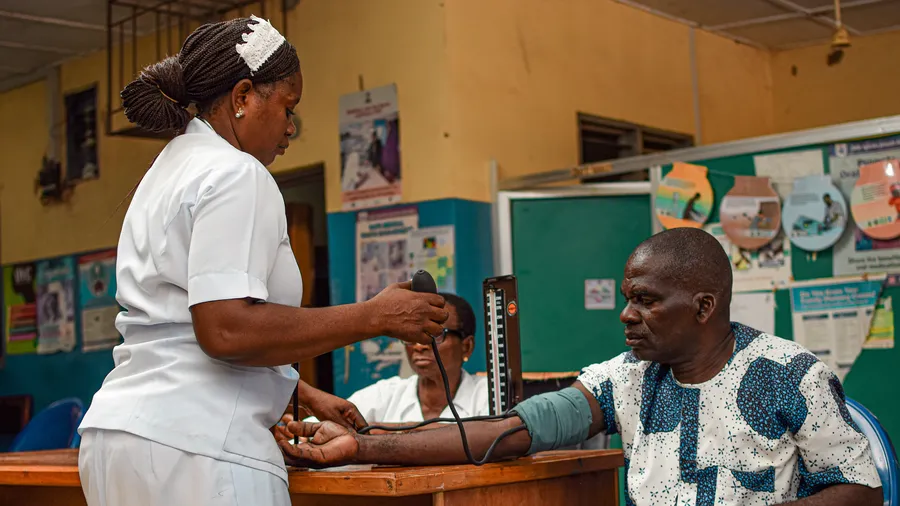
A patient receives consultation in Abuja, Nigeria. Photo Credit: Shutterstock.com/2268837877
Understanding and using health information remains a challenge for many in Nigeria and South Africa, especially where access to health services is limited. Two Salzburg Global Fellows, Phinah Kodisang and Kemisola Agbaoye, share their journeys building trust with marginalized communities to advocate for better access to health care information.
Phinah Kodisang is the CEO and executive board member of the Soul City Institute for Social Justice, an award-winning intersectional feminist organization based in Johannesburg, South Africa. Reflecting on disparities she witnessed in her hometown, she explained, "as a young professional, one of the things I wanted to contribute to was to shift that narrative, to contribute to a world where people who are of the same color as me get the same kind of treatment from healthcare providers."
Kemisola Agbaoye is the Director of Programmes at Nigeria Health Watch with over 10 years of global and public health experience. She began her career as a physician and transitioned into health communications, driven by questions such as:
“How do you make sure that the money that you've put into the health sector actually translates into improved health outcomes?”
Social Listening in Offline and Online Spaces
To advocate for timely public health information, Kemisola works to ensure information is evidence-based, using data generated through social and community listening. As she explained, “The government is looking for data, is using data to make decisions about how they provide health services within the communities... And they are using information in the content to make decisions about their health and their well-being.”
Using AI tools, Kemisola’s team scrapes the web to analyze what people are discussing online on health, turning the results into insights for communication strategies and surveillance. As not all Nigerians are online, she combines this with offline listening by partnering with trusted community members who observe people’s perceptions, thoughts, concerns, and questions around public health issues such as vaccines and outbreak responses. These insights become research data used to inform public health initiatives. "It leverages local actors, and then we have systems in place that allow what we're hearing from people to filter to those that matter,” she said. The data feeds into participatory decision making, policy making, and programming across community organizations and government agencies.
To address health misinformation, Kemisola is building the Health Information Disorder and Infodemic Management Network (HIDIM) under Nigeria Health Watch. “It's diverse because it has media practitioners, it has storytellers in it, it has researchers in it. It has public health practitioners, people in INGOs and international NGOs," she highlighted.
Co-Creating Community Advocacy
Phinah’s work centers on co-creating health initiatives with marginalized communities and stakeholders in South Africa. She reflected on her personal experience setting up a fully staffed one-stop clinic with nurses, psychologists, peer counselors, and social workers. “We had to do a lot of consultative work with the government. And engage with the young people themselves to understand from them, what type of treatment they would want to get,” she recalled. The clinic also offered skills development, including computer literacy, CV drafting, and peer learning, “because we wanted them also to know that even if you have HIV, you can still thrive.”
Through Soul City, Phinah expanded this model by creating space for the LGBTQ+ community to advocate for themselves. “We create platforms where they can engage with policy makers, where we can be in dialogue with service providers about why they are excluding or why the type of service they provide is not the same to different groupings of people,” she said. The organization facilitates community clubs for children, young women, gender minorities, and parents, where life skills and age-appropriate sexual health education are offered. Phinah elaborated, “We just go to schools and say, if you are a young woman who wants to change their community for the better, here's an opportunity... but we want you to be the ones who are driving the change.” These clubs help communities form networks and engage media to highlight the issues they are facing.
One successful campaign challenged the mischaracterization of statutory rape as “teenage pregnancy.” Phinah emphasized, “10-year-olds are giving birth, and it's reported as teenage pregnancy. And we've been loud in saying it cannot be treated as yet another pregnancy, because that's a violation to this 10-year-old. The age of sexual consent in our country is 16.” Through Soul City’s advocacy, she was able to push for a more nuanced understanding of gender-based violence. “Our own president, when he was giving a speech, changed the narrative from ‘we have a crisis of teenage pregnancy in the country’, and he started talking about ‘we have the crisis of statutory rape in the country.’”
Today, Phinah is working to revive a South African soap opera focused on marginalized communities. “We have the TV drama, we have talk shows... We've done radio shows as well, then the social media.” Soul City continues to publish key messages across media platforms to spark engagement and public dialogue.
Building Trust for Community-Driven Health Advocacy
Kemisola noted that the health system often fails to recognize the lived experiences of marginalized communities as valid data, which excludes them and reinforces distrust. “Because when you come and tell them this is a problem... they're like, no, but you can't tell me what my problem is. This is my reality, this is how I'm living. This is how have managed this over the years. And you don't know my story.” These perspectives, she believes, vanish too easily in research and public health conversations.
For Phinah, the key to effective health campaigns is simple: “Go to communities, they know what works best for them.” She underscored the importance of listening to those experiencing the issues. “We don't come into communities with expertise. We go into the communities to harvest the expertise. We take that information, we use our skill sets to package it. And then we take it back to the people and we allow them to use that information that we have packaged whichever way suits them. We are not prescriptive,” she said. This process gives communities agency and strengthens their capacity to co-create solutions with health advocates.
To ensure the sustainability of health campaigns, Phina stressed empowering people from within the communities. “The people who are doing the mobilization [on] health education are people from those communities.” This approach encourages open conversations that challenge assumptions while “bringing outside knowledge...where we can build new knowledge together.”
The experiences of Phinah and Kemisola in their own contexts demonstrate that effective health campaigns require community participation in data collection and in the co-facilitation and co-creation of health initiatives. Their work highlights the essential blend of science and storytelling. They are reframing trust-building not as a barrier but as an opportunity to collaborate with communities and elevate their grounded knowledge.
Annual Spotlight: Centering Africa
This article is part of our Annual Spotlight: “Centering Africa." Across our sessions and events in 2025, Salzburg Global is highlighting the central role that the African continent will play in global development now and in the next decades. As demographic trends across much of the world project a future of older and less productive economies, the African continent stands out for its growing youth population, dynamism and innovation. In reimagining an international system that better responds to the needs of the 21st century, it is our hope that Salzburg Global can play a small but meaningful role in centering African ideas, innovations, and perspectives in global forums like ours.
Support for this program was provided by the Robert Wood Johnson Foundation. The views expressed here do not necessarily reflect the views of the Foundation.
