

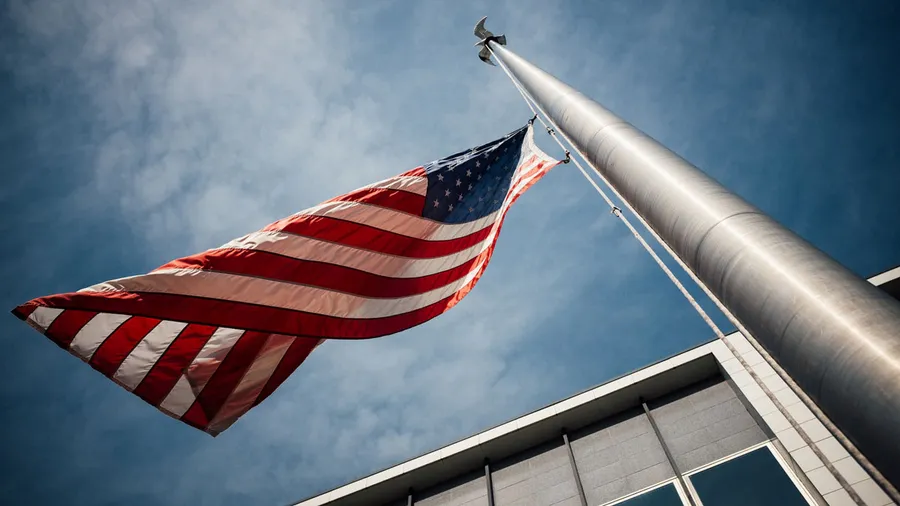
Salzburg Global Fellow Myrto Drizou reflects on the current dynamics and unreconciled historical roots affecting the U.S.’ image and influence worldwide
This op-ed piece is part of a series, written by Fellows of the Salzburg Global Seminar program Democracy on the Front Lines: Polarization, Culture and Resilience in America and the World.
From its very inception as a nation, the United States has fashioned itself as the proponent of liberal democratic values. This national narrative informs the U.S. cultural identity and shapes its image as the leading defender of democracy and human rights. This image, however, is undermined by a profound contradiction: while the U.S. champions democratic values worldwide, it often comes short of securing these values domestically as well. A long history of unreconciled historical roots, including the legacy of slavery and violence, and a resurgent wave of religious conservatism are causing the U.S. to lose its credibility, hurting its image and influence worldwide.
This is primarily the case for younger generations who are losing their trust in the promise of American democracy. Teaching American Studies both in the U.S. and abroad has offered me a vantage perspective of students’ attitude toward the U.S. as an ideal and a lived reality. Bogaziçi University, where I am currently teaching, is an interesting case; though it is a Turkish public research institution, it was founded by American missionaries—as the first American university outside the U.S.—and keeps strong ties to the U.S. through its progressive orientation and liberal arts education. My students are bright kids who aspire to pursue graduate studies in the U.S. and, in fact, feel more at home talking about American than Turkish culture.
In American Studies courses, we read foundational political documents such as the American Declaration of Independence along with controversial texts such as Thomas Jefferson’s Notes on the State of Virginia, where the dehumanization of African Americans is supported by eighteenth-century “scientific” racism. Driven by their youthful idealism, students react with indignation at the contradiction between blatant racism and the alleged defense of democratic values—the oft-cited “life, liberty, and the pursuit of happiness” of the Declaration of Independence. This contradiction is interestingly reproduced in the students’ reaction toward the U.S. On one hand, they are drawn to the promise of American democracy, which is especially resonant nowadays in Turkey; on the other hand, they revolt against the enduring legacy of racism and inequality.
This legacy is sustained by violence not only in the marginalization of historically underserved communities but also in the consistent practice of racial profiling and abuse of authority against minorities. Violence continues to target marginalized groups as seen in the excessive use of police force and mass shootings that affect vulnerable communities. The lack of effective gun control breeds a culture of violence that seems incompatible with the image of the U.S. as a safe haven and refuge. Perhaps the main difference between the violence in American society and the one we see in heavily militarized (or even authoritarian) regimes is the arbitrary nature of the former, which corrodes the U.S.’ image as the arbiter of social justice on a global scale as well.
Speaking of justice, one cannot ignore the current dynamics of deep-seated divisions that drive controversial debates, such as women’s right to abortion. The recent decision of the U.S. Supreme Court to overturn Roe v. Wade is the result of a widening gap between the conservative forces of American society who usually align with a Republican, religion-centered tradition and progressive groups who emphasize the importance of choice, especially for women’s lives. While this polarity is not unique to the US, it carries further weight in the American context, precisely because the global US image is based on the liberal discourse of self-determination and freedom of will.
The social, political, and economic dynamics of these differences are complex yet not irreconcilable. What needs to be considered, though, is how—and, perhaps most importantly, at which cost—reconciliation can be achieved. What is certain is that sincere dialogue, open debate, and courageous conversations can make a change for the U.S. and the world.
Myrto Drizou is assistant professor in the department of Western languages and literatures at Bogaziçi University in Istanbul, where she teaches courses on American studies, American literature, and critical theory. Her scholarship addresses the intersections of politics and literature, with emphasis on historical and cultural constructions of identity in 19th/20th century US literature.
