

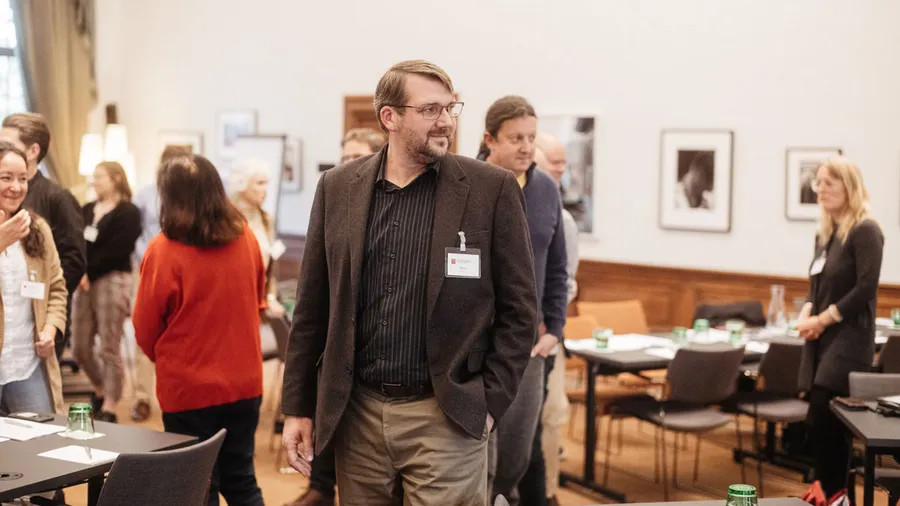
Salzburg Global Fellow Mark Elliott reflects on Salzburg Global Seminar, the UDHR and what the United States could learn from them
This op-ed piece is part of a series, written by Fellows of the Salzburg Global Seminar program "Democracy on the Front Lines: Polarization, Culture and Resilience in America and the World."
The founding of the Salzburg Seminar in American Studies as it was called in 1947 coincided with the creation of a committee to draft a “Declaration of Fundamental Human Rights and Freedoms” that would provide the newly-formed United Nations with a set of specific, normative principles to support and promote around the world. The committee, headed by Eleanor Roosevelt, might have been expected to produce a manifesto of “American principles” to be used for anti-communist or neo-colonial propaganda. What it produced instead was something quite different. A diverse group of academic, religious, and political leaders from across the globe including communist nations contributed to an expansive list of thirty inviolable rights that include traditional liberal-democratic rights alongside social and economic rights as well as visionary new international rights like Article 14’s “right to seek and to enjoy in other countries asylum from persecution” and Article’s 16’s “equal right” of men and women “to marry and found a family.” The document went far beyond rights guaranteed in the United States laws and constitutions and was quickly deemed too radical to be a binding declaration and so was adopted by the UN as an “aspirational” statement of values.
In its 75th year, the now Salzburg Global Seminar should take inspiration from the Universal Declaration of Human Rights (UDHR) and its origins. Although the document did not instantly become a legally enforceable “bill of rights,” it set an agenda that has led to a body of international law, treaties, courts, and institutions that grown more effective over time. Powerful interests within the United States have often felt threatened by it and the UDHR has served more often to indict the U.S. for its human rights failures than it has propaganda. In a similar vein, Salzburg Global promotes the values of democracy and human rights in its “American Studies” program, while not fearing to be critical of all anti-democratic forces at work in the world, including those within the United States itself. Whether the United States or any national government can be trusted to stand behind an expansive human rights agenda is doubtful without international bodies to pressure them (or punishing them when possible). Educational and academic deliberative bodies are essential too—without constant dialogue about what constitutes democracy, inherent rights or social justice, these concepts weaken.
The UDHR and the United Nations itself were created in the wake of the greatest failure of the modern international system—the Second World War with all its attendant mass murder and destruction. Their attempt to articulate an international agenda based on human rights and dignity were meant to set a new path that would avoid repeating the horrors that the world had just endured. Maintaining peace, enjoying freedom and achieving economic security were their goals. Their wisdom was hard-won and the UDHR contains wisdom in short supply at the present time. Once again, the same forces that led the world into the global disaster of 1937-1945 have returned. Hyper-nationalism, cynicism, authoritarianism, racism, economic insecurity, and fear. China is a rising, expansionist empire not unlike Japan of the 1930s while Russia is an aggrieved, defeated great power trying to reconstitute its lost empire, not unlike Nazi Germany. The international community must confront these authoritarian states and halt the spread of their principles and methods. The United States has never seemed less prepared to do this on its own. Without international solidarities to bolster the democratic nations, the will to overcome authoritarianism may never materialize.
Salzburg Global Seminar should continue to emulate the inclusiveness of the drafting committee of the UDHR because a diverse body of deliberators will deepen and broaden definitions and understandings of democratic values.
Mark Elliott is an associate professor of history at the University of North Carolina, Greensboro where is he is also the associate head of the history department. His current research focuses on ideas of human rights and American nationalism in the nineteenth century. He is the author of Color-Blind Justice: Albion Tourgée and the Quest for Racial Equality (2006). The book won the Avery O. Craven Award from the Organization of American Historians. He also coedited Undaunted Radical: The Selected Writings and Speeches of Albion Tourgée (2010) with John David Smith.
