-
Topics
TopicsOur programs create spaces where open-minded leaders can gather for breakthrough conversations on pressing global issues – each aligned to one of the following pillars:Get Involved
-
Events
EventsExplore the variety of events Salzburg Global hosts within Austria and in the rest of the world. Learn more about our programs and what else happens at Schloss Leopoldskron.Upcoming EventsOct 19 - Oct 22, 2026Peace & JusticeThe Collective Action Problem: How Should Democratic Societies Respond to Increasing State Violence without Exacerbating Polarization and Political Violence?Violent Threats to Democratic SystemsOct 21 - Oct 25, 2026Peace & JusticeDemocracy Across the Frontlines: How Can Democracy Movements Collaborate To Build Resilience Across Borders?Democracy Resilience Forum
- Insights
-
Fellowship
FellowshipSince 1947, more than 40,000 people from over 170 countries have participated in Salzburg Global's sessions. Collectively, these alumni are known as Salzburg Global Fellows.
-
About Us
About UsSalzburg Global is an independent, non-profit organization committed to creating spaces that overcome barriers and open up a world of better possibilities.Our Approach
-
Support Us
Support UsYour generosity helps us gather open-minded leaders for breakthrough conversations, while creating space for dialogue that overcomes barriers and opens up a world of better possibilities.
- Donate

- Published date
- Written by
Share
Peace & Justice
Opinion
The Lost Art of Thinking Together
Published date
Written by
Share
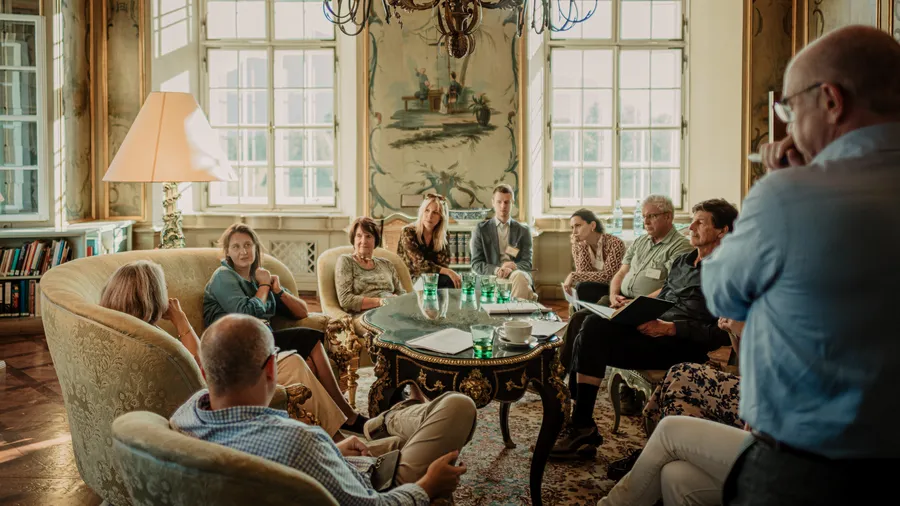
Fellows having a discussion at the American Studies program in September 2025. Photo Credit: Richard Schabetsberger
Key takeaways
- Democracy falters not from broken procedures but from a weakened ability to deliberate, understand disagreements, and form collective judgments.
- The decline of institutions that once organized shared thinking leaves digital platforms amplifying expression but fragmenting genuine civic understanding.
- Reviving self-governance demands rebuilding sustained deliberative communities where citizens repeatedly practice disagreement, negotiation, and commitment together.
This article was written by Salzburg Global Fellow Erica Schoder, who attended the Salzburg Global American Studies program on “What Next for the U.S.? What Next for America in the World?” in September 2025.
The views expressed here belong to this Fellow individually and should not be taken to represent those of any organizations to which they are affiliated.
A Cognitive Crisis of Liberal Democracy
In the great body of liberal democracy, one muscle has quietly atrophied: the capacity to deliberate. Societies can still argue, protest, and mobilize, but their ability to work through deep disagreements together - to understand what drives the other side, identify trade-offs, and figure out how to work together despite remaining differences - has weakened. The result is a democracy that still moves, but whose mind has split from its body: expression without deliberation, motion without collective thought.
Modern politics often confuses voice for deliberation. Expression is abundant; deliberative venues are scarce. Where most discourse happens, spaces are built for engagement, not working through disagreement. Expression becomes performance: people voice what they think their side thinks rather than what they actually believe. Outrage travels quicker than explanation; revision is rare.
Meanwhile, even when citizens try to think together, they often misread one another. Research shows widening perception gaps. Each side believes the other more extreme than it is, and even meta-perception gaps emerge: We misunderstand how others see us. The result is civic vertigo: We think we know what everyone thinks, yet we can no longer know what anyone means.
Liberal democracy's real crisis is cognitive, not procedural. For democracy to succeed, deliberation is not optional. It is what makes self-governance possible amid deep disagreement, what gives collective decisions their legitimacy and secures losers' consent. Without it, elections become rituals of aggregation rather than acts of judgment, and governance responds to performance rather than worked-through commitments.
The Decline of Deliberative Spaces
Recovering that cognitive capacity requires distinguishing what democracy demands procedurally from what citizens need substantively. Procedurally, this includes thin but load-bearing guardrails: lawful governance, mutual rights of expression and association, electoral integrity with peaceful alternation, and restraints on violence. Substantively, this entails enduring spaces to work through moral questions that procedures alone cannot answer, venues where citizens practice understanding what drives disagreement, identifying trade-offs, and committing to act together despite remaining differences.
This capacity once lived in institutions that structured collective thought: political parties, newspapers, legislatures, churches, unions, civic associations, and local governments. They organized feedback loops through which citizens could deliberate together, translating noise into policy. These spaces weren't just information processors - they were places where voices emerged through repeated practice, where people developed what they thought by working through substantive questions in sustained relationship with others.
However, in recent years, their decline has had multiple causes: nationalization of politics, suburban fragmentation, economic restructuring, and legislative reforms. What declined wasn't just individual institutions, but enduring deliberative publics where people worked through disagreements over time, building the capacity to disagree and commit. Digital platforms that dominate public discourse reward engagement over deliberation, amplifying voice without building conditions for collective sense-making.
Rebuilding a Deliberative Ecosystem
If those venues are gone, what would rebuilding them require? Whether through reforming existing institutions or building new ones, the task is creating structures and conditions that nurture enduring deliberative publics, or Deweyan publics, sustained communities where people practice working through disagreement over time. Deliberation's task is to make disagreement livable: understanding what each side values, being honest about trade-offs, and committing to act together even while disagreeing. Within this minimal procedural frame, citizens can disagree about everything else. Only then can they do the hardest thing in politics: disagree and commit.
There are no silver bullets here. Deliberation cannot simply be downloaded as an app. It requires the whole deliberative ecosystem: institutional structures, social norms, and sustained practice that together build capacity for working through disagreement. This is the foundation of self-governance itself.
Such recovery requires ritualized iteration: disagreement, commitment, and revision through repeated practice. Citizens can stay in the room, not because they agree, but because they trust commitments will be honored and they'll retain voice and power in another round. Done well, deliberation does not erase difference - it makes difference governable.