-
Topics
TopicsOur programs create spaces where open-minded leaders can gather for breakthrough conversations on pressing global issues – each aligned to one of the following pillars:Get Involved
-
Events
EventsExplore the variety of events Salzburg Global hosts within Austria and in the rest of the world. Learn more about our programs and what else happens at Schloss Leopoldskron.Upcoming EventsOct 19 - Oct 22, 2026Peace & JusticeThe Collective Action Problem: How Should Democratic Societies Respond to Increasing State Violence without Exacerbating Polarization and Political Violence?Violent Threats to Democratic SystemsOct 21 - Oct 25, 2026Peace & JusticeDemocracy Across the Frontlines: How Can Democracy Movements Collaborate To Build Resilience Across Borders?Democracy Resilience Forum
- Insights
-
Fellowship
FellowshipSince 1947, more than 40,000 people from over 170 countries have participated in Salzburg Global's sessions. Collectively, these alumni are known as Salzburg Global Fellows.
-
About Us
About UsSalzburg Global is an independent, non-profit organization committed to creating spaces that overcome barriers and open up a world of better possibilities.Our Approach
-
Support Us
Support UsYour generosity helps us gather open-minded leaders for breakthrough conversations, while creating space for dialogue that overcomes barriers and opens up a world of better possibilities.
- Donate

- Published date
- Written by
Share
Peace & Justice
Opinion
Restoring American Democracy, One Conversation at a Time
Published date
Written by
Share
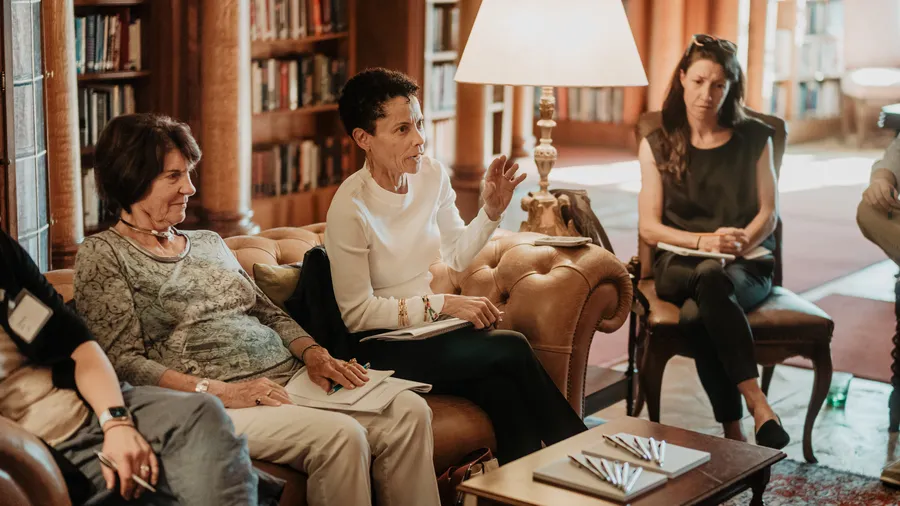
Fellows engage in conversation during the American Studies program in September 2025. Karina Kloos is pictured on the right. Photo Credit: Richard Schabetsberger
Key takeaways
Today’s American political crisis stems largely from rising affective polarization and unhealthy social-psychological behaviors.
Encouraging accurate perceptions, constructive dialogue, and empathy can reduce animosity, reveal common ground, and strengthen democratic trust.
Despite structural headwinds, rebuilding democratic resilience requires re-normalizing disagreement and fostering curiosity, connection, and civic engagement across communities.
This article was written by Salzburg Global Fellow Karina Kloos, who attended the Salzburg Global American Studies program on “What Next for the U.S.? What Next for America in the World?” in September 2025.
The views expressed here belong to this Fellow individually and should not be taken to represent those of any organizations to which they are affiliated.
How Did We Get Into This Mess?
A decade ago, I co-authored a book, “Deeply Divided.” In our first chapter, we ask, “How Did We Get into This Mess?” and in the final chapter, we explore, “Restoring American Democracy,” which, notably, focuses primarily on structural and policy problems and potential solutions.
As we reflect today, however, on how we got into this mess and try to understand how we’ll restore American democracy, it is the social dynamics that most require our attention.
The partisan battles in Congress, to be sure, are acute and toxic, rising to unprecedented levels. Policy differences between the two parties are higher today than in the decades just following the Civil War, as captured by VoteView data.
But it is affective polarization – or intense dislike and distrust of those with different perspectives – that is especially toxic in our society today. Affective dimensions around political identity and social sorting now undergird our gridlock and dysfunction, dynamics perhaps best described by political scientist and Salzburg Global Fellow, Lilliana Mason, in “Uncivil Agreement: How Politics Became Our Identity.”
In other words, while the structural and policy “mess” we described in “Deeply Divided" persists, we have now amplified and risk ossifying those dysfunctions through social and psychological behaviors. The list is long and too-familiar: motivated reasoning, confirmation bias, social sorting, group think, intra-group censorship, trolling, doxxing, cancel-culture. These are dispositions and habits that promote tribalism and political violence, illiberalism and authoritarianism.
We are upon – if not already in – a moment of awakening to the reality that fixing the structural decay of our democratic institutions requires softening and rebuilding the connective tissue that binds pluralistic societies. This reckoning is certainly upon those of us in higher education. Just this week, the Wall Street Journal published “The New Must-Have College Admissions Skill: Tolerating Other Viewpoints.”
Re-Normalizing Disagreement
At Stanford University, we recently launched an initiative focused on such efforts, ePluribus Stanford, for which I am the executive director. The following are a few insights we have gleaned from our campus community to reset the narrative and our social habits.
First, as ironic as it may seem, we need to re-normalize disagreement. As Debra Satz, political philosopher and Stanford Dean of Humanities and Sciences, states at the beginning of each “Democracy and Disagreement” class: “The fact that we have real disagreements, the fact that we have difficult conversations is not a bug of democracy, it is a feature of democracy.”
Second, we don’t actually disagree as intensely as we’re often made to believe. In the recent Strengthening Democracy Challenge mega study led by Stanford scholars, several of the most successful interventions – those decreasing partisan animosity – corrected misperceptions about our ideological differences. The interventions provided participants with information highlighting commonality, for example, citing that more than two-thirds of the electorate agree on key issues we tend to think are the most polarizing, e.g., birth control, gun control, immigration, climate change (a point we also underscore in "Deeply Divided").
Third, when we engage in dialogue across differences, as revealed through dozens of deliberations organized and studied through the Stanford Deliberative Democracy Lab, we are not only able to surface points of agreement, but we tend to move away from extreme viewpoints and move toward more nuanced ideological perspectives, more humanizing views of one another, and greater trust in democracy itself. These findings have been replicated across geographies and generations, including in the recent “America in One Room: The Youth Vote.”
Fourth, as social psychologist and Stanford Professor Jamil Zaki writes in “The War for Kindness: Building Empathy in a Fractured World,”: “We are isolated, stressed, and drowning in animosity [and] we have more reasons to avoid empathy than ever,” but “against the odds, we can find ways to connect, building empathic habits and overcoming division.” Recent scholarship, including Zaki’s, offers encouraging empirical insights that we have the “psychological mobility” to strengthen curiosity and empathy. These are not fixed traits. Our animosity is not immutable.
Effectively implementing such insights is the enormous challenge before us.
A Collection of Conversations
There are some tailwinds. A recent study conducted by the Institute for Citizens and Scholars on the civic outlook of young adults in America reports that nearly 40% of youth find conversations with those holding differing views to be “interesting” and “informative.” Following its recent Youth Vote study, the Deliberative Democracy Lab reports that more than two thirds of youth feel that those with whom they strongly disagree still “have good reasons.”
But the headwinds are daunting. Our information systems seed and exacerbate division, and we are already deeply divided. Economic inequality fuels social anomie, and our economic and class divides are only widening. The policy and structural democratic backsliding of the past decade will require extraordinary efforts to overcome in the coming decade.
And still, we fundamentally have to find ways to reconnect and rebuild, from our own (campus) communities upwards, to restore American democracy.
A more curious and empathetic conversation may not feel transformative, but I know for me it unlocks the paralysis of staring into the political abyss. It honestly just leaves me feeling a little better, too. And what is democracy, after all, if not a collection of conversations that steer our nation in one direction or another?