

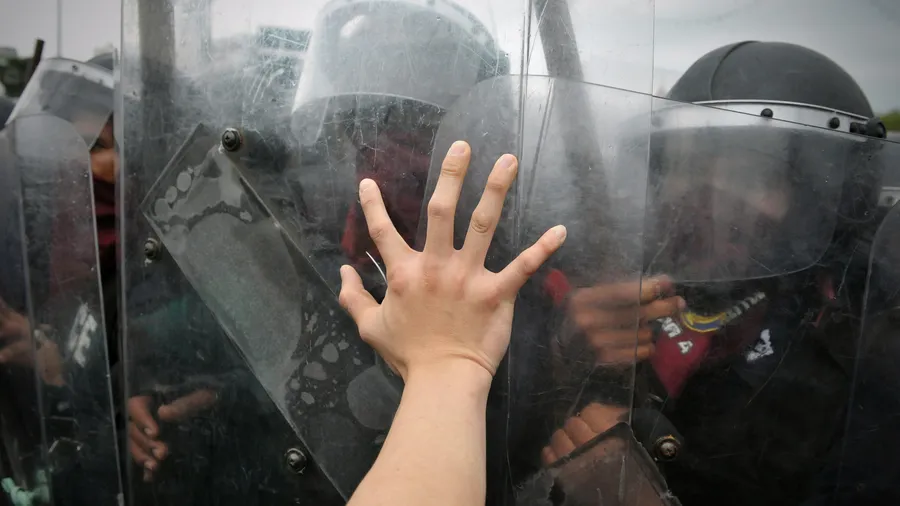
Salzburg Global Fellows reflect on political polarization and violence in Thailand and the southern Philippines
This article was written by Salzburg Global Fellows Jovanie Camacho Espesor and Patporn Phoothong. These Fellows participated in different cohorts of the Asia Peace Innovators Forum. Thanks to the generous support of the Nippon Foundation, they also attended Salzburg Global sessions on "Polarization and Violent Threats to Democratic Systems: Assessing the Threats and What We Can do About Them" and "Crossing the Pacific: The Asian American Experience in U.S. Society and Discourse" in September 2024. This article was informed by cross-contextual learnings gained from their experiences across these programs.
Academic scholars and researchers have consistently explored the connection between political polarization and violence, examining how these phenomena threaten democracy. Over the years, numerous democratic regimes worldwide have experienced democratic backsliding, often driven by the rise of populist leaders and the influence of radical ideologies that undermine democratic values, principles, and institutions.
In many post-conflict communities, which are common targets of liberal agents to promote and consolidate democracy, polarization does not necessarily result in violence. However, it often intensifies political competition among individuals and groups with divergent interests. This dynamic is particularly pronounced in post-war communities, where actors frequently engage in power struggles. In insurgency-ridden communities in Southeast Asia that are undergoing transitions from war to peace, such as Thailand and the southern Philippines, political elites often exhibit a tendency to monopolize power rather than share it - a prerequisite for democracy to thrive in fragile environments.
The Case of Thailand
In Thailand, political polarization is a deeply entrenched issue, shaped by socio-economic disparities, regional divides, and firmly held ideological beliefs. The divide between the Yellow Shirts, representing the urban elite and advocating for monarchy and anti-corruption, and the Red Shirts, aligned with rural populations demanding greater representation, has fueled longstanding tensions. These divisions have historically resulted in violent confrontations, such as the 2010 clashes, and repeated military interventions, perpetuating cycles of conflict that undermine democratic aspirations. For instance, the 2023 general elections, while marked by high voter turnout, failed to produce a stable governance structure, leading to widespread dissatisfaction and skepticism about the country’s democratic trajectory. Initial optimism surrounding the reformist Move Forward Party quickly faded as coalitions led by the Pheu Thai Party and pro-military factions appeared to undermine meaningful reform efforts.
The emergence of youth-led movements since 2021 signals a growing demand for change, rooted in frustrations over governance and the lack of representation. Despite this momentum, the persistent ideological divide, compounded by social and economic pressures, continues to impede political cooperation, development, and the process of democratization. The persistent polarization in Thailand poses significant challenges to the stability of its democratic processes. Deeply entrenched divisions obstruct constructive dialogue, weaken democratic norms, and complicate political transitions. Civil society remains fragmented, with activism often mirroring the broader societal divides. Social media exacerbates polarization by reinforcing echo chambers and intensifying conflicts. Grassroots movements advocating for community rights face resistance from state forces and internal skepticism, undermining their capacity to address critical social and environmental issues.
The Case of the Southern Philippines
The Bangsamoro region in the southern Philippines, long plagued by protracted armed conflict, provides a compelling case for examining the interplay between political polarization and violence. Since the 1970s, Mindanao has been marked by violent clashes, beginning with the Moro National Liberation Front (MNLF) and later the Moro Islamic Liberation Front (MILF) launching separatist rebellions against the Philippine government. For decades, armed skirmishes, mass displacements, and widespread human rights violations were daily realities for the predominantly Muslim population of the region.
Efforts to resolve the insurgency, such as the 1976 Tripoli Agreement and the 1996 Final Peace Agreement, failed to bring an end to the conflict. Instead, these political settlements deepened polarization among emerging political elites from the MNLF, such as Nur Misuari, and traditional political clans whose dominance was threatened by the arrival of new power players. This division within the Moro community, split between pro-MNLF factions and supporters of traditional politicians, undermined social unity and jeopardized the gains of peace processes. Mindanao experienced a relapse into conflict when the MNLF resumed hostilities. The situation grew more complex with the formation of the MILF, a breakaway group that engaged in years of armed conflict with Philippine security forces.
A breakthrough came with the signing of the Comprehensive Agreement on the Bangsamoro (CAB) in 2014, which offered hope for ending decades of conflict and achieving lasting peace in Mindanao. However, it took the Philippine Congress four years to enact the Bangsamoro Organic Law in 2018, which operationalized the CAB. In 2019, the Bangsamoro Transition Authority (BTA) was established, allowing MILF leaders to govern the newly autonomous region. The first regional parliamentary election is scheduled for May 2025.
As the election approaches, polarization and political competition among various groups have intensified. Democratic mechanisms, such as political party formation and elections, have become avenues for rival factions to compete for power. Prominent players include the MILF's United Bangsamoro Justice Party, the MNLF’s Bangsamoro Party, and regional parties backed by Moro warlords. Additionally, minority groups, such as the Teduray and Lambangian-Manobo indigenous communities, find themselves marginalized in the electoral process. Despite heightened competition, major violence has been notably absent. Political actors remain cautious, as large-scale violence would provoke intervention from the Armed Forces of the Philippines and jeopardize the ongoing peace operations in the region.
The cases of Thailand and the southern Philippines highlight the critical importance of addressing the root causes of polarization, promoting reconciliation, and bridging societal divides to build a more inclusive and sustainable democratic future.
