-
Topics
TopicsOur programs create spaces where open-minded leaders can gather for breakthrough conversations on pressing global issues – each aligned to one of the following pillars:Get Involved
-
Events
EventsExplore the variety of events Salzburg Global hosts within Austria and in the rest of the world. Learn more about our programs and what else happens at Schloss Leopoldskron.Upcoming EventsOct 19 - Oct 22, 2026Peace & JusticeThe Collective Action Problem: How Should Democratic Societies Respond to Increasing State Violence without Exacerbating Polarization and Political Violence?Violent Threats to Democratic SystemsOct 21 - Oct 25, 2026Peace & JusticeDemocracy Across the Frontlines: How Can Democracy Movements Collaborate To Build Resilience Across Borders?Democracy Resilience Forum
- Insights
-
Fellowship
FellowshipSince 1947, more than 40,000 people from over 170 countries have participated in Salzburg Global's sessions. Collectively, these alumni are known as Salzburg Global Fellows.
-
About Us
About UsSalzburg Global is an independent, non-profit organization committed to creating spaces that overcome barriers and open up a world of better possibilities.Our Approach
-
Support Us
Support UsYour generosity helps us gather open-minded leaders for breakthrough conversations, while creating space for dialogue that overcomes barriers and opens up a world of better possibilities.
- Donate

- Published date
- Written by
Share
Peace & Justice
Opinion
Internationalism, Not Nationalism: Securing Cultural and Academic Exchange
Published date
Written by
Share
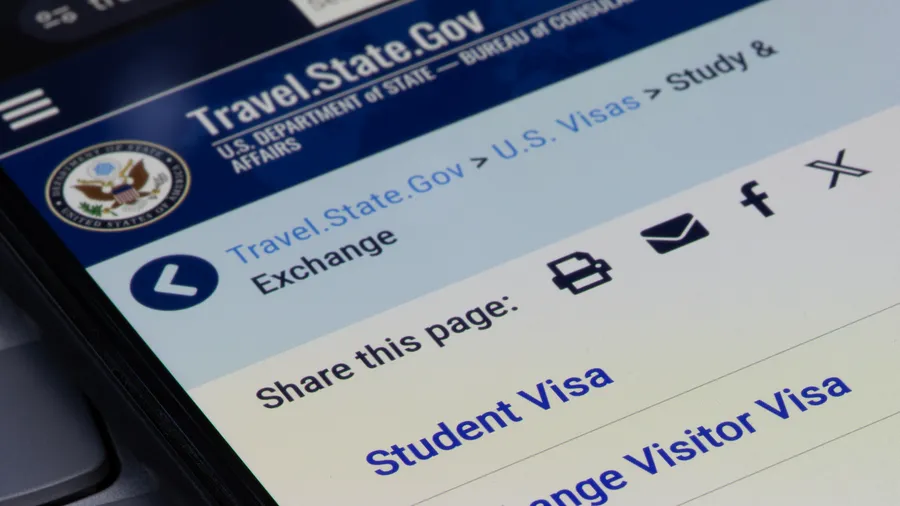
Photo Credit: Shutterstock.com/2635395657
Key takeaways
- Academic exchange fosters mutual understanding, adaptability, and a “shared sense of the world” among young people preparing to address global challenges.
- Restrictive U.S. policies and funding cuts now endanger exchange programs like Fulbright that have long promoted freedom of speech and the exchange of ideas.
- If governments retreat, institutions and communities must step in with grassroots initiatives to keep channels of international exchange open.
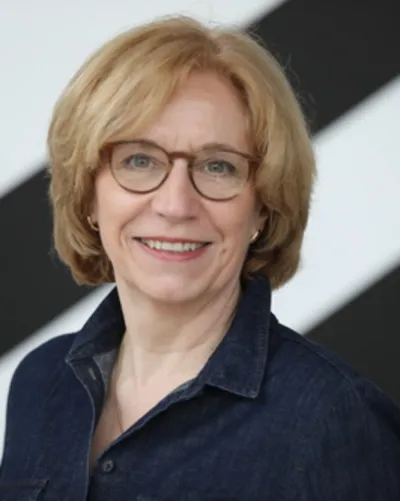
This article was written by Salzburg Global Fellow Martina Kohl, who attended the Salzburg Global American Studies program on “What Next for the U.S.? What Next for America in the World?” in September 2025.
The views expressed here belong to this Fellow individually and should not be taken to represent those of any organizations to which they are affiliated.
Last February, I had coffee with a young American, let’s call him Andy, the best friend of a friend‘s son, who was spending a semester abroad in Berlin. We chatted about his university program that entailed moving with his whole class of international students to a new city abroad each semester while pursuing a B.A. degree.
We connected, although two generations lie between us. We share the experience of participating in academic exchange, what it means to adjust to a new culture, and to maneuver a language not one’s own.
At the end of his term, Andy and three of his friends in the same program, students from Sweden, Canada, and England, spent a sunny afternoon on the terrace of our house in Berlin. They had been exploring the birthplace of Alexander von Humboldt on a Sunday hike. The students had just handed in their final projects covering a wide range of interests such as sustainable community banking, gaming and A.I., solar fusion and statistics, and the impact of lightning on different shapes. They were excited about returning to their university’s home base in the U.S. for their project presentations and graduation ceremony. All of them enthusiastically confessed their desire to return to Europe at some point. They felt prepared to adjust to any new culture. I have confidence that this generation will contribute significantly to solving humanity’s problems such as climate change, poverty, and inequality.
The story could end here with these young people looking optimistically towards their future, but the Swedish student's extension of his student visa for the U.S. was denied. He is not alone. Access to U.S.-based universities and colleges for international students has become increasingly difficult due to the restrictive policies of the current administration. Foreign students are no longer welcomed with open arms, but confronted with deep distrust.
But foreign students are not just an economic asset. They enrich academic programs by adding new perspectives and taking their experience back to their homelands. Friendships are formed for life across borders and cultures: a win-win situation for both the guest and home country.
After the destruction caused by World War II, American Senator J. William Fulbright understood the power of educational exchange to bring about mutual understanding and peaceful cooperation in order to prevent future wars. President Harry S. Truman signed the Fulbright Act into law in 1946. More than 400,000 alumni later, the Fulbright Commission would be celebrating its enormous success and 80th anniversary next year. But the program might not make it.
With the dismantling of USAID, humanitarian aid, and peacekeeping missions, cultural funding seems less important, maybe even worth giving up in favor of saving lives, combatting illness, and poverty on the ground. But the 2026 “Big Beautiful Bill” is not an “either/or.” It is an effort to use remaining funds without budgetary restraints and for ideological and short-term purposes. Implications for the Fulbright program and many other exchange programs, including those supporting underserved youth, are devastating.
While major funding comes from an appropriation by the U.S. Congress annually, non-profit and private organizations as well as foreign governments in 49 countries supplement funding. The Fulbright Program exists in 160 countries.
Many Nobel laureates and heads of state are among the alumni, but it is the numerous students that make the difference around the globe. They return to teach, work in their communities, run cultural and social projects, run tests in labs, and help build stable democratic institutions. They exemplify the exchange programs’ goals: promoting freedom of speech and an exchange of ideas.
But in today’s America, internationalism is seen as threatening and isolationism seems to be the trajectory the U.S. is on. This has severe implications for how our nations will deal with each other in the future. We all will be poorer for it, less safe, less inspired, and less healthy because the exchange of ideas and serious research led by U.S. institutions will be hampered.
My urgent wish: Should U.S. politicians be willing to sacrifice academic freedom and mobility, we should keep our end of the bargain.
Youth exchanges are the seed of a just and value-based international order. We need to keep them going, at least for another 80 years. Instead of relying on the government, let us create small-scale opportunities for international exchange that may be implemented at all educational levels and across communities.
We all can foster a “shared sense of the world” by seeking alliances on a grassroots level between our institutions and counterparts in the U.S. We can tap into existing structures such as academic exchange networks, sister city connections, and international corporations operating in the U.S., as well as utilize personal connections. Let’s apply the knowledge and resources we already have for keeping channels open.
For decades, the U.S. government and non-profit foundations have provided funding for institution-building and exchange of ideas all over the world (e.g. Salzburg Global, the Free University Berlin). It is time to return the investment and “fill a space” for the young through grassroots initiatives.
This text is an edited version of Martina's blog “A Plea for Cultural and Academic Exchange: Let’s Keep It Going!”