

Salzburg Global Fellow Sha Elijah Dumama-Alba on addressing collective trauma, restoring dignity, and empowering young people in conflict-affected communities
This op-ed was written by Salzburg Global Fellow Sha Elijah Dumama-Alba, who has attended the Salzburg Global Asia Peace Innovators Forum and the “Global Innovations on Youth Violence, Safety, and Justice” initiative.
I have had the enormous privilege of being a Salzburg Global Fellow and joining two programs that have greatly impacted my work as a peace worker. In 2020, I joined the first cohort of the Asia Peace Innovators Forum and in 2021, I also joined the multi-year initiative on “Global Innovations on Youth Violence, Safety, and Justice.” My participation in both has allowed me to appreciate other global contexts and approaches to peace and safety, as well as to talk openly about issues that are otherwise uncharted in my own cultural context.
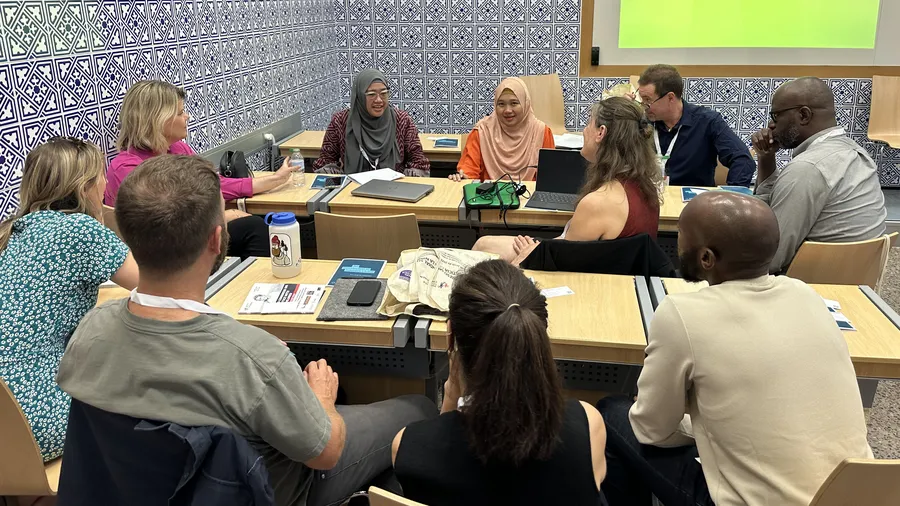
Recently, I had the fortune of sharing the stage with other Salzburg Global Fellows at the World Congress on Justice With Children in Madrid, Spain from June 2 to 4, 2025. Our workshop on “Redirecting Marginalized Youth in Crisis-Affected Societies: From Exclusion to Justice, Dignity, and Agency” was led by like-minded Bangsamoro peace advocates and Fellows working in Myanmar and Bangladesh contexts.
Understanding Youth Violence in Bangsamoro
I come from a place called “Bangsamoro” in the southern part of the Philippines, whose inhabitants are composed of majority Muslims, but there are also Indigenous Peoples and Christians settlers. The heterogeneous composition of the residents in the region is a mix of social and cultural characteristics with different sets of values, customs, upbringing, norms, and even laws and legal traditions. It is worth mentioning that while the Bangsamoro is bound by shared narratives of oppression, historical injustices, discrimination, and marginalization, we are also proud of our rich cultural heritage, strength, resilience, and strong value for kinship.
Speaking of strength, the Bangsamoro courage and valor stem from the collective struggle for autonomy through the right for self-determination and preservation. This is pertinent to the culture that we share as a people. So, taking a culturally-situated approach to understanding youth violence in the Bangsamoro can facilitate a broader understanding of the motivations of youth offenders, who are often also victims of circumstances. A culturally-situated approach has vast implications in exploring responsive structural and legal frameworks for justice reforms and innovations in the Bangsamoro.
It is best to understand how youth violence manifests in our culture before imagining innovative approaches that are context-specific and dignified.
In the Bangsamoro culture, establishing our identity as a people is important. There is a feeling of honor in fighting for the Bangsamoro cause because it is informed by cultural experience. As opposed to individualist cultures that record high rates of index crimes, the Bangsamoro collective culture causes young people to offend in ways that would highlight the Bangsamoro identity and the struggle. There is a belief that there is reward in the afterlife, as well as reward in status and living conditions per se.
Bangsamoro youth have been involved in armed struggle as combatants and as non-combatants supporters of revolutionary groups. These groups are community-based, and their recruitments target families and communities who have had little to no support from the government in terms of education and livelihood, and who are generally left with a feeling of neglect. Families and communities were and are a big part of young people’s decision to join the rebellion.
Conflict has exposed the Bangsamoro to commit crimes collectively such as recruitment of child soldiers, involvement in gangs and private armed groups, engaging in clan wars to defend family’s honor, radicalization, and violent extremism. Commitment of offenses are triggered by group-oriented motivations due to prolonged war, poverty, exploitation, and government corruption.
Bangsamoro's Path Toward Peace and Justice
After the successful signing of the Comprehensive Agreement on the Bangsamoro in 2014 and the establishment of the Bangsamoro Autonomous Region in Muslim Mindanao in 2019 as an autonomous political entity, the Bangsamoro people have been hopeful about the peace process. The unique tri-justice system that allows for a whole-of-society approach gives a promise of inclusivity and safe space among Bangsamoro inhabitants regardless of stature in society.
We confront a situated of prolonged conflict which has weakened state institutions and accountability structures that continue to severely restrict access to justice, especially for vulnerable groups such as women, youth, rebel returnees, and internally displaced persons. Youth re-marginalization is becoming common again. Experiences tend to push youth to engage in new forms of violence and criminality. Many feel betrayed or are disappointed with the peace dividends that government fails to deliver.
More than ever, Bangsamoro communities demand more accountability from the government, from those who have caused the injustices, and even from among their own brethren. Since the Bangsamoro society deals with collective violence, it follows that they experience collective trauma, that would therefore require collective healing.
With peace advocacy at my core, I remain hopeful that the community-based interventions and approaches being undertaken by both the Central and Bangsamoro Governments to heal and transform conflict-affected Bangsamoro societies could be sustained so we can give Bangsamoro children and youth a chance to dream for a better tomorrow and live their best lives, like any other child.
I wish to thank Salzburg Global and all the organizers of the World Congress on Justice With Children for allowing us to share the Bangsamoro story.
Sha Elijah Dumama-Alba is a Member of Parliament in the Bangsamoro Transition Authority and serves as its Parliament Floor Leader. She is also the Minister of the Interior and Local Government in the Bangsamoro Autonomous Region in Muslim Mindanao. Previously, Elijah served as the region's first Bangsamoro Attorney General and co-Head of the Joint Secretariat of the Intergovernmental Relations Body, a mechanism for cooperation and coordination between the National Government and the Bangsamoro Government. She is a member of both the regular Philippine Bar and the special Philippine Shari'ah Bar.
