

Salzburg Global Fellows apply The Salzburg Method to reflect on their participation in the 5th World Congress on Justice With Children
This article was written by Salzburg Global Fellows Staci B. Martin, José Arraiza, Shanmugapriyah Thiyagarajah, Samuel Karuita, and program manager Kateryna Anselmi. These Fellows have all participated in various cohorts of the Asia Peace Innovators Forum.
Can justice and administrative institutions treat children fairly, safely, and in a way that effectively protects their rights?
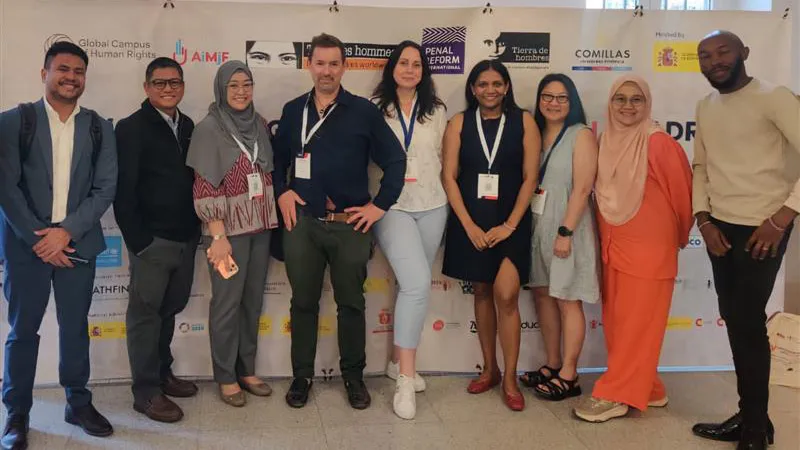
At the 5th World Congress on Justice With Children, we participated as Salzburg Global Fellows and tackled these questions alongside civil society actors, human rights defenders, governments, and international organizations. By convening in Madrid, Spain, from June 2 to 5, 2025, we aimed to advance child-centered justice systems and prevent violence against children within those systems. Salzburg Global joined the Congress as an associated partner, emphasizing a commitment to building justice systems that prioritize children's well-being and safety, address structural challenges, and promote child-friendly approaches within institutions. The Congress also highlighted the importance of preventing and responding to all forms of violence against children in the justice system, including physical, sexual, and emotional harm.
Amid a crisis of solidarity and funding for humanitarian, development, and peace interventions, we had the rare opportunity to delve into the complexity of child protection in both conflict-affected humanitarian crises and more stable contexts. We actively participated in the Congress alongside 20 Salzburg Global Fellows from the Asia Peace Innovators Forum and the Global Innovations on Youth Violence, Safety, and Justice program. We engaged in a variety of dialogues and spoke across 12 different workshops that ranged from preventive approaches to criminal justice to working with children and youth in fragile, conflict, and violent contexts. Through the support of Salzburg Global and its partners, we also hosted a workshop on “Redirecting Marginalized Youth in Crisis-Affected Societies,” where we shared our experiences from Myanmar, the Bangsamoro Region in the Philippines, and Bangladesh.
Applying The Salzburg Method
What set the engagement of us as Salzburg Global Fellows apart was how we applied The Salzburg Method, a set of convening principles for breakthrough conversations on pressing global issues. As we have seen the power of this method firsthand, we embedded it into the way we created spaces for conversation at the Congress.
The first principle is: “gathering divergent voices, not convergent views.” This was experienced by José Arraiza, a Madrid-based human rights defender and Salzburg Global Fellow, who reflected that,
"In the context of a global crisis of solidarity and funding, what I most appreciated personally was to see and connect with a community that continues to care deeply and work for better and more humane treatment of children by institutions, even in times of crisis. This tells me that there is still plenty of hope and energy and a lot to work towards.”
The second principle is: “creating transformational spaces, not predictable sessions.” This was incorporated by Kateryna Anselmi, program manager for Peace and Justice programs at Salzburg Global, who said,
"Bringing our Salzburg Global Fellows together again in Madrid was a deeply affirming moment. Amid the many conversations at the World Congress, our workshop on “Redirecting Marginalized Youth in Crisis-Affected Societies” stood out. Our Fellows didn't speak from theory — they spoke from lived realities, where justice isn't abstract but a matter of survival. Their strength, honesty, and commitment reminded me why this work matters and why it matters to me.
While many Congress workshops followed a traditional format — audiences listening passively — our workshop made a clear, intentional shift. We invited everyone in the room not just to observe but to contribute. At first, there was hesitation. But slowly, the energy shifted. People engaged, shared, and listened — turning the room into a space for genuine exchange. One hour wasn't enough, but the moment of co-creation was powerful.
What continues to inspire me is the clarity of purpose our Fellows bring — from Myanmar, Mindanao, Sri Lanka, and beyond. Their insights are grounded, urgent, and too often underrepresented. I hope we continue to create spaces — like Salzburg Global does — where these voices aren't just heard but trusted, centered, and sustained. Because lasting change begins not with presentations, but with people — sharing, connecting, and building something better together."
The third principle is: “leveling the playing field, not elevating the 'stars'.” Another participating Salzburg Global Fellow emphasized,
“By attending the World Congress, I learned that children's and youth's participation in justice is very important. Creating a workspace for children and youth is necessary for our work, projects, agenda, workshops, seminars, focus group discussions, and research. Respecting children and youth and listening to their voices are essential for all of us to create a better environment for our community. Bringing back these lessons to the local community, particularly at the youth workshop held in Myanmar, is very fruitful. Sharing lessons learned with local youth in Myanmar, including ethnic communities, is highly encouraging to them, as it fosters further creative thought and empowers youth to navigate challenges such as military rule and forced conscription practices, ultimately contributing to peace and justice in the country.”
The fourth principle is: “making it relational, not just transactional.” This was seen when Samuel Karuita, a Salzburg Global Fellow, said,
“Attending the 5th World Congress on Justice with Children was both affirming and catalytic for my work as a practitioner deeply grounded in prevention. The Congress’s apparent shift toward prioritizing the prevention of violence—rather than merely responding to its consequences—marked a necessary and long-overdue reorientation within the discourse on child justice. As someone whose practice is shaped by an understanding of structural drivers and systemic inequalities, I found it particularly valuable to engage with sessions that foreground lived experiences and shared contextually grounded innovations and interventions. These sessions did not merely present models of success but interrogated the social, economic, and political conditions that push and pull children into contact with the justice system.
Of equal significance was the presence of children and youth—not as token participants, but as informed and purposeful contributors, including in organizing roles. Their perspectives added depth and clarity to the discussions, underscoring a critical takeaway for me: Children’s participation must be substantive, not symbolic. This calls for a renewed commitment to centering their voices in all programs I contribute to—not just in quantitative terms but in ways that uphold the quality, depth, and impact of their engagement. The Congress also created space for meaningful reconnection with Salzburg Global Fellows across various cohorts. These exchanges reminded me of the power of community among practitioners committed to justice and dignity for marginalized youth. I look forward to deepening these relationships and drawing on our shared commitment to transforming systems that often exclude, rather than empower, the children we serve.”
The fifth principle is: “prioritizing in-depth conversations, not quick and easy answers.” Shanmugapriyah Thiyagarajah, a global leader in international development and aid and Salzburg Global Fellow, explained,
“My participation in the World Congress on Justice with Children was highly insightful, offering a crucial platform for reflection. The Congress highlighted persistent challenges in the sector, particularly around funding, consistent policy implementation, and critical gaps in technical expertise and specialized training for justice professionals. While the Congress emphasized child participation, it was notable that the actual involvement of children, particularly those from the Global South, was minimal. Additionally, an area for future improvement is to ensure that case studies and scenarios presented during discussions accurately reflect the unique experiences and challenges faced by children living in the Global South, thereby enhancing the understanding of diverse contexts within global child justice. It was observed that the presence of direct donor representatives was not clearly evident, presenting a missed opportunity for strategic engagement on critical resource and funding challenges identified by many participants.
To ensure long-term systemic change, I believe the Congress organizers, including Salzburg Global, must continue to sustain the network, actively disseminate knowledge, advocate for policy implementation, and facilitate resource mobilization, transforming the momentum generated into tangible, lasting improvements in justice for children globally. Moving forward, I am eager to establish partnerships with organizations focusing on joint research, advocacy, and training initiatives, especially in Myanmar.”
The sixth principle is: “welcoming the unexpected, not clinging to the script.” This was observed by Staci B. Martin, a community-based action researcher, critical hope scholar, and Salzburg Global Fellow, who said,
“At this conference, I felt that the conversation was shifting toward how we can change conditions (e.g., discriminatory laws and policies, inadequate legal representation, and violence within the justice system) with children’s active participation so that they have the agency and self-determination to make their own decisions. Among the sessions, I participated in "Youth Experiential Learning Labs: Take a Walk in My Shoes." This simulation allows participants to experience what it’s like to be a child in the juvenile justice system. It had a profound impact on me, as it reminded me of my internship at the Cook County Juvenile Detention Center (CCJDC) in Chicago, IL. I will never forget a conversation with a young person when I asked him what he wanted to do when he was older. He responded, 'If I make it to 14, I want to finish high school and get a job.' I was taken aback that he used 'if' instead of 'when.' The conditions where these children were living were untenable, violent, and unsafe. Although two decades ago, this moment changed the trajectory of my career as I shifted my focus to prevention and peacebuilding.”
The seventh principle is: “inspiring collaborative action, not just personal reflection.” This principle is evident throughout this article, as we wrote it together through a collaborative effort involving Salzburg Global Fellows and staff who attended the Congress.
Taking the Work Forward
The 5th World Congress on Justice with Children highlighted child-centered justice, that is, prioritizing children's well-being and safety within justice systems while preventing all forms of violence against children. The Congress gathered diverse perspectives to foster hope and meaningful connections, creating interactive, co-creative environments rather than traditional, passive sessions.
In this context, we actively modeled these values through The Salzburg Method. Our reflections, supported by the seven convening principles, shift from merely responding to violence to preventing it. This change involves centering children's voices in all justice programs, while addressing persistent gaps in funding, policy implementation, and expertise. We want to emphasize the need for authentic participation from children and youth, particularly those from marginalized communities and the Global South. Children must not only have a seat at the table, but real power in shaping the systems that affect them.
The Congress highlighted the need for long-term, collaborative approaches to reform child justice systems, emphasizing prevention, inclusion, authentic participation, and sustained advocacy. Salzburg Global’s engagement in global events like this and the continuing work of Fellows like us across regions shows what’s possible when we connect experience with purpose, and when we act not just in response to injustice, but in pursuit of lasting peace and justice for all children.
