-
Topics
TopicsOur programs create spaces where open-minded leaders can gather for breakthrough conversations on pressing global issues – each aligned to one of the following pillars:Get Involved
-
Events
EventsExplore the variety of events Salzburg Global hosts within Austria and in the rest of the world. Learn more about our programs and what else happens at Schloss Leopoldskron.Upcoming EventsOct 19 - Oct 22, 2026Peace & JusticeThe Collective Action Problem: How Should Democratic Societies Respond to Increasing State Violence without Exacerbating Polarization and Political Violence?Violent Threats to Democratic SystemsOct 21 - Oct 25, 2026Peace & JusticeDemocracy Across the Frontlines: How Can Democracy Movements Collaborate To Build Resilience Across Borders?Democracy Resilience Forum
- Insights
-
Fellowship
FellowshipSince 1947, more than 40,000 people from over 170 countries have participated in Salzburg Global's sessions. Collectively, these alumni are known as Salzburg Global Fellows.
-
About Us
About UsSalzburg Global is an independent, non-profit organization committed to creating spaces that overcome barriers and open up a world of better possibilities.Our Approach
-
Support Us
Support UsYour generosity helps us gather open-minded leaders for breakthrough conversations, while creating space for dialogue that overcomes barriers and opens up a world of better possibilities.
- Donate

- Published date
- Written by
Share
Peace & Justice
Opinion
Gen Z Doesn’t Do Politics the Way We Did - And That Changes Everything
Published date
Written by
Share
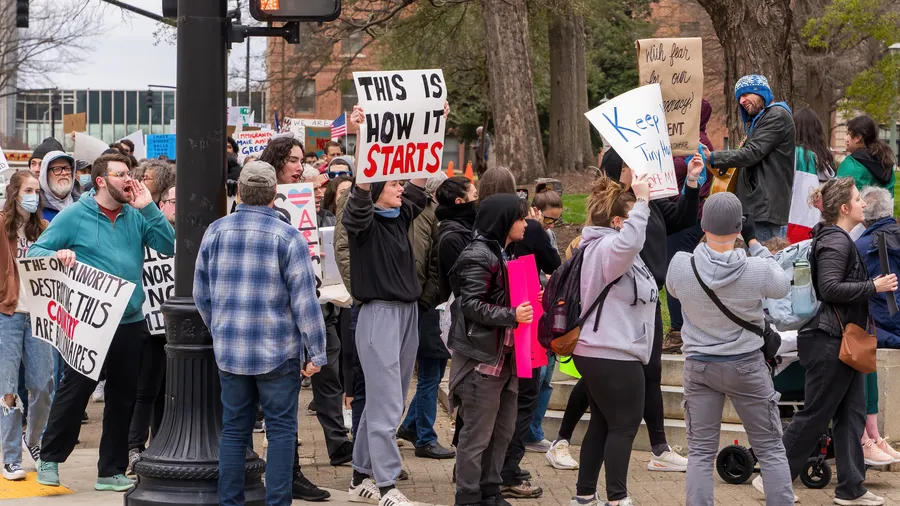
Photo Credit: Shutterstock.com/2586198321
Key takeaways
- Young people today are determined to make their perspectives known about the issues and policies they care about, engaging with politics more through movements than political parties.
- While Gen Zs grew up hearing about the U.S. as the “world’s police,” they see the role both as a reputation and a responsibility.
- The younger generation does not believe that the U.S. has all the answers and wants the country to take a more humble and collaborative view towards the world.
This article was written by Salzburg Global Fellow Bill Gates, who attended the Salzburg Global American Studies program on “What Next for the U.S.? What Next for America in the World?” in September 2025.
The views expressed here belong to this Fellow individually and should not be taken to represent those of any organizations to which they are affiliated.
Today, young people are engaging politically in groundbreaking ways. It is well accepted that Gen Z gets its news and information primarily from social media. According to a 2024 report by the nonprofit News Literacy Project, they don’t trust the mainstream media. As a result, there is no longer an agreed upon set of facts or sources of information that Gen Z trusts. If citizens do not agree on what is true, it makes it exponentially more difficult to reach consensus on policy issues (or even have civil discussions).
This generation relates to politics in ways I never could have imagined when I was in my 20s. I asked my graduate fellow at the Mechanics of Democracy Laboratory at ASU how her generation uses social media, and she responded that they use it “not just for personal expression, but as a platform to engage in meaningful civic conversations. Young people today are far more attuned to the debates and policies that could shape the issues they care about, and they are determined to make their perspectives known.”
Gen Z is continuing the trend of recent generations of decreasing political party affiliation. At the same time, those who identify as members of a party have more polarized views than ever before. Today, those who are on the fringes are hyper-engaged while many of those who are in the middle recoil from politics. Young people rarely connect with politics via a political party in the way that I did when I started the Teenage Republican club at my high school thirty-five years ago. They are more likely to engage by connecting with a movement. On the left, young people are driven to engage politically by movements like Black Lives Matter, March for Our Lives, the response to the conflict in Gaza, and the No Kings protests. On the right, politically interested young people are joining the chapters of Turning Point USA (“TPUSA”). TPUSA understands how to connect with young people online and now has an outsized influence that even dwarfs that of the Republican Party in some states including Arizona. As parties continue to decline in relevance and influence, it may weaken party discipline, which could either lead to more chaos in our politics or, alternatively, could allow more cross-partisan collaboration.
Gen Z’s view of America’s place in the world is complicated. As my graduate fellow also noted, “Many young people grew up hearing the U.S. described as the world’s police.’ A role rooted, at least in aspiration, in the nation’s founding principles of democracy and the rule of law. I see that as a responsibility as much as a reputation.” However, young people today do not expect the United States to be a monolithic superpower that goes it alone. They support the United States leading international cooperation on global problems. Young people across the political spectrum are looking to the United States to address climate change. Even young people who identify themselves as MAGA are twice as likely to identify climate change as a significant concern than older MAGA supporters.
Around the world, young people do not look to the United States to solve their problems. At Arizona State University, we host a group of Mandela Fellows who are young leaders from Africa who attend a six-week institute that supports the development of their leadership. A Mandela fellow who attended the ASU institute captured the view of many when he said they “must look for African solutions to global challenges.” My experience with the Mandela Fellows has taught me that young people do not believe that the United States has all the answers, but they don’t want the United States to retreat from the world. They want the U.S. to take a more humble and collaborative view towards other global players.
As the world becomes multi-polar and the U.S. shares the world stage with BRICs, the EU, and others, the U.S. continues to have an outsized cultural influence on the world. Not only do American brands continue to dominate the world economy, but the great innovation of the 2020s – Generative AI - has also been driven by American companies. Most young people worldwide value and elevate global diversity, empathy, inclusion, and cross-cultural understanding. America’s influence in the world will likely be driven by the extent to which American domestic and foreign policy emphasizes these principles.