

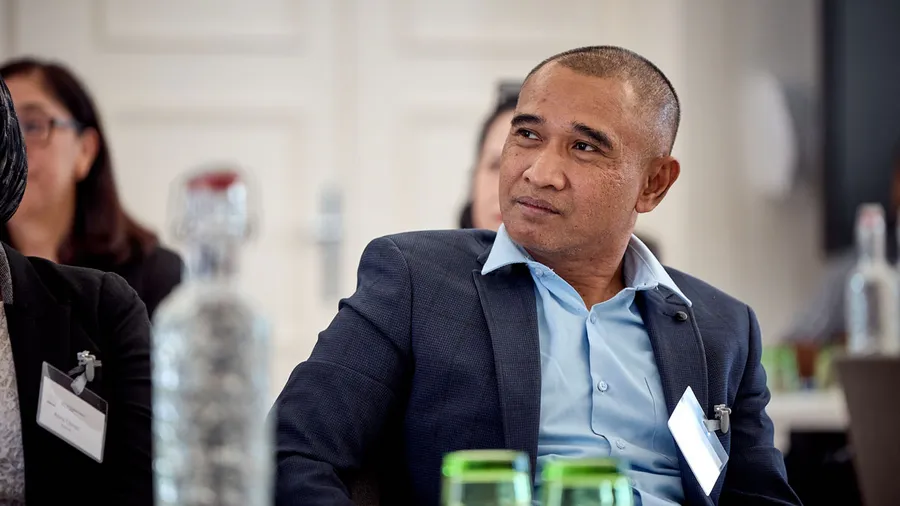
Mochamad Mustafa on peacebuilding through democracy promotion and his expectations of the Asia Peace Innovators Forum
This interview was conducted prior to Salzburg Global's Asia Peace Innovators Forum in-person program in June 2023.
Mochamad Mustafa is a Fellow of Salzburg Global’s 2023 Asia Peace Innovators Forum. He works as the program director for democracy and governance at the Asia Foundation Indonesia. With over 15 years of experience in the field, he currently leads the implementation of various democracy promotion, human rights, and peacebuilding portfolios. We spoke to Mochamad regarding his experience and expectations from the Asia Peace Innovators Forum 2023 at Salzburg Global Seminar.
Sadaf Taimur, Salzburg Global Impact Fellow: Tell us more about what you're currently working on. How is your work related to peacebuilding?
Mochamad Mustafa: I am Mochamad Mustafa from the Asia Foundation international office. The Asia Foundation is an international organization based in San Francisco. We are working in 20 countries in Asia. And part of the program with the Asia Foundation that I have been concerned about is peacebuilding and conflict resolution. I'm now the director for the democracy and governance unit, within which we have our portfolios in democracy promotion, building and promoting freedom of religion tolerant society, as well as countering violent extremism.
While I moved towards democracy, social inclusion, and tolerance issues about five years ago from the local governance domain, I was expected to include the aspects of governance in peacebuilding. This is because, at that time in Indonesia, many thoughts on peacebuilding relied on civil society action and movement rather than enforcing the State or the government. We are thinking of a new approach involving governance in peacebuilding and within the Asia foundation itself. In terms of this network, the first consideration is the range aspect of Asia. I think that anything that I can get from the networking will benefit my organization as well. The Asia Foundation in Indonesia is now trying to build connections with other Asian organizations. We hope this connection with a network of Asia experts expands my knowledge, also my capacity to work more broadly at the ASEAN level.
ST: You're working for democracy and governance right now. What are your thoughts on how democracy and governance are related to peacebuilding directly in Indonesia and why? What keeps you motivated or inspired to work in peacebuilding?
MM: First, democracies should lead to peace based on respect, tolerance, and equal society. Right. But in the context of Indonesia, where democracy doesn't deliver well, it has led to majority populism and bad governance in the existing fragility of conflict in recent years. Minority groups have always been the victim because the calculation will be of political populism. In that case, we think that we need to work directly with the government, the politician, and at the governance level to limit the behavior of the state or give better guidance for the state in resolving the conflict. The second aspect is that, in the Indonesian context, most of the conflicts are boosted by political and trade interests as well, where political actors are involved in the conflict and try to be part of the competing groups that are conflicting. The final aspect is that we have seen a good improvement in some areas where local politicians and governments also show an initiative in peacebuilding with support from other civil society actors and us. I'm really excited to spread out the initiative throughout the country and among other countries, especially in ASEAN, where similar conflict and political patterns can be observed.
ST: Why did you decide to join the Asia Peace Innovators Forum?
MM: There are two reasons why I joined the program. First is a personal reason. I heard about the global program from my supervisor, I have a country representative and deputy country representative that have been involved in one or two global seminar programs. They recommended me to participate and expand my network. When the announcement came from Salzburg Global Seminar and the issue of peacebuilding, it made me more excited because it is my focus area right now. And also, even though I've been doing it for five years and expanding my network and knowledge, maybe we can set our experience to other participants as well.
ST: What are you hoping to experience through this program?
MM: The first thing that I expect within the program in Salzburg is people with a lot of expertise and experience. So, maybe I can absorb a lot of new approaches, new knowledge, or new strategy or in dealing with peacebuilding in Indonesia. I might also contribute to the new knowledge to understand as well. So I expect to have dialogue, conversation, and sharing sessions in the seminar. The first takeaway from [Salzburg Global] is the knowledge itself. Secondly, it is the network. From the global network, we can think of having one as a continuous setting. The second is potential collaboration for work. As I said before, in the case of ASEAN, there are a lot of opportunities for collaboration. For example, I don't know about community best practices or program collaboration at the ASEAN level.
Since coming to Salzburg in June 2023, Mochamad has been working alongside other Salzburg Global Fellows on a project about digital peacebuilding.
