

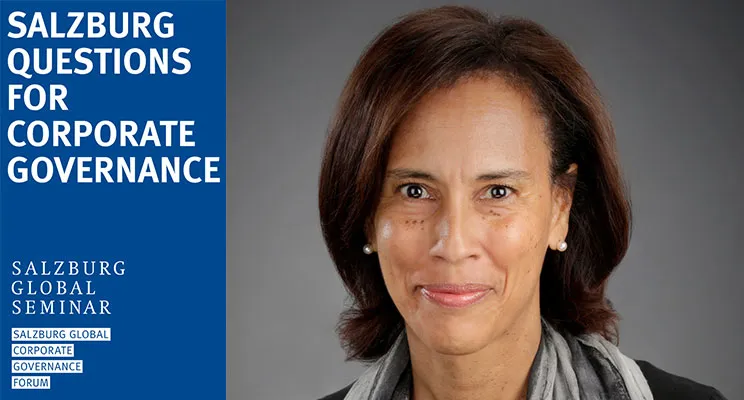
In the latest installment of the Salzburg Questions for Corporate Governance, Anne Gates, an independent board director and global consumer products professional, explores what boards require to identify qualified future candidates
This article is part of the Salzburg Questions for Corporate Governance series by the Salzburg Global Corporate Governance Forum
As corporations build their boards, they have looked for candidates based on their value-added expertise. The dimensions of this searched-for expertise have changed over time to meet the challenges of the period.
The past two tumultuous years have really forced corporate boards to reassess their desired-for expertise to address a multitude of rapidly evolving challenges and changes. Examples of these diverse challenges have included:
- High profile cybersecurity and ransomware issues;
- Multiple severe climate events;
- Increased institutional investor activism, especially in the area of ESG;
- The George Floyd murder and its ramifications;
- China’s potential turn inward;
- And the COVID-19 pandemic’s impacts on employee morale, working habits, retention, and well-being.
These events have expanded the criteria of value-added skills, expertise, and attributes that governance committees are looking for. Against this background, governance committees not only need to expand their aperture in looking for current board members, but they must also think about how they develop a talent pipeline for future board members and chairs of their board committees as other risks and challenges rise in importance.
I have found governance committees that thoroughly chart the inventory of their current board members’ skills can be much more proactive in developing the talent pipeline. In addition, the inventory of skills should apply a present/future risk-informed lens specific to the industry, not just a typical list of governance attributes.
For example, financial expertise continues to be extremely important, but deep experience in managing change for a rapidly evolving workforce is a skill that has not been on the typical governance list in the past. Another example of a newly emerged skill is digital channel development expertise.
Proactive governance committees also inventory attributes such as age, cultural identity, and geographic location. Diversity in all these attributes definitely contributes to a higher impact board. For example, as a board member, I have been part of decision-making in a crisis situation. Due to the board’s diversity, the board could effectively optimize individual points of view into a consensus viewpoint, thereby enabling the board to come to a decision that was greater than the sum of the parts.
Gaps on both inventory lists, attributes, and skills, are usually then identified and prioritized. A check-in at each governance committee meeting reminds the members of the key skills and attributes that the committee is looking for. A periodic reminder to the entire board expands those involved in developing a board director pipeline.
Hopefully, with these now-developed requirements, governance committees can develop a wish list of potential candidates. They can build on their networks and/or the efforts of a search firm, with timing informed, if possible, by mandatory board retirement rules. I have seen companies start conversations and continue them for over two to three years. Proper cultivation is key.
Board members need to stretch their network beyond what is comfortable for them. This action will help ensure the surfacing of as many appropriate candidates with diverse skills and attributes as possible. Most people will need go further than their usual day-to-day network to ensure one does not risk homogeneity of the board pipeline. One does need to be creative in expanding one’s network. However, there are many ways to move outside of one’s comfort zone. For example, reaching out to a person highlighted in an article on a particular area of diversity may turn up great sources for diverse talent.
Being proactive and thinking about the changing business landscape is also key. For example, since 2019, the SB-826 law in California has required corporations to successively increase the proportion of female board directors. As a result, there’s been a dramatic increase in the number of women on boards in California’s companies. Illinois is another state that has stepped into the board composition considerations. Thinking about what rules and trends your government is considering can give the board a first-mover advantage, even before the changes occur. Institutional investors are also a catalyst to watch in the area of board composition.
The past two years have shown boards will continue to operate in a rapidly changing landscape. They will require a non-static list of attributes and skills that should often be revisited. An effective and diverse talent pipeline is required to meet the corporate governance challenges of today. To develop that pipeline, boards must be proactive, use foresight and develop an expanded network to identify qualified candidates.
Have an opinion?
We encourage our readers to share your comments by joining in the discussion on LinkedIn
.
Anne Gates has been in global consumer products businesses for over 35 years. She is currently on the Kroger board, serving on the audit and public responsibility committees as an audit committee financial expert and the chair of the audit committee. Anne is chair of Tapestry, Inc. board, and chair of its governance committee. She is on the Raymond James board, serving on the Audit and Risk Committee. She also serves on the PBS SoCal board as chair of the investment committee and the boards of the University of California Berkeley Foundation and CADRE in Los Angeles. In 2017, Anne retired as president of MGA Entertainment, the largest privately held toy company in the United States with a global reach. She is past executive vice president and chief financial officer of The Disney Company’s Consumer Products Division ($3 Billion in revenues) and past managing director for Disney Consumer Products Europe and Emerging Markets based in London. She has a bachelor’s degree in applied mathematics from UC Berkeley. She received her M.Sc. from the Engineering School at Columbia University, where she also completed post-graduate work. In 2010, Anne was named to the Power List of Britain’s 100 most influential black people. Anne is a member of the Board of Directors of Salzburg Global Seminar.
The Salzburg Questions for Corporate Governance is an online discussion series introduced and led by Fellows of the Salzburg Global Corporate Governance Forum. The articles and comments represent opinions of the authors and commenters and do not neces
sarily represent the views of their corporations or institutions, nor of Salzburg Global Seminar. Readers are welcome to address any questions about this series to Forum Director Charles E. Ehrlich: cehrlich@salzburgglobal.org. To receive a notification of when the next article is published, follow al-seminar/" target="_blank">Salzburg Global Seminar on LinkedIn or sign up for email notifications here: www.salzburgglobal.org/go/corpgov/newsletter