
-
Topics
TopicsOur programs create spaces where open-minded leaders can gather for breakthrough conversations on pressing global issues – each aligned to one of the following pillars:Get Involved
-
Events
EventsExplore the variety of events Salzburg Global hosts within Austria and in the rest of the world. Learn more about our programs and what else happens at Schloss Leopoldskron.
- Insights
-
Fellowship
FellowshipSince 1947, more than 40,000 people from over 170 countries have participated in Salzburg Global's sessions. Collectively, these alumni are known as Salzburg Global Fellows.
-
About Us
About UsSalzburg Global is an independent, non-profit organization committed to creating spaces that overcome barriers and open up a world of better possibilities.Our Approach
-
Support Us
Support UsYour generosity helps us gather open-minded leaders for breakthrough conversations, while creating space for dialogue that overcomes barriers and opens up a world of better possibilities.
- Donate

Peace & Justice
A Coin Mid-Flip: Resilience and Hope in a Fractured International Order
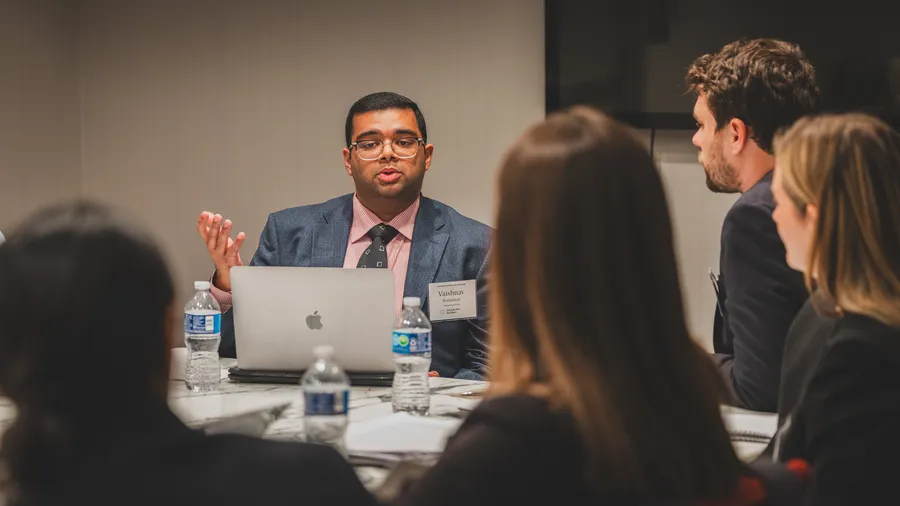
Vaishnav Rajkumar at the Cutler Fellows Program in February 2026. Photo Credit: Stefan Agregado
Key takeaways
- International law today stands at a turning point, caught between past precedents and an uncertain future.
- International dispute settlement now operates where law, politics, and policy collide, reshaping how and when lawyers act.
- Despite deeper and broader challenges, resilience and hope remain central to the renewal of the international legal order.
This reflection was written by Salzburg Global Fellow Vaishnav Rajkumar, who attended the 2026 Salzburg Cutler Fellows Program on "Disruption and Renewal: Charting the Future of the International Rule of Law, Democracy, and Pluralism".
What does international law look like today? What will it look like in the future? What does the rule of law mean, and what role can we ascribe to international tribunals and courts?
These are but some of the questions that Natalie Reid, partner at Debevoise & Plimpton LLP, and John Bellinger III, partner at Arnold & Porter LLP and former legal advisor to the U.S. Department of State and National Security Council, tackled during a candid fireside chat on “The Practice of International Law in a Fractured World”.
The panel was an ideal way to commence the 2026 Salzburg Cutler Fellows Program, which centered on the theme of “Disruption and Renewal: Charting the Future of the International Rule of Law, Democracy, and Pluralism”. It was clear to the panelists and audience alike that the discussion was not intended to provide definite answers to the questions raised. Rather, the conversation focused on topics of resilience and hope - resilience in the face of unprecedented challenges to the international legal order as we know it, and hope that while it may not emerge unscathed, it will indeed emerge as a revitalized and more potent mechanism for global peace.
Moderated by William Burke-White, Richard Perry Professor of Law at Penn Carey Law School, the panelists began by reflecting on what it means to be an international lawyer in the United States at a time and context when the discussion of such matters feels increasingly precarious. Panelists discussed how changing dynamics have served to highlight that the apparent strength of international law and its inherent fragility are, perhaps, two sides of the same coin. It felt like a coin that many in the room would agree is currently mid-flip, suspended between past precedents and an uncertain future.
The panelists then moved to the subject of international dispute settlement (IDS), specifically focusing on impacts on the field from a practitioner’s point of view. IDS necessitates that practitioners today acknowledge and work into their strategy the fact that international law exists at the juncture of law, politics, and policy. It is becoming more likely that the usual rules of play will come into tension with “realpolitik” and associated considerations. As legal and political dimensions are becoming increasingly intertwined, the question has now moved to whether - not just where and how - IDS should be used. As lawyers, that question might have been taken for granted in years past. Now, each of us is required to be prepared with the conviction that legal avenues do indeed provide the ideal path to move forward in productive and efficient capacities.
International law has, at many points in history, found its place in the room questioned. The idea that a given matter falls outside the purview of international law has existed for as long as the field itself, appearing even in its most well-known decisions, from Nicaragua to the South China Sea arbitration and even the recent Climate Change advisory opinion. Through these challenges, international law has steadfastly navigated forward with resilience as the unspoken but most significant word in the room. Natalie Reid put it best when she said:
“We are at a moment of inflection. We are at a moment of change.”
The challenges today might be more fundamental and of a larger scale than the international legal system has faced before - and yet, the way forward remains vested in the resilience and hope that underscored not only the fireside chat, but the Cutler Fellows program as a whole.
