-
Topics
TopicsOur programs create spaces where open-minded leaders can gather for breakthrough conversations on pressing global issues – each aligned to one of the following pillars:Get Involved
-
Events
EventsExplore the variety of events Salzburg Global hosts within Austria and in the rest of the world. Learn more about our programs and what else happens at Schloss Leopoldskron.
- Insights
-
Fellowship
FellowshipSince 1947, more than 40,000 people from over 170 countries have participated in Salzburg Global's sessions. Collectively, these alumni are known as Salzburg Global Fellows.
-
About Us
About UsSalzburg Global is an independent, non-profit organization committed to creating spaces that overcome barriers and open up a world of better possibilities.Our Approach
-
Support Us
Support UsYour generosity helps us gather open-minded leaders for breakthrough conversations, while creating space for dialogue that overcomes barriers and opens up a world of better possibilities.
- Donate

- Published date
- Written by
Share
Culture
Opinion
Youth Can Restore Democracy: How A New Model Could Turn Youth Voice Into Choice
Published date
Written by
Share

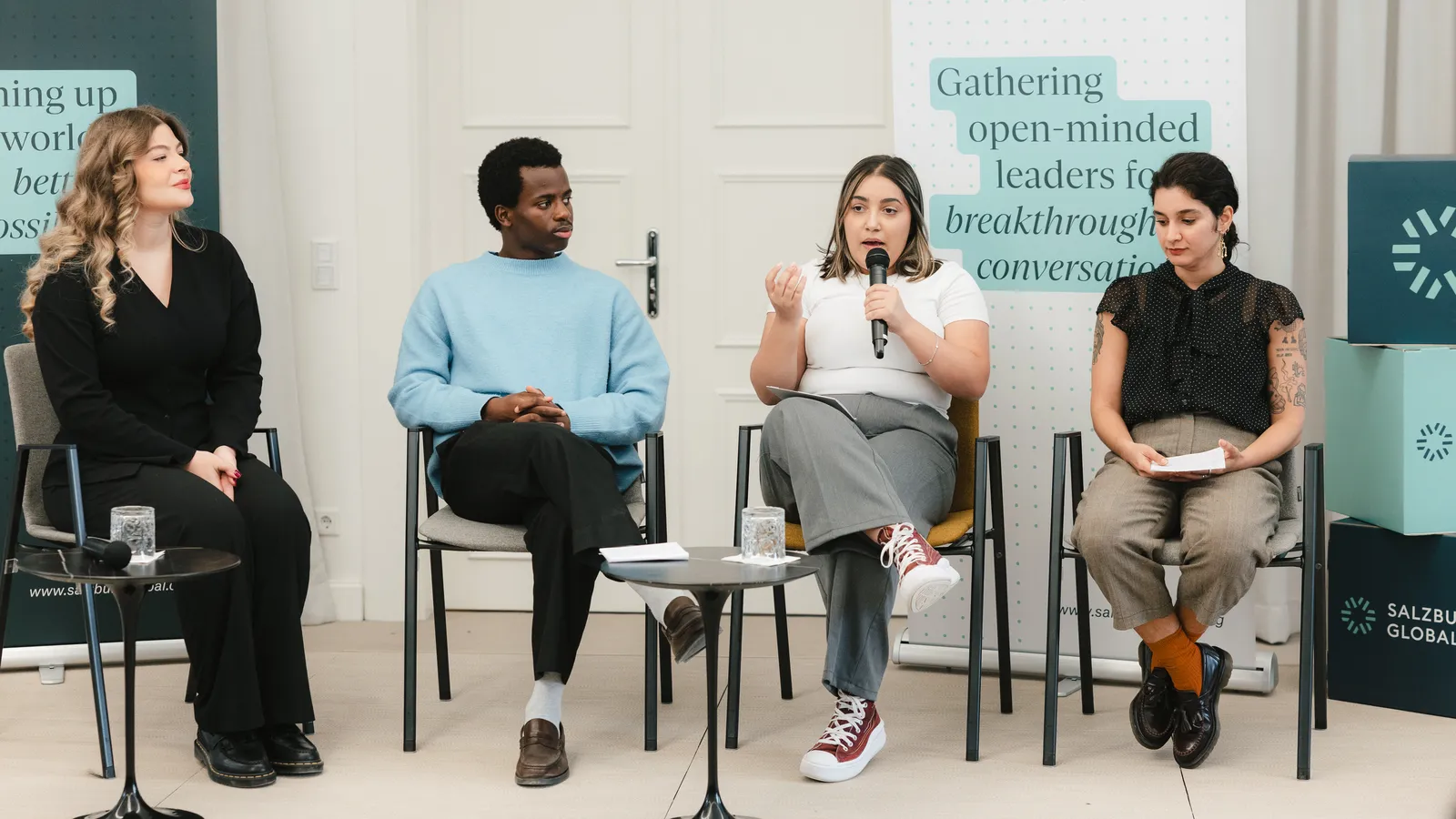
Fellows engage in a brainstorming exercise during the Public Policy New Voices Europe program in October 2025. Photo Credit: Katrin Kerschbaumer
This thought piece was written by Salzburg Global Fellows Samanta Brahaj, Rodrigo Cardoso, Romina Grigore, and Isadora Pinheiro e Silva. They attended the Public Policy New Voices Europe session on "Rebuilding Trust and Cohesion in European Public Policy".
The views expressed in this article are those of these Fellows individually and should not be taken to represent those of Salzburg Global or any organizations to which they are affiliated.
Nowadays, much of the discussion on youth participation focuses on how to engage young people in civic and political life. Far less attention is paid to why youth lose trust and withdraw from formal institutions. The reasons are often more tangible than commonly assumed: no electricity, no running water, unsafe or impassable roads, inaccessible or inequitable education systems, and other basic services left unmet.
In Mizil, a small town in south‑eastern Prahova County in Romania, where many residents face limited access to public services, young people did not wait for institutions to act. Instead, they applied constant pressure on local authorities, pushing them to move beyond promises on paper and deliver tangible improvements.
This concrete and specific example, observed in similar contexts across Europe, shows that the challenge is not motivating youth to participate, but creating structures that give them real influence over the decisions that shape their lives.
Democracy Under Strain: The Younger Generation Losing Trust Is the Reason
Across Europe, democracy is shifting in ways that expose a widening trust gap. Younger generations, in particular, are turning away from formal political institutions. Recent EU data shows that nearly 60% of eligible young voters abstain from national elections, and more than 70% stay home during European Parliament elections.
But this withdrawal does not reflect apathy. Young people remain politically active through protests, boycotts, and volunteering. Their engagement moves toward spaces where participation feels real and impactful. This shows that what they are rejecting is not democracy, but political structures that appear unresponsive and symbolically participatory to their realities.
Disengagement becomes rational when institutions ask for youth input but rarely share power. The problem, therefore, is less youth “disengagement” and more institutional failure to create conditions where meaningful participation is possible.
Youth Engagement Moving Beyond Rights and Representation as a Strategic Priority
If young people are not turning away from politics but from institutions that exclude them, then the priority is to build shared decision-making spaces. Youth participation is not merely about rights but an investment in the legitimacy and resilience of democratic systems.
Research shows that when young people participate in real decision making, trust in institutions increases and long-term civic engagement strengthens. Local governments that adopt youth co-governance also see policies become more responsive and communities more cohesive.
The stakes are economic as well as democratic. Youth disengagement correlates with higher NEET rates, which cost OECD countries up to 1.5% of GDP annually. Exclusion erodes productivity, social cohesion, and long-term growth. Youth co-governance is hence structural, and essential for democratic and economic sustainability.
Romania as a Regional Precedent
We propose Romania as the ideal home for launching institutionalized youth co-governance. The country offers a uniquely meaningful context for testing models of democratic renewal for several key reasons:
- EU Membership and Regional Influence: As a member of the European Union, Romania operates within shared frameworks of participation and inclusion. Its proximity (both geographical, traditional, and historical) to the Western Balkans, where democratic consolidation remains uneven, means that successful institutional innovation in Romania could serve as a model for both internal EU cohesion and the Union’s neighborhood and enlargement agenda.
- Acute Challenges in Connecting Young People To Formal Politics and the Labor Market: According to the European Commission, only 19.7% of Romanian voters in the December 2024 parliamentary elections were aged 18 to 35. Furthermore, Eurostat data shows that in 2024, eight EU countries recorded NEET rates above the EU average of 11%, with Romania among the highest, where 14% or more of youth aged 15 to 29 were neither in employment nor in education or training. These figures highlight a structural failure to integrate young people into civic and economic life and the urgent need for meaningful participatory mechanisms.
- Minority Inclusion Challenges: Data from OSCE shows Romania is home to one of the largest Roma populations in the EU (estimated at around 9% of the population). Yet political representation remains negligible: Even at the local level in Romania, in 2012, only 161 Roma were serving as local councilors, representing only 0.39 % of total seats. Youth exclusion is tied to broader patterns of discrimination, making democratic renewal inseparable from policies that promote minority meaningful inclusion.
Youth Council: Rebuilding Trust Through Shared Decision-Making Starting From Mizil
Building on the challenges of youth disengagement and low trust in institutions, we propose piloting a Youth Council in Mizil, a Romanian town of approximately 14,300 residents in south‑eastern Prahova County, including a very socially active but politically excluded Roma community of roughly 15 %. Many neighborhoods face poor access to basic infrastructure, including water, sewage, asphalt, and electricity.
Mizil represents a strategic scale for democratic innovation: small enough for relational governance to function, large enough for reforms to be socially visible and empirically evaluable, and home to a diverse population.
The Youth Council would be designed as a replicable model of meaningful youth co‑governance, moving beyond symbolic consultation to give young people real influence over municipal decisions. It would:
- Include delegates from all registered youth associations, with guaranteed seats for ethnic minority youth.
- Review and provide input on municipal policies affecting all residents, from housing and transport to cultural investment and public space.
A nine-member Joint Oversight Board – four members appointed by the Youth Council, four by the mayor’s office, and one directly elected by residents – would monitor implementation and publish biannual accountability reports.
By embedding youth participation, ensuring minority representation, and providing transparent and collaborative oversight, Mizil’s model addresses the gap where institutions solicit input without sharing decision-making power.
Aligned with European standards – including the European Charter on the Participation of Young People in Local and Regional Life, EU Youth Strategy (2019–2027), and the EU Roma Strategic Framework (2020–2030) – this pilot is scalable and replicable, providing a pathway to rebuild democratic trust, enhance inclusion, and foster long-term political engagement, while also promoting more innovative and effective policymaking.
A Replicable Model for Strong Democracies in Europe and Beyond
The proposed Youth Council Model shows how giving young people real decision-making power can transform communities, rebuild trust, and strengthen democracy. This is not another symbolic institution: it is a blueprint for responsive governance, minority inclusion, and sustained civic and economic engagement. Romania has the chance to lead Europe by institutionalizing youth co-governance and creating a model scalable across towns and regions.
The time to act is now: Youth are politically engaged, ready to contribute, and bring the firsthand experience needed to address urgent challenges, from climate change to economic and social crises. Institutions must embed young people in decision making, share power transparently, and let their voices shape policies that affect everyone. A democracy that listens to its youth is stronger, more inclusive, and built to endure while continuously innovating to meet society’s future needs.