-
Topics
TopicsOur programs create spaces where open-minded leaders can gather for breakthrough conversations on pressing global issues – each aligned to one of the following pillars:Get Involved
-
Events
EventsExplore the variety of events Salzburg Global hosts within Austria and in the rest of the world. Learn more about our programs and what else happens at Schloss Leopoldskron.
- Insights
-
Fellowship
FellowshipSince 1947, more than 40,000 people from over 170 countries have participated in Salzburg Global's sessions. Collectively, these alumni are known as Salzburg Global Fellows.
-
About Us
About UsSalzburg Global is an independent, non-profit organization committed to creating spaces that overcome barriers and open up a world of better possibilities.Our Approach
-
Support Us
Support UsYour generosity helps us gather open-minded leaders for breakthrough conversations, while creating space for dialogue that overcomes barriers and opens up a world of better possibilities.
- Donate

- Published date
- Written by
Share
Culture
Testimonial
The Value of Each Story: Researching Fair Migration Policies in Austria
Published date
Written by
Share
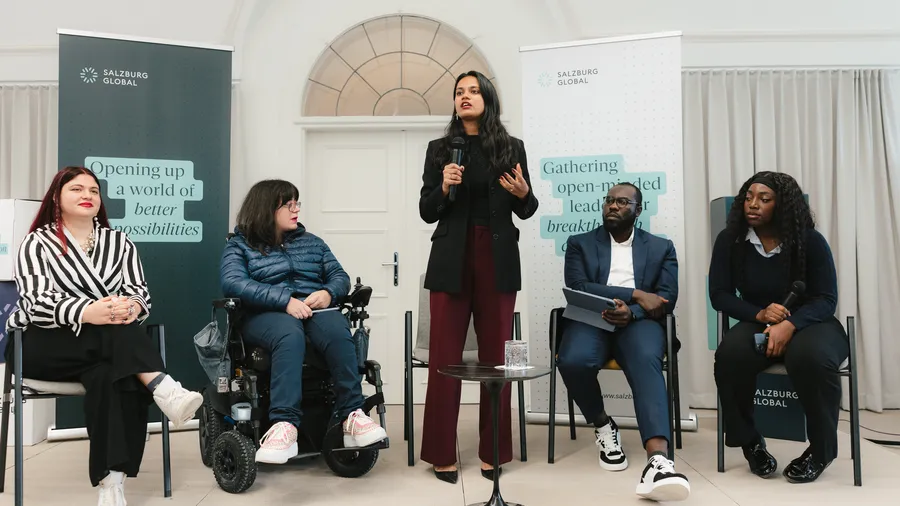
Tanishka Murthy (standing in center) at the Public Policy New Voices Europe session in October 2025. Photo Credit: Katrin Kerschbaumer
Taking Action as a Fellow
During the Salzburg Global Public Policy New Voices Europe cohort 4 meetings and workshops, one topic sparked a particularly intense discussion: Austria’s 12-month visa extension policy for non-EU graduates. For many Fellows, especially those coming from the UK, EU countries, or even from non-EU citizens who had never considered the topic, the realities of the visa extension policy came as a surprise. The length of the extension itself, the restrictions on work during the job-seeking period, the difficulty of securing a job, and the lack of support measures for non-EU citizens all became points of concern in our conversations.
These discussions stayed with me long after the session in Salzburg. What impacted me most personally was seeing how people from different backgrounds and levels of privilege, in this case with a stronger passport, felt this frustration and recognized the unfairness of these policies. Those conversations increased my motivation to work on this topic and renewed my sense of purpose to create tangible change in Austria.
One of the most valuable parts of the Public Policy New Voices Europe Fellowship was the way it expanded my thinking. Through meeting Fellows and mentors, I was introduced to new ways of approaching public policy problems: not only through statistics, but also through collaboration, storytelling, and collective leadership. The conversations I had in Salzburg challenged me to think more deeply about who is affected by policy decisions, whose voices are often excluded, and how research can be a meaningful tool for advocacy.
My Research Project on Visa Policies in Austria
Before beginning my own project, I reviewed existing research on the visa extension policy, including quantitative research that gave an overview of its fairness.
At the same time, I realized there was still a gap in the research, as quantitative research can show patterns, but it cannot fully capture the human experience behind those numbers. This is where pursuing the qualitative approach sparked my interest. From the conversations I had in Salzburg, hearing personal stories and struggles about migration, uncertainty, and trying to build a future in Europe made me realize how important it is to pursue research that values individual experiences and portrays them with the dignity they deserve.
This realization inspired me to pursue a qualitative research project, which I designed with the Science for Society Hub at Central European University (CEU, Vienna). This became an entirely qualitative study composed of one-on-one interviews with a variety of non-EU post-graduates navigating Austria’s visa extension policy. Over the course of a month, we conducted interviews with participants who shared similar challenges, but also very different personal experiences.
The interviews were later transcribed and used in a qualitative coding process. Through support from the Student Engagement Office at CEU through the civic engagement fellowship, I partnered with the Austrian Federal Economic Chamber (WKÖ) to design and conduct this research.
Not only did this project enhance my research and communication skills, but it also enabled me to lead my first research team. Together with three students, we built a collective leadership capacity inspired by a shared vision and goal of finding important stories and advocating for change using an academic approach.
In many ways, I drew directly from my experience in Salzburg while leading this project. As a Fellow, I had already learned how to bring together people with different backgrounds, passions, personalities, and expertise. It also gave me confidence in my ability to contribute meaningfully as a leader in my own context.
These skills helped me tremendously while leading this research team and communicating with our partners and interviewees. Through the connections to global peers and mentors I gained in Salzburg, I was encouraged to think ambitiously while approaching problems in tangible ways. I drew on this network to better support, train, and empower my own research team to utilize their individual strengths and produce more meaningful results.
The Stories Behind the Statistics
As we analyzed each interview we had conducted, our team gasped and sighed, expressing confusion and frustration throughout. It became clear that these non-EU citizens were working incredibly hard to build stable futures in Austria. They wanted to work in their fields, earn a livable wage, and begin a new chapter of their lives with more stability and clarity. Yet, the application process for the visa extension, the job-seeking journey, and the variety of challenges they faced often hindered their ability to achieve their goal.
What stayed with me most was how easily each of these individuals are reduced to a statistic. But we rarely hear individual stories and experiences in ways that bring humanity back into policy discussions. We hope this research helps others understand the emotional realities behind the data and better recognize how migration policies shape everyday lives.
Throughout this process, I reflected often on my time in Salzburg. Many of the conversations I had with Fellows there centered around the struggles each of us face in building a good life for ourselves in Europe or beyond. From the incredibly intelligent and hardworking Fellows I met, I already knew we are all trying to make it work with the resources we have. My conversations in Salzburg and my research both reinforce my belief that everyone deserves an equal chance to build a life they are happy with.
What Comes Next?
The result of our study was clear: There is room for improvement in Austria’s visa extension policies. After gaining insight into what these individual experiences look like, we know that different stakeholders have different responsibilities to make these changes.
One of the most important lessons I carried with me from Salzburg Global was the concept of the “light switch,” introduced by our mentor Jim Shultz. The idea encouraged us to think critically about who has their hand on the metaphorical “button” that can create change. Who has the power? Who needs to be involved for policy change to happen? These are questions that I reflect on deeply as I lead my team through conversations with the Austrian Market Service, ministries, university administration, and the Federal Economic Chamber.
My participation in the Public Policy New Voices Europe Fellowship connected me to incredible global leaders who broke down big issues into digestible pieces. With their support and encouragement, I was able to gain the resources, networks, and confidence needed to conduct valuable research and reach a global audience.
These experiences showed me that not only do I have the ability to reach those with their hand on the light switch, but I can also reach broader communities and effect change on a broader scale. At Salzburg Global, we all had our own stories to share, and the individuals navigating these visa policies are no different.
Our qualitative approach puts a story to the statistic, and I aim to continue sharing those stories with the people who have their hand on the light switch so that everyone, no matter where they come from, has a fair chance to build the life they want.