
-
Topics
TopicsOur programs create spaces where open-minded leaders can gather for breakthrough conversations on pressing global issues – each aligned to one of the following pillars:Get Involved
-
Events
EventsExplore the variety of events Salzburg Global hosts within Austria and in the rest of the world. Learn more about our programs and what else happens at Schloss Leopoldskron.Upcoming EventsOct 19 - Oct 22, 2026Peace & JusticeThe Collective Action Problem: How Should Democratic Societies Respond to Increasing State Violence without Exacerbating Polarization and Political Violence?Violent Threats to Democratic SystemsOct 21 - Oct 25, 2026Peace & JusticeDemocracy Across the Frontlines: How Can Democracy Movements Collaborate To Build Resilience Across Borders?Democracy Resilience Forum
- Insights
-
Fellowship
FellowshipSince 1947, more than 40,000 people from over 170 countries have participated in Salzburg Global's sessions. Collectively, these alumni are known as Salzburg Global Fellows.
-
About Us
About UsSalzburg Global is an independent, non-profit organization committed to creating spaces that overcome barriers and open up a world of better possibilities.Our Approach
-
Support Us
Support UsYour generosity helps us gather open-minded leaders for breakthrough conversations, while creating space for dialogue that overcomes barriers and opens up a world of better possibilities.
- Donate

Peace & Justice
Statement
The Salzburg Statement on the Rule of Law
When the rule of law works, it is often invisible. You board a plane and trust that safety rules have been followed. You buy food or medicine assuming that standards exist and are enforced. You sign a contract believing it will be honored. You vote expecting that the result will count. You save for retirement trusting that markets are not simply a playground for fraud or impunity. In short, the rule of law enables ordinary people to rely on the world around them.
But the rule of law is more than the existence of laws. Unjust systems may also have laws. The central question is whether law genuinely limits power. A rule-of-law system restrains officials, protects rights, applies rules predictably, and provides meaningful remedies when people are harmed. Without it, what happens to you depends not on what the law says, but on who you are, who you know, and what you can pay.
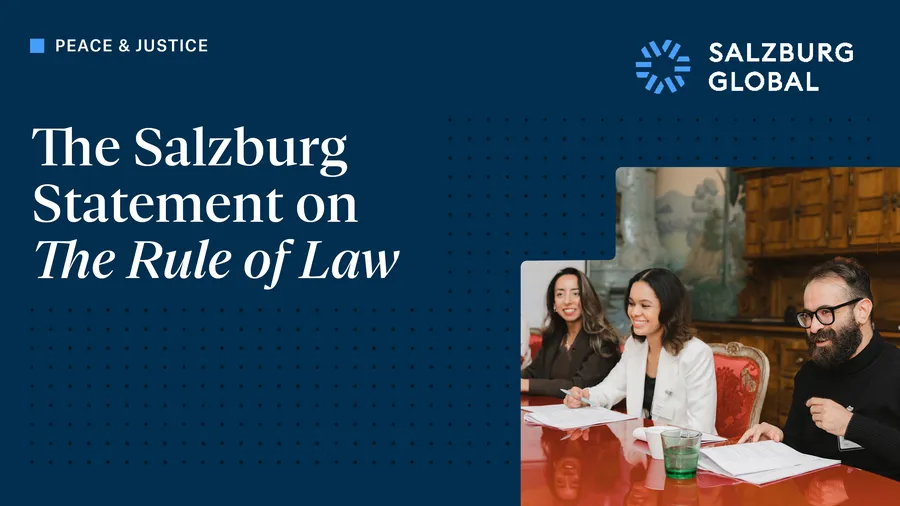
We, the Salzburg Global Fellows of the International Law Fellows Network, reaffirm the definition of the rule of law set forth by our predecessors in The Salzburg Statement on the Critical Role of Lawyers in Safeguarding the Rule of Law, published in March 2025. In this article, we emphasize three critical components of that definition that are under particular strain today: publicly promulgated laws, equal application and enforcement, and independent adjudication.
- Publicly promulgated laws. Laws must be public, stable, transparent, and understandable. People cannot organize their lives, protect their rights, or hold power to account if the rules are hidden, constantly shifting, or applied only after the fact.
- Equal application and enforcement. The law must apply equally to all - rich or poor, powerful or vulnerable, close to government or far from it - regardless of race, gender, religion, political position, wealth, or other status. Personal connections should never determine whether the law protects or constrains a person.
- Independent adjudication. Legal rights mean little without decision-makers who apply the law predictably, impartially, and independently, and without ready access to effective remedies when power is abused.
These principles govern our most basic expectations. When you buy eggs at a grocery store, you expect to pay the price displayed on the shelf, not a different number at the register. When the State spends public money, contracts should be awarded through open and fair competition under published criteria, not to the friends or family of those in power. And when someone breaks a deal, a court should apply the same rules to both sides; the judge's neighbor or the richest company in town should not automatically win.
That is the baseline of the rule of law today: rules people can know, rights people can rely on, institutions people can trust, and limits on power that apply even when those limits are inconvenient.
Why the Rule of Law Matters to Us All
The erosion of the rule of law is not an abstract crisis; it has immediate and tangible consequences. It harms communities subjected to unequal policing, voters who lose faith that peaceful change is possible, businesses that can no longer rely on contracts, and societies that depend on trust to function. Nor are rule-of-law failures confined within national borders. International rules shape air travel, trade, supply chains, financial markets, product safety, human rights, war, and migration. These rules may feel distant until their failure reaches home.
The rule of law rarely disappears in one moment. It erodes through small exceptions: a bribe paid, a court ruling ignored, a lie excused, a remedy denied, a minority excluded, or a shortcut accepted. As exceptions multiply, institutions become less fair and less predictable. As institutions weaken, it becomes easier for those with power to avoid accountability. The result is not only a legal crisis but a crisis of public confidence: a growing belief that rules are optional for the powerful and uncertain for everyone else.
The deeper danger is that this erosion often feels ordinary while it is happening. Daily life carries on: people go to work, receive packages, pay bills, vote, and sign contracts. Beneath that veneer of normalcy, however, legal safeguards weaken. Regulators become unreliable, trade rules turn unpredictable, anti-corruption commitments are enforced unevenly, and states distance themselves from international accountability systems. Each step may seem technical, remote, or like someone else's problem.
Yet institutional drift reaches ordinary households. Teachers, nurses, factory workers, civil servants, and firefighters may never think of themselves as market participants, but their pensions and retirement savings depend on predictable legal frameworks - ones in which companies cannot mislead investors with impunity, insiders cannot loot without consequence, fiduciary duties are enforced, regulators police fraud, and courts provide remedies. When those assumptions erode, the harm reaches everyone.
The central questions remain simple: Do people have a say? Are their rights protected? Can they obtain a remedy when power is abused? If the answer is no, the rule of law is not merely weakened in theory; it is failing in people's lives.
The Rule of Law Under Pressure
The pressures on the rule of law are visible in domestic legal systems, international institutions, markets, media, and public life. Around the world, people are losing confidence that laws are applied fairly, institutions act independently, and power is constrained by rules.
In some countries, governments weaponize law to silence dissent, discriminate against particular groups, detain people without due process, or punish individuals, organizations, and businesses without transparent rules and procedures. Courts and judges face overt political pressure, targeted attacks for independent decisions, or efforts to reshape their benches to serve partisan interests. When legal institutions become instruments of political control, outcomes are reshaped to serve the interests of those in power.
These pressures reinforce one another. In many societies, legitimate grievances about corruption, inequality, exclusion, lack of opportunity, and democratic fatigue have weakened trust in public institutions. Bad-faith political actors then exploit those grievances. They promise simple solutions, national restoration, or protection from imagined enemies while using the language of law to concentrate power, target opponents, and undermine independent institutions.
The fracture extends into the international order. We are witnessing a shift away from compliance with shared rules toward selective, transactional, or unilateral uses of legal power. States weaken the international rule of law when they demand compliance from others while treating their own obligations as optional, or invoke shared rules selectively against adversaries but not themselves or their partners. International institutions also face intense strain. They are frequently criticized - and sometimes rightly - for failing to apply law consistently or to listen adequately to the experiences, voices, and legal traditions of historically marginalized actors. These perceptions, and sometimes realities, weaken confidence in the international rule of law at the very moment when global cooperation is most needed.
New technologies, media ecosystems, and powerful non-state actors have also intensified these pressures. When properly governed, artificial intelligence, social media, and other technologies can be significant forces for good. Where legal safeguards are weak, however, they can be harnessed to spread misinformation, attack courts and lawyers, distort public debate, and undermine trust in institutions that protect justice and fairness. At the same time, private actors increasingly wield influence once associated mainly with governments, often without comparable structures of accountability.
These pressures are distinct, but they point in the same direction: a weakening of the institutions, habits, and expectations that make law a genuine restraint on power.
The Salzburg Statement on the Rule of Law
The Salzburg Statement on the Rule of Law
We invite you to download and share The Salzburg Statement on the Rule of Law.
The Salzburg Global International Law Fellows Network session on “The Future of the Rule of the Law in a Fractured World,” was held from June 11 to 14, 2026 in partnership with the International Bar Association and with the support of the 21st Century Trust. The views expressed here do not necessarily reflect the views of these organizations.
