

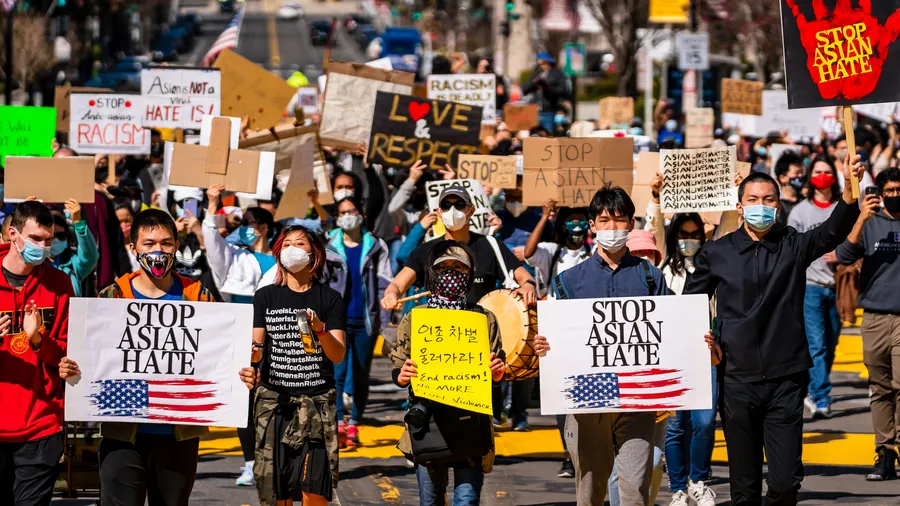
Salzburg Global Fellow Cynthia Choi explains how divisive political language is fueling discrimination, violence, and fear against Asian Americans
This article was written by Salzburg Global Fellow Cynthia Choi, who attended the Salzburg Global American Studies program on “Crossing the Pacific: The Asian American Experience in U.S. Society and Discourse” in September 2024.
There are a plethora of past and contemporary examples of divisive political rhetoric affecting discrimination and violence against Asian Americans. The following are just a few examples.
In the late 19th century, politicians and labor leaders claimed that Chinese immigrants were taking jobs from white Americans and their foreignness was a threat to American society. This ultimately led to the Chinese Exclusion Act and eventually the Asiatic Barred Zones Act preventing "undesirables" from immigrating to the U.S. During this period, there was widespread discrimination, including exclusion from certain professions and neighborhoods. There were also violent incidents such as the 1871 Los Angeles Chinese Massacre, where 18 Chinese men and boys were lynched by a mob.
Following the attack on Pearl Harbor, Japanese Americans were portrayed by politicians and the media as potential spies and saboteurs, despite a lack of evidence supporting these claims. President Franklin D. Roosevelt signed Executive Order 9066 in 1942, which led to the forcible relocation and internment of around 120,000 Japanese Americans in camps under harsh conditions. This not only violated their civil liberties but also caused long-term economic hardship and generational psychological damage to the Japanese American community.
After the September 11 attacks, political leaders and media outlets often conflated Arabs, Muslims, Sikhs, and South Asians, leading to a rise in xenophobic and Islamophobic rhetoric. Many members of this diverse community and those perceived to be Muslim faced increased hate crimes, discrimination, and violence. Sikhs, often mistaken for Muslims, were particularly targeted.
More recently, political leaders, including President Donald Trump, referred to COVID-19 as the "China virus" or "Kung Flu", which fueled anti-Asian sentiment and scapegoating.
This rhetoric contributed to a significant rise in hate crimes and violent attacks against Asian Americans. Stop AAPI Hate reported thousands of incidents, including physical assaults, verbal harassment, and property damage. High-profile attacks included the murder of six Asian women in the Atlanta spa shootings in March 2021.
Divisive bipartisan political rhetoric has been shown to significantly impact discrimination and violence against Asian Americans. Stop AAPI Hate has documented a correlation between anti-immigrant, racist, and sino-phobic rhetoric and a rise in anti-Asian incidents.
- Increase in Hate Incidents: Stop AAPI Hate reported a surge in hate incidents against Asian Americans and Pacific Islanders (AAPIs), especially during the COVID-19 pandemic. This increase has been linked to political leaders using inflammatory language that associates the virus with China or Asian people, leading to scapegoating and xenophobia.
- Nature of Incidents: The reported incidents range from verbal harassment and shunning to physical assaults and civil rights violations. The language used by some political figures can embolden individuals who harbor prejudices to act on them, believing their views are legitimized by public discourse.
- Racial Profiling and Discrimination: The emphasis on containing China can result in increased racial profiling and discrimination against Asian Americans. For instance, policies or rhetoric targeting Chinese nationals or Chinese Americans for espionage can lead to broader suspicion and scrutiny of all individuals of Asian descent. Stop AAPI Hate has documented instances where such profiling and discrimination have heightened during periods of intensified geopolitical rhetoric.
- Mental Health Impact: The rhetoric and subsequent violence have profound effects on the mental health and sense of security within AAPI communities. Many report feeling more fearful and anxious, and there is a documented increase in stress and mental health issues among those targeted.
- Root Causes: The focus on countering China often leads to the perpetuation of negative stereotypes and xenophobic rhetoric. Political leaders and media coverage that emphasize China as a threat can inadvertently stoke anti-Asian sentiment within the U.S. This has been evident in the increase of hate incidents reported by Stop AAPI Hate, where individuals of Asian descent are unfairly targeted and blamed for geopolitical tensions.
- Community Response: Stop AAPI Hate and other advocacy groups emphasize the need for policies and initiatives that counteract harmful rhetoric, promote solidarity, and support victims of discrimination and violence. They also stress the importance of accurate and respectful language from public figures to prevent further harm.
- Call for Responsible Leadership: Advocacy groups, including Stop AAPI Hate, call for responsible leadership and the use of precise, non-inflammatory language when discussing geopolitical issues. They stress the importance of distinguishing between geopolitical strategies and domestic racial issues to prevent the conflation that leads to discrimination and violence against Asian Americans.
Cynthia Choi is the co-founder of Stop AAPI Hate, a national coalition addressing anti-Asian racism across the U.S She is also the co-executive director of Chinese for Affirmative Action in San Francisco, a community based civil rights organization committed to protecting the dignity and fair treatment of all immigrants and fulfilling the promise of a multi-racial democracy. Cynthia has over 35 years of experience working in the nonprofit sector and over 20 years serving in leadership positions. She has led local, state and national community-based organizations and initiatives working on a range of issues from racial and gender justice and violence prevention.
Explore our digital publication, which includes more coverage from the Salzburg Global American Studies program on “Crossing the Pacific: The Asian American Experience in U.S. Society and Discourse.”
