

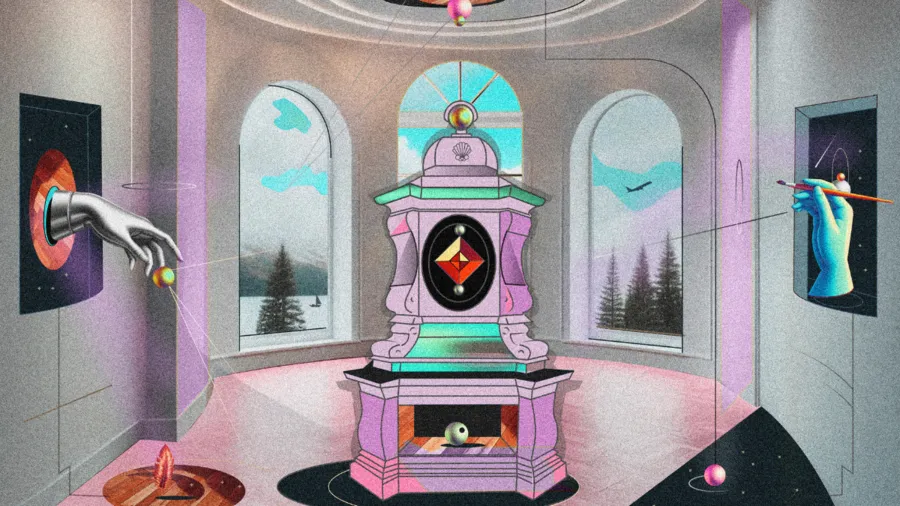
Artifical intelligence is shaping tomorrow's creative landscape and transforming artistic expression
Artists have always worked with tools, from the paintbrush to the camera; humanity has created visual marvels with technological innovations. With the birth of artificial intelligence (AI), the inseparable link between artists and tools has never been more palpable and challenging. What is true creative expression when tech billionaires control the tools that express creativity? What will the future of AI be when it is built on the injustices of the past?
For many, AI has an almost mystical quality, but as Fellows peeled this virtual onion, they reminded us that it is, despite all its magic-like capabilities, purely a tool. More specifically, as journalist and writer Akihiko Mori put it, it is a tool “forged in capitalism”. Ultimately, AI is built on global inequalities, and understanding AI outside of this political economy context is akin to drawing in the sand. As AI continues to develop, it was clear to Fellows that these systemic power imbalances will determine the future of artistic expression.
Power structures are invisible but pervasive. In the development of AI, power comes from the ability to exclusively mine, select, and store data and the ability to set the narrative. Who is the creator, the artist, or Big Tech? These profound questions of authorship demand a pluralistic approach that is missing from the current discourse on AI. Mona Gamil, an Egypt-based artist, elaborated, “We need to disrupt the positive branding of AI that is dictated by Big Tech and rewrite the narrative”. Indeed, Big Tech has constructed a narrative around AI safety, while the more pressing matter for the public is AI ethics.
Jun Fei, Professor of Art and Technology at the Central Academy of Fine Arts, spoke of “value alignment” and the importance of diversity and inclusivity in setting the new principles and standards of AI. These principles empower marginalized groups, indigenous cultures, and impoverished communities. More specifically linked to art, Fellows raised concerns over the value of the “human touch", as artist and painter Phaan Howng reflected, “How can we teach a machine the physicality of artistic labor? The unpredictability of art?” Incorporating the ineffable human experience into language-based models is another incompatibility left out in the AI discourse, reiterating Fellow’s call for broader inclusivity.
The discussion also drilled into the roots of power imbalances, or what Oscar Ekponimo, Founder and CEO of Gallery of Code in Nigeria, referred to as the “hierarchy of influence”, more explicitly, “capitalistic influences”. Capitalistic constructs are engrained in and communicated through our everyday structures. One example is copyright laws, which intrinsically link art, and thereby creative expression, to trade agreements. For Micaela Mantegna, a lawyer and activist in digital ethics, copyright laws exclude other forms of labor and funnel power into a selected few. As technology outpaces regulation, what was intended to protect creativity and artists has transgressed into an instrument of restraint. “Copyrights shrink the public domain,” said Michaela, “It excludes artists working with AI when the digital space is not scarce, and the digital world does not need to be scarce”.
Copyrights are just one iteration of a competition-based system that pits individuals and companies against each other. Fellows believed resetting these incentives across all domains would be a crucial determinant of an equitable and inclusive future. In the development of AI, Fellows pointed to realigning intentions and crafting principles that would foster collaboration. Octavio Kulesz, philosopher and digital publisher, shared a UNESCO framework that could guide countries to a culturally diverse and human-centric perspective on AI. While the framework could potentially steer countries toward self-determination in AI development, a more radical redistribution of powers and wealth was also explored. When suggesting alternatives to copyright, Micaela proposed taxation and universal basic income to rebalance the scales and compensate all labor in the creative process.
Although discussions have often posed more questions than answers, one thing is certain: the importance of honest and open conversations. Through their discussions, Fellows reminded and showed us that connection, compassion, and community have always been the core of human experience, and at this critical juncture, returning to what makes us truly human could well decide our collective future.
The Salzburg Global Fellows featured in this article convened alongside around 50 other artists, technologists, futurists, curators, and activists for Salzburg Global's annual Culture, Arts and Society program in May 2024. "Creating Futures: Art and AI for Tomorrow's Narratives" explored the emergent possibilities at the intersection of creative expression, technology, and artificial intelligence.
This article featured in our Shorthand story, which includes more coverage from the program "Creating Futures: Art and AI for Tomorrow's Narratives".
