-
Topics
TopicsOur programs create spaces where open-minded leaders can gather for breakthrough conversations on pressing global issues – each aligned to one of the following pillars:Get Involved
-
Events
EventsExplore the variety of events Salzburg Global hosts within Austria and in the rest of the world. Learn more about our programs and what else happens at Schloss Leopoldskron.Upcoming EventsOct 19 - Oct 22, 2026Peace & JusticeThe Collective Action Problem: How Should Democratic Societies Respond to Increasing State Violence without Exacerbating Polarization and Political Violence?Violent Threats to Democratic SystemsOct 21 - Oct 25, 2026Peace & JusticeDemocracy Across the Frontlines: How Can Democracy Movements Collaborate To Build Resilience Across Borders?Democracy Resilience Forum
- Insights
-
Fellowship
FellowshipSince 1947, more than 40,000 people from over 170 countries have participated in Salzburg Global's sessions. Collectively, these alumni are known as Salzburg Global Fellows.
-
About Us
About UsSalzburg Global is an independent, non-profit organization committed to creating spaces that overcome barriers and open up a world of better possibilities.Our Approach
-
Support Us
Support UsYour generosity helps us gather open-minded leaders for breakthrough conversations, while creating space for dialogue that overcomes barriers and opens up a world of better possibilities.
- Donate

- Published date
- Written by
Share
Peace & Justice
Update
Pocket Parks, Big Impact: A Path Toward Urban Environmental Justice
Published date
Written by
Share
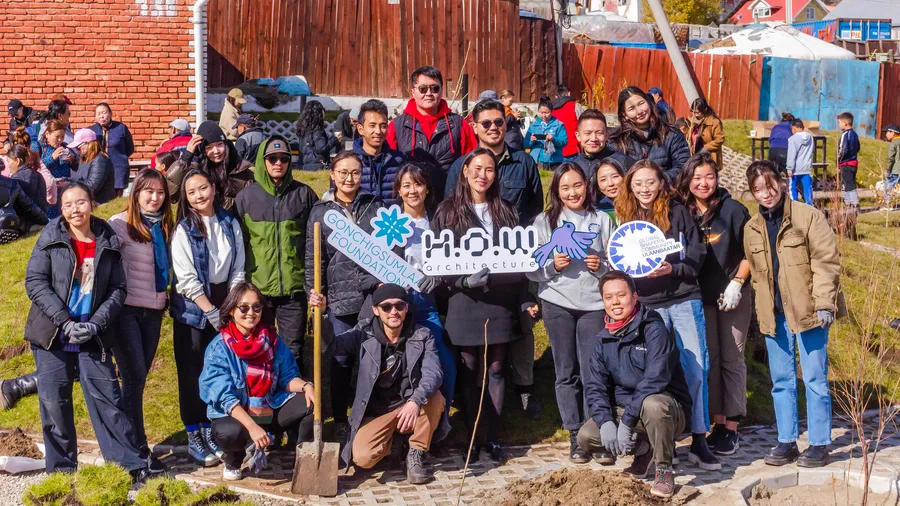
Temuulen Enkhbat (pictured center right holding a purple bird image) and others with the Ulaanbaatar Oasis project
This article was written by Salzburg Global Fellow Temuulen Enkhbat, who attended the Salzburg Global American Studies session on “Crossing the Pacific: The Asian American Experience in U.S. Society and Discourse” in September 2024. Temuulen's attendence was made possible thanks to the generous support of William J. Reckmeyer and Joan Reckmeyer through the Reckmeyer Family Fellowship.
“Green spaces are where people gather, breathe fresh air, and take a break from daily life. But for many of us here, those spaces simply don’t exist,” says Galtmaa Baaran, a long-time resident of Ulaanbaatar’s informal settlements. For the past thirty years, she has lived in the outskirts of Mongolia’s capital in an area known as the “ger” districts, where over half of the city’s population resides.
Like many developing countries, Mongolia is experiencing rapid urbanization. But instead of lifting everyone up, this growth is dividing Ulaanbaatar into two separate worlds: one with modern infrastructure and parks near the city center; the other, a sprawling settlement of informal housing with limited access to basic services. In the ger districts, clean air, running water, safe roads, and public green spaces are scarce. The green, well-planned areas near the city center seem far away—not just in geographic distance, but in terms of fairness and opportunity.
Research consistently shows that green spaces are vital to a better quality of life. They improve mental and physical well-being, strengthen communities, and build resilience against the climate crisis. In today’s cities, green space is no longer a luxury—it is essential for environmental justice. According to the American Public Health Association, environmental justice means that everyone, regardless of where they live or who they are, should have equal access to a healthy environment and a fair voice in the decisions that shape it. Yet in many cities, including Ulaanbaatar, deep-rooted issues like poverty, systemic inequality, and uneven urban development continue to deny low-income communities that basic right.
The problem isn’t unique to Mongolia. In the United States, for example, communities of color are three times more likely to live in nature-deprived areas than white communities. According to the Center for American Progress, 67% of Asian Americans live in nature-deprived neighborhoods, compared to just 23% of white Americans. Low-income communities are 20% more likely to face these challenges than those with moderate to high incomes, with 70% experiencing similar issues. These disparities are more than just environmental—they have serious health consequences, including higher rates of high blood pressure and chronic illness. This raises important questions: What happens next? Who is responsible for fixing these problems? And how do we create real, lasting solutions?
To help address this growing inequality, we launched the Ulaanbaatar Oasis Project to close the “nature gap” and bring accessible green spaces closer to communities in the ger districts. According to the World Health Organization, everyone should have access to green space within 300 meters (a five-minute walk) of their home, as a basic standard for healthy and inclusive urban living.
To meet this goal, the Ulaanbaatar Oasis Project is turning underused and neglected public spaces, such as water kiosks, into pocket parks, creating small but meaningful green areas in the heart of underserved neighborhoods. These kiosks already serve as daily gathering points, as most households in the ger areas lack access to centralized water infrastructure. By transforming them into vibrant, green community hubs, we are not only adding trees and benches but also fostering social connection, mental well-being, and a sense of belonging.
At the core of our approach is innovation, inclusive design, and community ownership. Local residents are involved in every step, from planning to planting, to ensure the parks reflect their needs and values. This helps create long-term stewardship and makes the green spaces more than just amenities; they become shared spaces of care, resilience, and pride.
Green space is not just about aesthetics or leisure, it is a fundamental right tied to health, dignity, and equity. As cities around the world continue to expand, we must ask: Who gets to enjoy that growth, and who is left behind? The story of Ulaanbaatar’s ger districts is a reminder that environmental justice starts at the neighborhood level.
By investing in small, community-led solutions like pocket parks, we can begin to close the nature gap and restore a sense of balance and fairness in our cities. Everyone, no matter their income, background, or location, deserves access to clean air, green space, and a future where they can thrive. It’s not just about planting trees, it’s about planting hope and reclaiming the right to live well, together.
The Ulaanbaatar Oasis project is a collaboration between Global Shapers Ulaanbaatar Hub, Gonchigsumlaa Foundation, and H.O.W Architecture, funded by Climate Reality Challenge and Youth4Climate Initiatives. The project was initiated through my participation in the "Emerging Urban Leaders" program from Salzburg Global in partnership with World Urban Parks.
Explore our digital publication, which includes more coverage from the Salzburg Global American Studies session on “Crossing the Pacific: The Asian American Experience in U.S. Society and Discourse”.